Strategy Insights: Activity Time vs. Real Language Growth
- Main Concept: Cognitive Processing over Busywork
- Key Framework: The Skills+ Phase of the MUSIC+ Framework
- Teacher Benefit: Protection from “time-waste” outcomes by upgrading the learning mechanism inside every activity.
- Practical Application: Assigning “Linguistic Missions” where students act as Grammar Detectives, Meaning Analysts, or Chunk Hunters to transform songs into structured input.
Have you ever spent hours finding the perfect song, only to be met with blank stares on Monday morning?
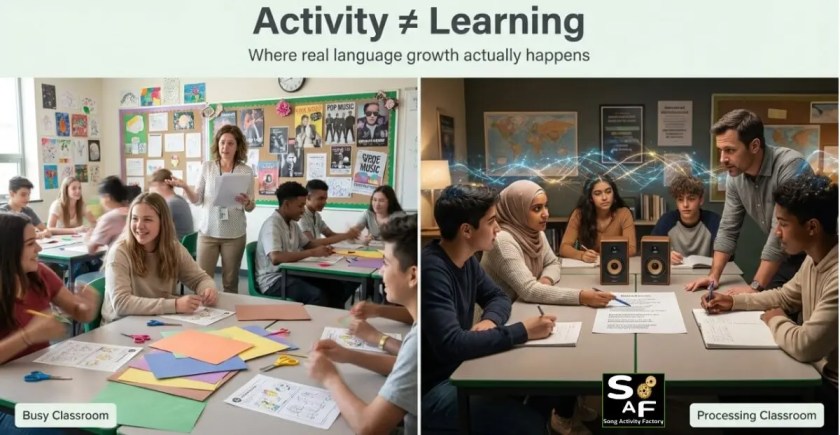
The class was lively. Students were cutting lyrics, talking, moving. If someone had walked in, it looked like a “great” lesson.
But later? The vocabulary is gone. The structure didn’t stick.
It leaves you feeling exhausted — like you invested time and energy in something that didn’t lead to real retention.
So what went wrong?
The Trap of “Survival Mode”
The problem isn’t the song.
It isn’t motivation.
It’s how the brain handles low-level tasks.
When students are asked to color, copy, or complete simple gap-fills, their brains often switch into completion mode, not learning mode. They do just enough to finish, but they don’t do the cognitive processing required to move language into long-term memory.
If a task doesn’t require learners to actively work out how language expresses meaning, the words stay on the worksheet — not in their usable system.
Students were busy.
But they weren’t processing.
The Shift: From Busywork to Linguistic Missions
The Old Model: Activity as Entertainment
Music becomes a reward. Students listen, fill gaps, maybe discuss meaning briefly — and the lesson ends before the language work really begins.
The New Model: The Linguistic Mission
Before you press play, you give students a clear language mission.
They might become:
- Grammar Detectives hunting for past modals of regret
- Meaning Analysts identifying how the singer expresses desire or frustration
- Chunk Hunters collecting phrases that show emotion
Now students aren’t just listening to music.
They’re interrogating how English works inside a real text.
That’s where learning begins.
Inside the MUSIC+ Cycle: The Skills+ Phase
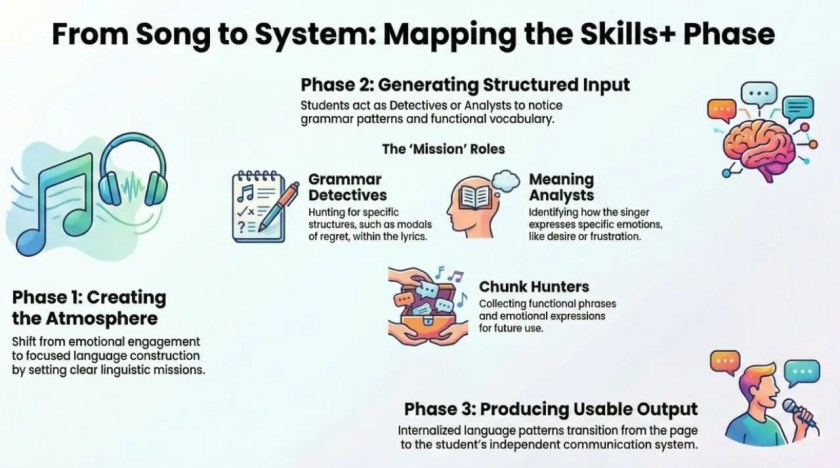
This move belongs to the Skills+ stage of the MUSIC+ framework — the phase where we shift from emotional engagement to language construction.
Here, the song stops being just atmosphere and becomes structured input. Students are guided to notice, analyze, and use language patterns as they naturally appear.
This is where learning flips:
- grammar becomes visible
- vocabulary becomes functional
- input turns into usable output
It’s the bridge between “fun lesson” and real language development.
Why This Is Serious Pedagogy
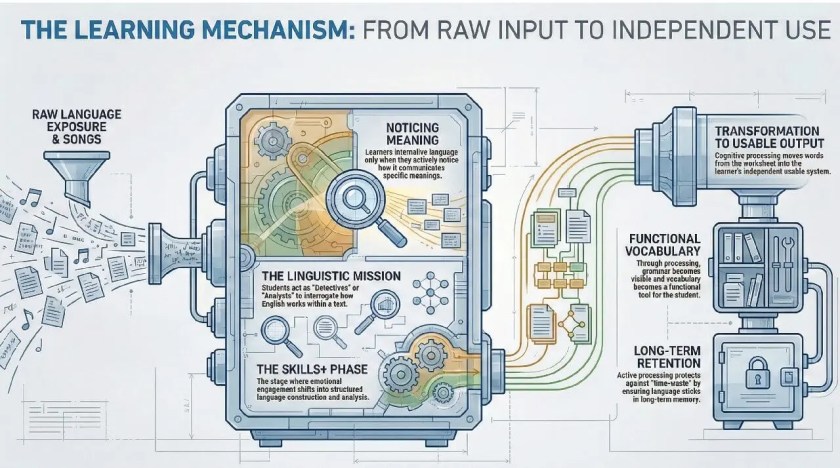
This approach aligns with what we know about language acquisition: learners internalize language when they notice how it is used to communicate meaning.
We are not adding extra activities.
We are upgrading the learning mechanism inside the activity.
That’s why this protects you from the “time-waste” criticism. Every task has a clear linguistic purpose, and every step moves students closer to independent language use.
See this process in action inside a full lesson sequence here.
The Core Takeaway
If your song lessons feel fun but flat, don’t change the song.
Change what students are mentally doing inside the lesson.
Students don’t learn from activity.
They learn from processing inside the activity.
Further Information & Author
Author Bio:
About the Author:Márcia Bonfim is an ESL/EFL teacher and creator of the Song Activity Factory. She helps educators create engaging lessons using her signature BEAT+ Method, which features the MUSIC+ Framework. You can discover her complete methodology summary here.
 Song Activity Factory