

Strategy Insights: The Metaphorical Transmediation Protocol
- Main Concept: Cross-domain metaphor mapping and Swain’s Pushed Output theory (ensuring the task does the heavy lifting for you).
- Key Framework: The BEAT+ Method and MUSIC+ Framework (Metaphorical Transmediation Protocol).
- Teacher Benefit: Breaks the “fluency plateau.” This protocol moves students past “safe” vocabulary and forces them to synthesize deep emotional meaning into precise, high-level structural output.
- Practical Application: Students act as meteorologists to forecast a song’s emotional trajectory. They build extended metaphors and use advanced grammar to defend their ideas in English.
| Protocol | Level | Class Time | Framework |
|---|---|---|---|
| Metaphorical Transmediation (Weather Forecast Summary) | B1–C1 | 20–25 minutes | MUSIC+ (Creativity+) |
The Classroom Problem
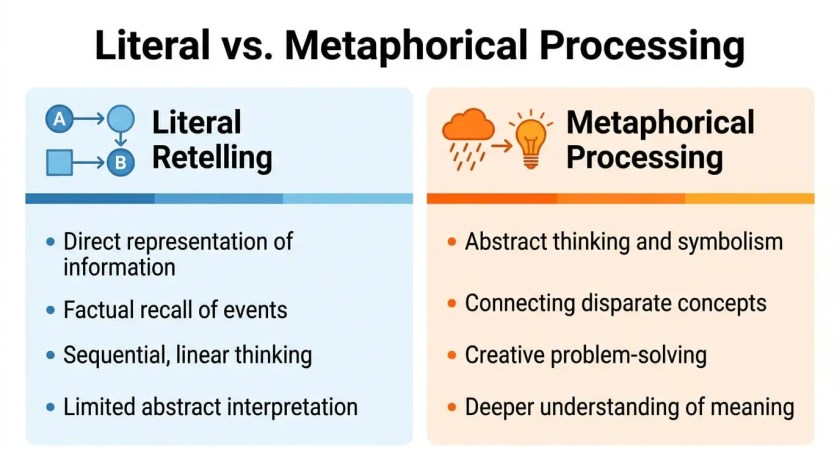
A pervasive difficulty in the English language classroom is the student tendency to simplify complex ideas during output tasks. When asked to summarize a narrative text or a song, learners almost universally default to literal, sequential retelling. The result is a flat, repetitive stream of basic language: “First the singer is sad, then he stays in bed, then he feels better.”
This reliance on basic semantic processing allows students to bypass the rigorous syntactic processing necessary for higher-level fluency. Furthermore, abstract pop lyrics often confuse students who attempt to interpret them literally, leading to breakdowns in communication and engagement.
Teachers frequently struggle to push learners out of this comfort zone, finding that standard discussion prompts fail to elicit the advanced vocabulary and complex sentence structures the students actually possess.
Songs create a perfect opportunity to address this problem. Because music naturally carries deep emotional resonance and relies heavily on figurative language, it provides the ideal raw material to push students out of literal retelling. By using the song as a cognitive trigger rather than mere entertainment, teachers can compel learners to synthesize emotional subtext into structured language processing.
The Pedagogical Insight
The cognitive mechanism behind this protocol is cross-domain metaphor mapping. Instead of allowing students to reiterate the plot using the exact same vocabulary provided by the lyrics, this protocol forces a conceptual transformation. Students must extract the core emotional narrative and map it onto an entirely different conceptual domain: meteorology.
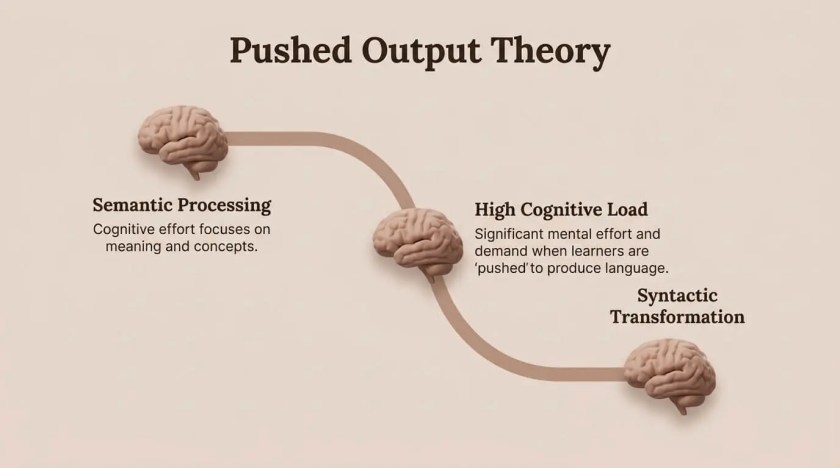
This process is scientifically validated by Merrill Swain’s concept of “Pushed Output”. When learners are pushed to transform abstract emotional states into concrete meteorological metaphors, they must recombine known elements in new ways to create novel meaning.
This generative processing requires high cognitive load; students must rigorously evaluate their vocabulary choices and sentence structures to ensure the metaphor holds together logically. By demanding this level of linguistic restructuring, we elevate the classroom task to the highest tier of cognitive challenge: creation.
The Protocol
The Metaphorical Transmediation Protocol (Weather Forecast Summary) requires students to translate the abstract, figurative emotions of a narrative song into the highly structured, concrete language of a weather report.
Instead of summarizing the lyrics directly, students act as “meteorologists” forecasting the emotional trajectory of the singer or the song’s characters. Anger becomes a “severe storm,” a breakup becomes a “cold front,” and hope becomes “sunny spells”.
Grammar Anchor
This language transformation pushes more complex language use by forcing students to utilize sophisticated descriptive adjectives and specific future tenses or conditionals to predict the narrative’s outcome. Because meteorological vocabulary is universally understood, this protocol is highly repeatable across many songs, scaling effortlessly from B1 continuous tenses to C1 advanced descriptive vocabulary.

Classroom Implementation
Step 1 — Listening and Observation
Play the selected song. Instruct students to listen strictly for the emotional shifts in the narrative. They should observe and note where the song feels tense, calm, turbulent, or clear.
Step 2 — Analysis
On the board, guide the class to build a semantic network of weather terminology (e.g., high-pressure system, brewing, severe drought, fog, clearing up).
Step 3 — Transformation Task
Place students in small groups and assign them the role of “Meteorologists“. Their mission is to synthesize the song’s emotional arc into a structured, 3-to-4 sentence weather forecast.
Step 4 — Output Creation
Students collaboratively write the forecast, ensuring they accurately map the song’s narrative progression onto the weather metaphors while adhering to a specific grammar constraint assigned by the teacher (e.g., Future Continuous: “Storms will be rolling in…”).
Step 5 — Presentation
Groups perform their weather forecasts for the class in the style of a live news broadcast.
Step 6 — Reflection and Language Audit
The class conducts a short feedback loop to evaluate which group’s meteorological metaphors best captured the true subtext of the original lyrics, engaging in the negotiation of meaning to defend their choices.
Song Demonstration
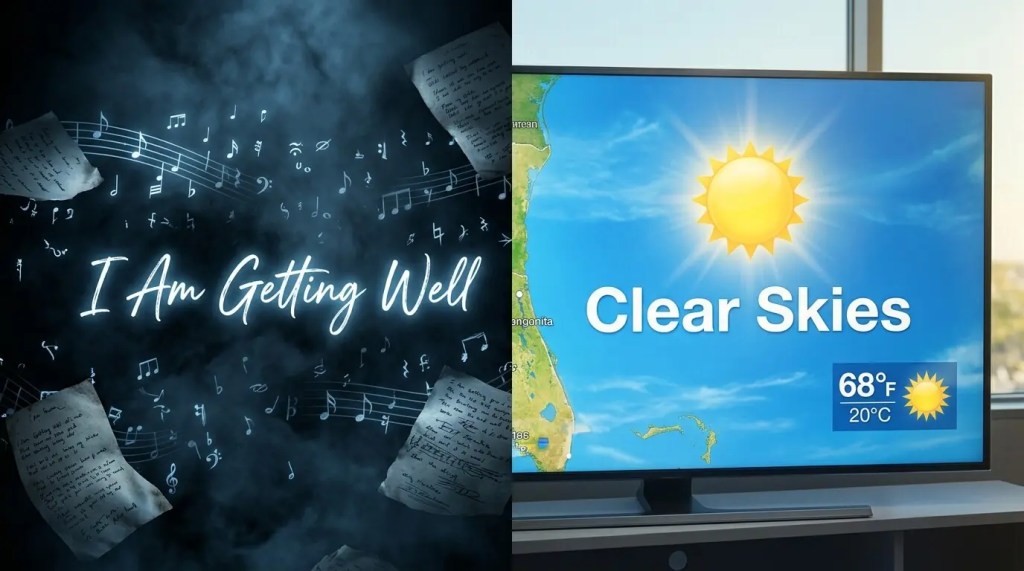
To demonstrate how this language transformation operates in a real classroom, consider the application of this protocol to the song “I Am Getting Well” by Dean Lewis, a B1/B2 track dealing with overcoming dark thoughts and seeking recovery.
| Song Lyric | Student Output |
|---|---|
| “The sun comes up but I don’t feel it on my face / The leaves start falling but the seasons never change… Now it’s dark, when it’s light and the spark in my eyes / Burning low… But it’s a long, long way up that hill / Past all the dead grass and the thoughts that could kill / It’s a long, long way up from Hell / But I, I am getting well” | “A heavy dark cloud is sitting over the area today, blocking out the sun and bringing very cold temperatures. We expect this freezing winter storm to last for a long time. However, a warm front is slowly moving up the hill, and we will be seeing clear skies soon.” |
The transformed output demonstrates deep semantic understanding while forcing the student into a highly structured output task. It sounds like something a real ESL learner could produce, avoiding overly complex literary language while completely sidestepping rote copying of the original text.
Teacher Insight
This protocol works because it introduces a strict cognitive challenge that fundamentally alters how students interact with the lyrics. By removing the option to simply repeat the plot, we force students into a state where meaning negotiation is mandatory. Transforming passive listening into the active construction of a complex, extended metaphor builds remarkable language precision. It proves that when we demand structured output and generative processing, students will consistently rise to the occasion, utilizing the target language as a vital tool for expression rather than a passive rule to memorize, effectively eliminating the gap-fill trap.
AI Prompt for Teachers
To generate tailored materials for this protocol instantly, paste the following prompt into your preferred AI tool:
Role: You are a Protocol-Aware Instructional Design Assistant specializing in the BEAT+ Method.
Task: Generate classroom materials for the Metaphorical Transmediation Protocol (Weather Forecast Summary).

Input Data:
Song: [INSERT TITLE & ARTIST]
Target Level: [INSERT CEFR LEVEL]
Lyrics: "[INSERT LYRICS HERE]"

Your Output Requirements:
1. Teacher’s Narrative Analysis (Temporal Orientation)
Analyze the song's timeline (Past reflection, present state, or future change). Map this timeline to a weather report sequence.

2. The Grammar Focus (Temporal Alignment)
Select one or two grammar structures appropriate for the [CEFR LEVEL] that naturally fit the song’s narrative.
Rule: At B2–C1 levels, explicitly allow/encourage mixed tense sequences.

3. The Student Word Bank (Strictly Scaffolding)
Provide 10 weather-related vocabulary words/phrases relevant to the song's mood.
Strict Constraint: Provide ONLY the word, its literal definition, and a literal example sentence. DO NOT explain the metaphor.

4. Student-Facing Task Instructions
Write a 5-step instruction set for the students.
Role: "Meteorologists."
Mission: Report on the "Emotional Climate" of the song.
Constraint: Move through the timeline and predict the "forecast" outcome.

5. Example Learner Outputs
Generate two 3-to-4 sentence examples of a weather report based on this song.
Constraint 1: Use at least three items from the Word Bank.
Constraint 2: Must sound like a real [CEFR LEVEL] learner.
Constraint 3: NO "sad rain" clichés. Use technical terms like "visibility," or "pressure system."
Part of the BEAT+ Protocol Library (coming soon). This protocol belongs to the BEAT+ Method, a music-based framework for transforming passive listening into active language processing through structured classroom protocols. Teachers interested in exploring additional resources aligned with the MUSIC+ Framework and BEAT+ Method can visit the Free Resource Library, which offers ready-to-use professional tools and system-aligned materials.
About the Author
Márcia Bonfim is an ESL/EFL teacher and the creator of Song Activity Factory. She helps educators design cognitively engaging lessons using her signature BEAT+ Method, built around the MUSIC+ Framework.
Her work focuses on transforming songs from “fun extras” into structured learning systems that develop real communicative performance at higher levels.
 Song Activity Factory