

Strategy Insights: Analyzing Taylor Swift’s ‘Fortnight’ for ESL
The Core Shift: Transmute a chart-topping pop collaboration into a vibrant pedagogical catalyst that fuses lyrical deep-dives with the cultivation of 21st-century superpowers.
- Main Concept: Multi-dimensional Song Analysis for Language and Life Skills
- Key Framework: The 4Cs Approach (Creativity, Critical Thinking, Collaboration, Communication)
- Category: ESL Pedagogy & Strategy
- Teacher Benefit: Enhances student engagement through culturally relevant media while providing a contextual playground for complex grammar and emotional intelligence.
- Expert Author: Márcia Bonfim
- Practical Application: Transitioning from passive listening to active creation, where students evaluate character motivations and author alternate narratives.
- Source: Song Activity Factory
Hello, ESL teachers! 🎵🌍
Ready to transform your English lessons with Taylor Swift’s ‘Fortnight’ featuring Post Malone? This song analysis will show you how to engage students and enhance their language skills. Buckle up, because we’re about to embark on a journey that will not only get your students’ toes tapping but also their minds buzzing with new language skills and thought-provoking themes! 🎉💡

In this detailed ESL song analysis, we’ll explore every aspect of Taylor Swift’s ‘Fortnight,’ from its lyrical depth to its potential as a teaching tool. We’ll uncover the hidden gems in the lyrics, explore the artist’s backstory, and most importantly, learn how to transform “Fortnight” into an ESL teaching sensation that will leave your students begging for more! 🎤✨
But wait, there’s more! We won’t just focus on the traditional language skills. Oh no, we’re going to take it up a notch and explore how “Fortnight” can help your students develop those all-important 21st-century superpowers – creativity, critical thinking, collaboration, and communication. 🦸♀️🦸♂️
So, are you ready to unlock the full potential of this lyrical treasure and give your ESL lessons a Swift-tastic makeover? Let’s dive in and discover the magic together! 🗝️🌈
Got a minute? Let’s chat about “Fortnight”! 🎵

Taylor Swift and Post Malone’s latest collaboration has taken the music world by storm, and it’s not hard to see why. Released on April 19, 2024, “Fortnight” quickly broke records, earning the highest single-day streams on Spotify and debuting atop the Billboard Hot 100. 📈🎉
But it’s not just the impressive numbers that make “Fortnight” a must-listen for ESL teachers and students alike. The song itself is a lyrical masterpiece, telling a story of love, loss, and the complexities of relationships in an American town where dreams don’t always come true. 💔🇺🇸
The title, “Fortnight,” adds an intriguing layer to the song’s narrative, hinting at the fleeting nature of the relationship described in the lyrics. It also serves as a unique vocabulary lesson, as the term is more commonly used in other English-speaking countries. 📚
Moreover, “Fortnight” is a treasure trove of themes and discussion points that can enrich any ESL classroom. From exploring the characters’ emotional journeys to analyzing the vivid imagery and figurative language, this song provides ample opportunities for students to engage with the English language in a meaningful way. 💬🌟
Are you ready to discover how “Fortnight” can add a new dimension to your ESL lessons? Let’s dive in and unpack the lyrical genius of Swift and Malone, and see how this chart-topping hit can inspire your students to fall in love with learning English. 🎓❤️
Lyrical Deep Dive: Unpacking the Themes and Language of “Fortnight” 🎶🔍
Alright, let’s put on our lyric-dissecting glasses and dive into the powerful words of “Fortnight” line by line. We’ll uncover the hidden ESL treasures and explore how you can use them to create engaging lessons that your students will love! 💖
Verse 1
I was supposed to be sent away
But they forgot to come and get me
I was a functioning alcoholic
‘Til nobody noticed my new aesthetic
All of this to say I hope you’re okay
But you’re the reason
And no one here’s to blame
But what about your quiet treason?
In the opening verse, Swift introduces a character who feels forgotten and grapples with personal struggles. The lines “I was supposed to be sent away / But they forgot to come and get me” suggest a sense of abandonment and isolation. The character’s struggle with addiction is evident in the phrase “I was a functioning alcoholic,” while the mention of a “new aesthetic” hints at a change in self-image. The theme of betrayal is also hinted at through the mention of “quiet treason,” which can lead to a discussion about figurative language and the complexities of relationships.
Key phrases:
“I was supposed to be sent away / But they forgot to come and get me”; “I was a functioning alcoholic” ;”what about your quiet treason?”
Chorus
And for a fortnight there, we were forever
Run into you sometimes, ask about the weather
Now you’re in my backyard, turned into good neighbors
Your wife waters flowers, I wanna kill her
The chorus captures the essence of a brief but intense connection, using figurative language to convey the idea of a fleeting yet impactful relationship. The juxtaposition of “fortnight” and “forever” in the line “And for a fortnight there, we were forever” creates a powerful contrast, emphasizing the significance of this short-lived experience. The repetition of the phrase “Run into you sometimes” and the mention of mundane activities like asking about the weather underscore the bittersweet nature of these chance encounters. The line “Your wife waters flowers, I wanna kill her” adds a dark, jealous undertone to the story.
Key phrases:
“And for a fortnight there, we were forever”;” Run into you sometimes, ask about the weather”; “Your wife waters flowers, I wanna kill her”
Verse 2
All my mornings are Mondays stuck in an endless February
I took the miracle move-on drug, the effects were temporary
And I love you, it’s ruining my life
I love you, it’s ruining my life
I touched you for only a fortnight
I touched you, but I touched you
The second verse delves deeper into the emotional aftermath of the brief relationship, with the character struggling to move on. The use of metaphors like “endless February” in the line “All my mornings are Mondays stuck in an endless February” adds depth to the description of the character’s emotional state, conveying a sense of being trapped in a cycle of sadness. The “miracle move-on drug” mentioned in the verse highlights the character’s desperate attempts to overcome their feelings. The repetition of the line “I love you, it’s ruining my life” emphasizes the intensity and destructive nature of this lingering attachment.
Key phrases:
“All my mornings are Mondays stuck in an endless February”; “I took the miracle move-on drug, the effects were temporary”; “I love you, it’s ruining my life”
Bridge
I love you, it’s ruining my life
I love you, it’s ruining my life
I touched you for only a fortnight
I touched you, I touched you
I love you, it’s ruining my life
I love you, it’s ruining my life
I touched you for only a fortnight
I touched you, I touched you
Outro
Thought of callin’ ya, but you won’t pick up
‘Nother fortnight lost in America
Move to Florida, buy the car you want
But it won’t start up ’til you touch, touch, touch me
Thought of calling ya, but you won’t pick up
‘Nother fortnight lost in America
Move to Florida, buy the car you want
But it won’t start up ’til I touch, touch, touch you
The bridge and outro sections feature a collaboration with Post Malone, adding a new perspective to the story. These sections explore the idea of missed connections and the longing for a second chance. The lines “Thought of callin’ ya, but you won’t pick up / ‘Nother fortnight lost in America” convey a sense of desperation and the passage of time. The mention of moving to Florida and buying a car that won’t start without the other person’s touch in the lines “Move to Florida, buy the car you want / But it won’t start up ’til you touch, touch, touch me” further emphasizes the theme of unresolved feelings and the impact of this brief encounter on the characters’ lives.
Key phrases:
- “Thought of callin’ ya, but you won’t pick up”
- “‘Nother fortnight lost in America”
- “Move to Florida, buy the car you want / But it won’t start up ’til you touch, touch, touch me”
By analyzing the lyrics verse by verse and highlighting key phrases, ESL teachers can guide students through a deep exploration of the song’s themes, figurative language, and emotional content. This analysis provides a foundation for engaging classroom activities and discussions that help students develop their language skills and critical thinking abilities.
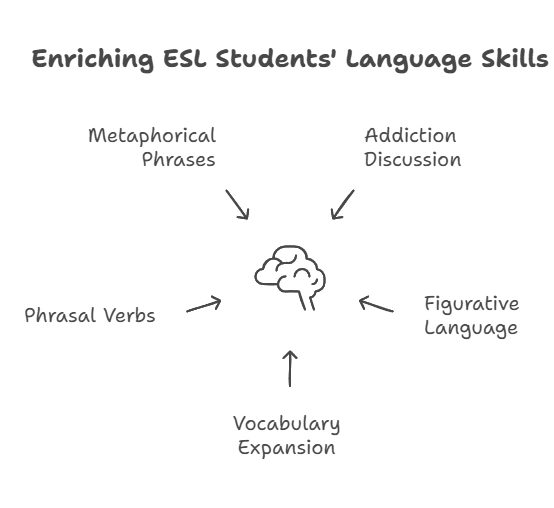
Decoding the Language: Key Vocabulary and Phrases for English Songs for ESL Learners 📚🔍

Explore essential vocabulary and phrases from ‘Fortnight’ to enrich your ESL students’ language skills and understanding:
“I used to be an alcoholic”: This phrase introduces the topic of addiction and can lead to discussions about mental health and personal struggles.
“Quiet treason”: This figurative expression hints at a sense of betrayal or disloyalty, providing an opportunity to explore metaphorical language.
“Fortnight“: The title of the song itself is a less common word meaning a period of two weeks, which can expand students’ vocabulary.
“Run into you“: This phrasal verb, repeated throughout the chorus, describes the act of encountering someone by chance.
“Endless February“: This metaphor conveys a sense of a prolonged, dreary period, offering a chance to discuss figurative language and how it can express emotions.
“Miracle move-on drug“: Another metaphorical phrase that compares the process of moving on from a relationship to taking a powerful medication.
By focusing on these key vocabulary items and phrases, ESL teachers can help students expand their lexicon and understand how language can be used creatively to convey complex ideas and emotions.
Spotlight on Grammar: Key Structures in English Songs for ESL Learners 📚✏️
Taylor Swift’s ‘Fortnight’ is a treasure trove of grammatical structures, perfect for enhancing your ESL students’ understanding of English grammar:

Past simple vs. present simple: The song uses both past simple (e.g., “I used to be an alcoholic“) and present simple (e.g., “I run into you“) to describe past habits and current experiences, respectively. This contrast can help students understand the differences between these tenses.
Present continuous: The song also employs the present continuous tense (e.g., “My aesthetic is cheating,” “It’s ruining my life“) to describe ongoing actions or states. This can be a useful structure for students to learn and practice.
Conditional sentences: The line “If I run into you, I’ll ask about the weather” is an example of a first conditional sentence, which describes a possible future situation and its likely result. This can be a starting point for teaching conditional structures.
Phrasal verbs: As mentioned earlier, the phrasal verb “run into” is repeated throughout the song, providing an opportunity to teach this common verb phrase and others like it.
By highlighting these grammatical structures within the context of the song, ESL teachers can make grammar lessons more engaging and memorable for their students.

Harnessing the Power of Music: Fostering 21st Century Skills with “Fortnight” in ESL Song Analysis 🎶💡
Use ‘Fortnight’ to foster 21st-century skills like creativity, critical thinking, collaboration, and communication in your ESL classroom. Here’s how you can incorporate these skills into your lesson plans, even if you’re new to using songs in the classroom:
Creativity 🎨
1- Introduce the task: Encourage students to write their own verses or create alternate endings to the song’s story.
2- Provide guidelines: Give students a clear structure for their writing, such as focusing on a specific character or theme from the song
3- Brainstorm ideas: Have students work in pairs or small groups to generate ideas and discuss their creative direction.
4- Write and refine: Allow time for students to write their verses or alternate endings and then refine their work based on peer feedback.
5- Share and celebrate: Have students share their creative pieces with the class and celebrate their achievements.
Example questions:
- What if the story was told from another character’s perspective?
- How could you change the ending to give the story a different message or tone?
Critical Thinking 🧠
1- Identify key moments: Help students identify crucial moments in the song where characters make important decisions or take significant actions.
2- Analyze actions and motivations: Encourage students to discuss why characters acted the way they did and what motivated their choices.
3- Consider alternatives: Ask students to brainstorm alternative actions the characters could have taken and discuss the potential outcomes.
4- Evaluate consequences: Have students assess the consequences of the characters’ actions and discuss whether they were justified or not.
5- Reflect on lessons learned: Encourage students to reflect on what they can learn from the characters’ experiences and how they can apply these lessons to their own lives.
Example questions:
- Why do you think the character reacted that way? What does this tell us about their personality or beliefs?
- What could the character have done differently in that situation? How might that have changed the outcome?
Collaboration 🤝
1- Form teams: Divide students into small groups and assign each group a different section of the song to analyze.
2- Assign roles: Give each group member a specific role, such as researcher, note-taker, or presenter, to ensure everyone contributes to the task.
3- Analyze and discuss: Have groups work together to analyze their assigned section, discussing the lyrics, themes, and characters.
4- Prepare presentations: Ask each group to create a short presentation summarizing their analysis and key findings.
5- Present and discuss: Have each group present their findings to the class, followed by a class discussion to share insights and ideas.
Example questions:
- What strengths can each team member bring to the group’s analysis?
- How can you ensure that everyone’s voice is heard and valued during the discussion?

Communication 💬
1- Introduce the discussion topic: Use the song as a springboard for discussions about relationships, emotions, and personal experiences.
2- Establish discussion guidelines: Set clear expectations for respectful and active listening, and encourage students to share their thoughts and experiences openly.
3- Pose thought-provoking questions: Ask open-ended questions that encourage students to reflect on their own experiences and relate them to the song’s themes.
4- Facilitate sharing: Encourage students to share their stories and opinions, and to listen actively to their classmates.
5- Summarize and reflect: Summarize the key points from the discussion and encourage students to reflect on what they learned from hearing their classmates’ perspectives.
Example questions:
- Can you relate to the emotions expressed in the song? Share a time when you felt a similar way.
- How do the relationships portrayed in the song compare to relationships you’ve experienced or observed in real life?
By incorporating these step-by-step guides for each 21st-century skill into your ESL song analysis lessons, you can create engaging and meaningful learning experiences that help your students develop critical skills for success in the modern world. Remember to start small, be open to trying new things, and have fun with the process! 🎉🙌
Classroom Activities: Bringing “Fortnight” to Life 🎭🎨

- Listening and Speaking: Engage your students with listening and speaking activities using ‘Fortnight.’ Discuss initial reactions, favorite lines, and personal interpretations to deepen their understanding. This can lead to a broader discussion about the themes of love, loss, and moving on.
- Writing: Ask students to write a short story or poem inspired by the song’s themes or characters. They can explore the perspectives of different characters mentioned in the lyrics or create their own narratives about brief but impactful relationships.

- 21st Century Skills: Use the song as a springboard for discussions about emotional intelligence, empathy, and effective communication in relationships. Students can analyze the characters’ actions and emotions, and consider how they might handle similar situations in their own lives.
By going deep into the rich language and themes of “Fortnight,” ESL teachers can create engaging, thought-provoking lessons that not only develop students’ language skills but also foster critical thinking, creativity, and emotional intelligence. This song-based approach to language learning offers a fresh, relatable way to connect with students and explore the complexities of the human experience. 🌟💞
So, what are you waiting for? Grab your guitar (or your speakers), hit play on “Fortnight,” and let the magic of music transform your ESL classroom into a hub of language learning, personal growth, and Swift-inspired awesomeness! 🎸🚀
Conclusion: Enhance Your ESL Teaching with the Power of Music 🎵🌍
There you have it, folks! A guide to transform Taylor Swift’s “Fortnight” from a chart-topping hit to a powerful ESL teaching tool. By exploring the song’s lyrics, themes, and language, we’ve uncovered a treasure trove of opportunities to engage students and help them develop their English skills and 21st-century competencies. 💪📚
Remember, the real magic happens when you and your students dive into the song together, discussing, analyzing, and creating. Feel free to adapt and expand on the ideas presented here to suit your teaching style and your students’ needs. The possibilities are endless! 🌈✨
I’d love to hear about your experiences using “Fortnight” in your ESL lessons. Share your successes, challenges, and any innovative twists you’ve added in the comments below. Together, we can create a community of music-loving ESL teachers who inspire and learn from each other. 🤝💕
The Finale: Empowering Your English Teaching with the Rhythm of Learning 🎉🎵
Congratulations, my fellow music-loving ESL teachers! You’ve made it to the end of this epic journey through the lyrical landscape of Taylor Swift’s “Fortnight.” I hope you’re feeling inspired, energized, and ready to bring the power of music into your English lessons like never before. 💪🎶
That’s it for this week! I hope these ideas are helpful and enjoyable!
SUBSCRIBE to SAF’s YOUTUBE CHANNEL!
SUBSCRIBE to FREE MUSIC CHANNEL (Copyright Free Music for Teachers!)
LIKE OUR NEW FACEBOOK PAGE!
FOLLOW SAF on TWITTER!
Happy teaching! 🙂
 Song Activity Factory
7 comments