

Strategy Insights: Smart Motivation in ESL via Songs
The Core Shift: Transmute the leaden weight of dry grammar drills into a golden state of pure joy by harnessing the emotional and rhythmic resonance of music to trigger unconscious language acquisition.
- Main Concept: The Motivation Principle of the MUSIC Framework
- Key Framework: MUSIC Framework (Motivation Component)
- Category: ESL Pedagogy & Strategy
- Teacher Benefit: Cultivates a high-energy classroom environment that reduces student anxiety and naturally develops 21st-century skills like critical thinking and global awareness.
- Expert Author: Márcia Bonfim
- Practical Application: Implementing a multi-sensory pedagogical flow through Lyrical Reading, Musical Grammar Pieces, and role-played Musical Interviews.
- Source: Song Activity Factory
Have you ever wanted to bring that kind of ENERGY into your classroom? The kind of feeling where learning is less like a task and more like… pure joy?
I’m talking about seeing your students so completely engaged, so lost in a catchy beat that they forget to be self-conscious. You see them tapping their feet, and then you hear it—those English words and phrases starting to flow, naturally and with a real sense of rhythm.
This isn’t some fantasy. This is the incredible, win-win reality that’s truly possible when we teach with songs.
In my last post, we talked about Why Teaching English with Songs is a Game-Changer, and I introduced you to my MUSIC framework. So today, I want to dive deep into the first, and maybe most important, piece of that puzzle: MOTIVATION.
Isn’t it funny how the brain works? You can probably remember every single word to a song from ten years ago, but you have no idea what you ate for lunch yesterday. LOL. This isn’t just a coincidence. It’s because music connects directly to our emotions, to our memories, creating pathways that are incredibly powerful.
Let’s face it… for us English teachers, this is PURE GOLD.
It means we can finally move beyond those dry grammar lessons and the dreadful vocabulary drills that bore everyone (us included!). Songs give us that authentic context, that real-world soul that textbooks just can’t touch.
This is how we get students leaning in, decoding lyrics like detectives on a case. It’s how we get them discussing themes with real passion, all while they unconsciously absorb language just by singing along. THAT is the true motivational power of music in action.
So, this post is all about sharing practical strategies to bring this energy into your classroom. From lyrical analysis to musical interviews, these techniques will help you create lessons that truly resonate.
Ready to bring this life into your English lessons? Let’s go!
Watch This Example of a Motivation+ Song Lesson
The Power of Music in Motivation
Let’s be real for a moment. In any English class, you’ve got a room full of students with different backgrounds and interests. Finding that one thing that truly connects with EVERYONE can feel like a huge challenge.
But then you play a song.
And for a few minutes, it doesn’t matter. They can feel the rhythm, they connect with the emotion… it creates a common ground for all of them. When we learn to harness that natural, built-in connection in our lessons, we open up a powerful source of motivation.
So, let’s look at exactly how songs work to boost student engagement:
Cultural Relevance: A Window to the English-Speaking World
Songs offer an authentic glimpse into English-speaking cultures, making language learning more meaningful and contextual. Through lyrics, students can:
- Explore contemporary issues and societal norms
- Understand colloquialisms and idiomatic expressions in context
- Gain insights into historical events and cultural movements
- Develop a more nuanced understanding of English-speaking societies
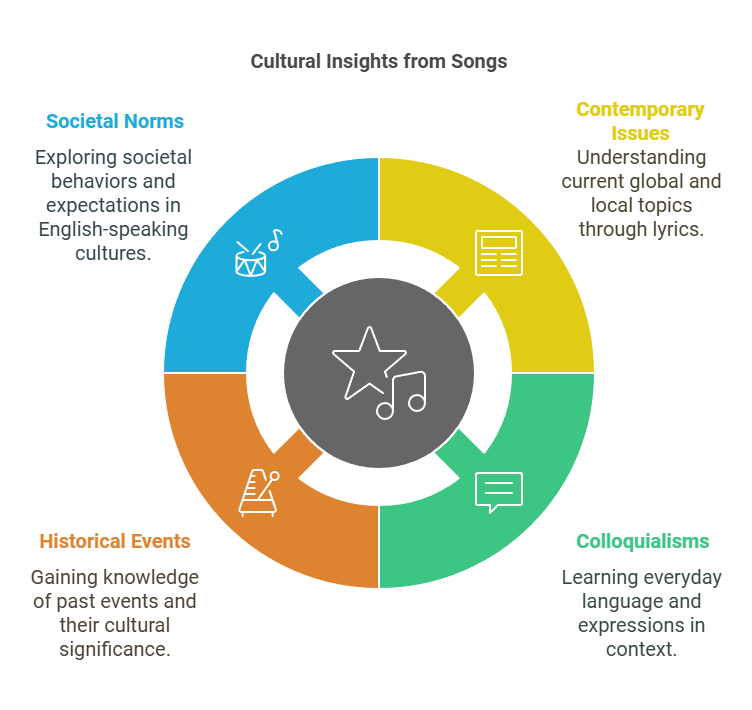
This cultural immersion fosters a genuine interest in the language beyond mere academic requirements.
Emotional Connection: Bridging Language and Feeling
Music has the power to evoke strong emotions, helping students connect with English on a deeper, more personal level. This emotional engagement:
- Creates memorable learning experiences
- Encourages self-expression in the target language
- Reduces anxiety associated with language learning
- Promotes empathy and cultural understanding
When students associate positive emotions with learning English, their motivation naturally increases.
Variety and Novelty: Keeping Lessons Fresh and Exciting
The vast array of musical genres and styles available ensures that lessons remain fresh and exciting. This variety:
- Caters to diverse student interests and learning styles
- Introduces students to different accents and dialects
- Allows for exploration of various linguistic features (e.g., rhythm, intonation)
- Prevents monotony in the learning process
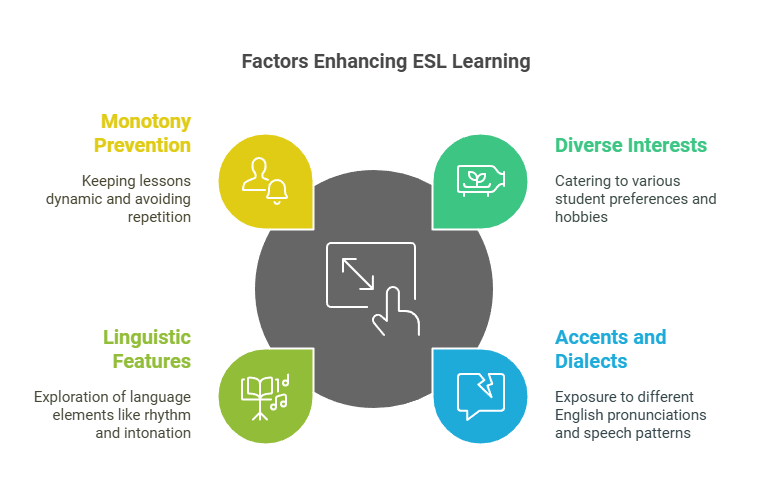
By regularly introducing new songs and genres, teachers can maintain high levels of student interest and engagement.
Unconscious Learning: Effortless Acquisition Through Repetition
The repetitive nature of songs, particularly choruses and hooks, facilitates effortless vocabulary and structure acquisition. This unconscious learning:
- Reinforces grammatical structures through natural repetition
- Enhances pronunciation and intonation skills
- Improves vocabulary retention through contextual usage
- Develops listening skills in an enjoyable, low-pressure environment
Students often find themselves singing or humming songs outside of class, unknowingly continuing their language practice.
Multisensory Engagement: Activating Multiple Learning Pathways
Songs engage multiple senses simultaneously, creating a rich learning experience. This multisensory approach:
- Appeals to visual learners through music videos or lyric sheets
- Engages auditory learners through melody and rhythm
- Involves kinesthetic learners through movement or dance
- Enhances overall cognitive processing and memory formation
By activating multiple learning pathways, songs create stronger, more lasting connections to the language.
By leveraging these powerful aspects of music, English teachers can create a highly motivating learning environment. The key lies in selecting appropriate songs and designing activities that maximize their potential for language acquisition and student engagement.

Motivating Activities for Your Classroom
Let’s explore some innovative activities that can significantly boost student motivation and engagement in your English lessons. Each of these activities harnesses the power of music to create dynamic, interactive learning experiences.
1. Musical Grammar Pieces
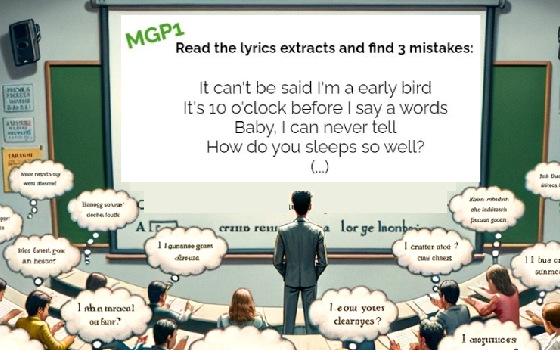
This engaging activity transforms grammar lessons into interactive puzzles. Students work with short extracts from song lyrics to identify and correct grammatical errors. The process involves:
- Individual Analysis: Students first examine the lyrics independently, spotting potential errors.
- Group Collaboration: They then form small groups to discuss their findings and reach a consensus on the correct grammar.
- Class Discussion: Groups present their corrections, explaining their reasoning to the class.

This approach not only reinforces grammar rules but also promotes teamwork and critical thinking. By using popular songs, it makes grammar lessons both fun and relevant, increasing student engagement and retention of grammatical concepts.
Benefits and 21st Century Skills:
- Critical Thinking: As students analyze lyrics independently, they identify potential errors and reason through grammatical rules, enhancing their analytical skills.
- Collaboration: Small group discussions foster teamwork as students share ideas and work together to reach a consensus on corrections.
- Communication: When presenting corrections to the class and explaining their reasoning, students develop clear expression and argumentation skills.
For a detailed lesson plan and printable resources for this activity, check out the full blog post on [Musical Grammar Pieces]
2. Lyrical Reading
This immersive activity sharpens students’ active listening skills through a multi-step process:
- Listening Phase: The teacher reads the lyrics of a song aloud (without music) twice.
- Note-taking: Students jot down interesting ideas, words, or phrases they hear, even if it’s just single words.
- Pair Discussion: Students pair up to share their notes and collaboratively deduce the song’s message.
- Group Analysis: The class reconvenes to discuss their conclusions and answer questions about the song’s type and genre.
- Music Video Comparison: Finally, the actual song or music video is played, allowing students to compare their interpretations with the artist’s presentation.
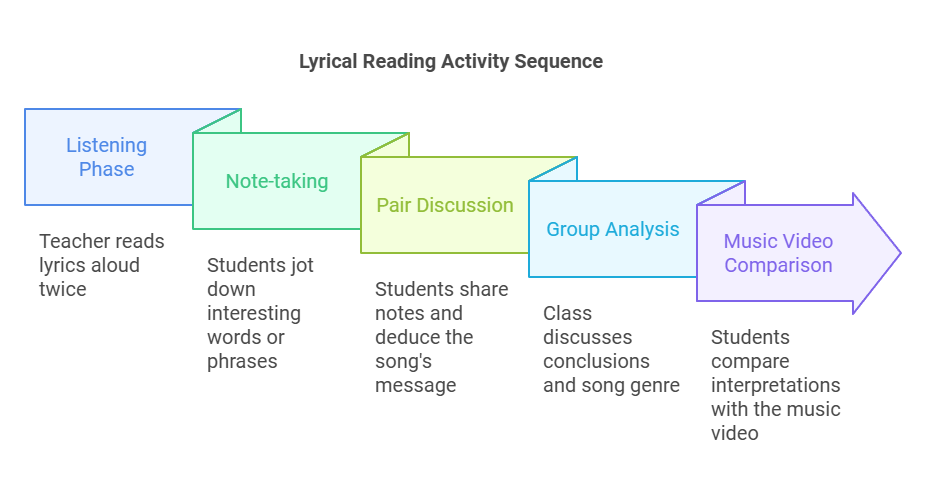
This activity enhances listening comprehension, promotes critical thinking, and encourages students to engage deeply with the language and themes of the song.
Benefits and 21st Century Skills:
- Critical Thinking: As students interpret lyrics and deduce the song’s message, they analyze complex ideas presented in poetic form, honing their analytical skills.
- Collaboration: Through pair discussions, students share and build upon each other’s interpretations, fostering teamwork and idea exchange.
- Communication: Class discussions on song type and genre require clear articulation of ideas and active listening, improving verbal expression and comprehension.
- Information Literacy: By comparing their interpretations with the actual song or video, students learn to evaluate and analyze different sources of information, enhancing their media comprehension skills.
For a detailed lesson plan and printable resources for this activity, check out the full blog post on [Lyrical Reading]

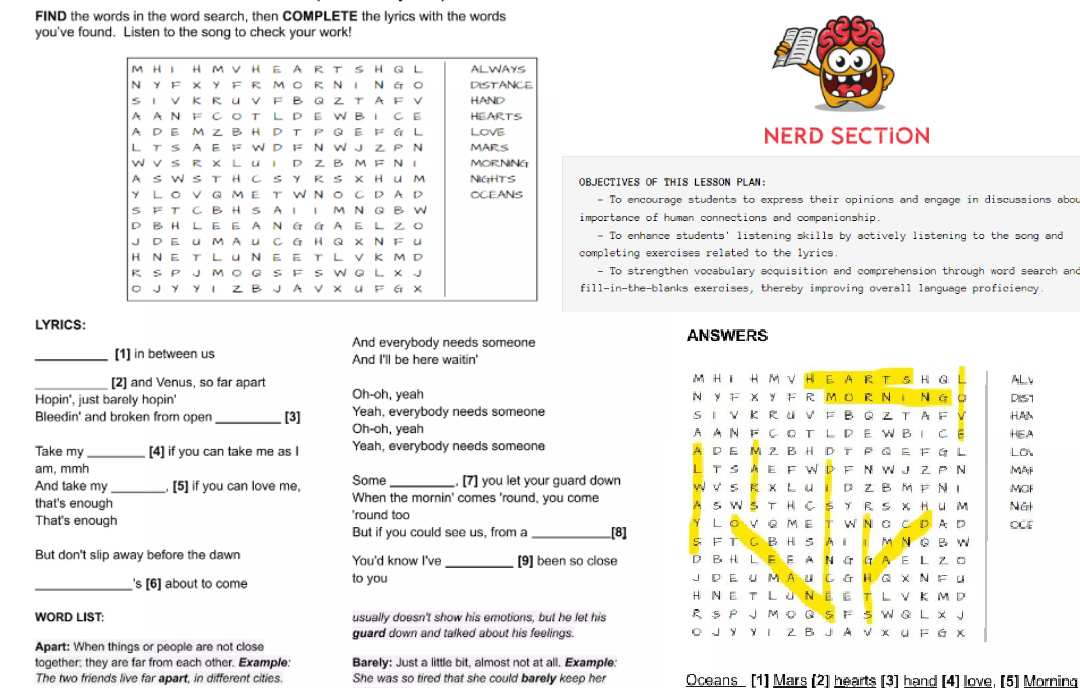
3. Musical Word Search
This activity explores the vocabulary and themes of a song through an engaging puzzle format:
- Theme Discussion: Begin by discussing the song’s theme with the class.
- Word Search: Students complete a word search puzzle featuring key words from the song’s lyrics.
- Lyric Completion: Using the words they’ve found, students fill in blanks in the song lyrics.
- Listening Check: Play the song, allowing students to check their work and enjoy the music.
- Thematic Discussion: Conclude with a class discussion where students interpret the song’s themes and express their opinions on the importance of the discussed themes.

This multi-step approach reinforces vocabulary, enhances comprehension, and promotes deeper engagement with the song’s content.
Benefits and 21st Century Skills:
- Critical Thinking: The thematic discussion at the end challenges students to interpret the song’s themes and express opinions, fostering analytical and reasoning skills.
- Information Literacy: As students locate and apply specific vocabulary within the context of song lyrics, they enhance their ability to find and use information effectively.
- Media Literacy: By engaging with song lyrics and potentially music videos, students develop skills to interpret and analyze different forms of media critically.
For a detailed lesson plan and printable resources for this activity, check out the full blog post on [Musical Word Search]
4. Song-based Conversation Class
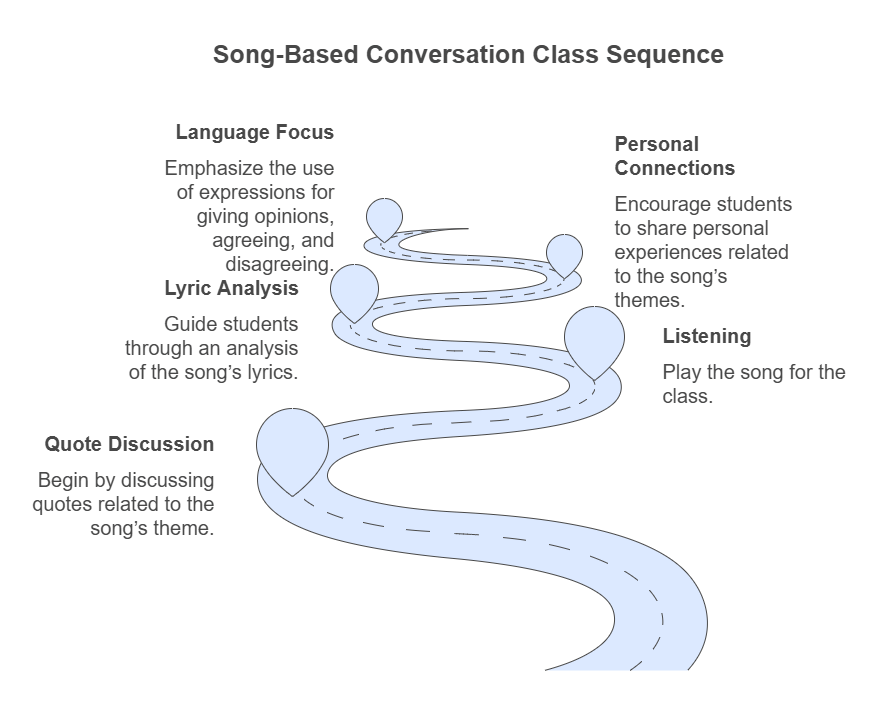
This lesson plan fosters meaningful conversations through song analysis:
- Quote Discussion: Begin by discussing quotes related to the song’s theme.
- Listening: Play the song for the class.
- Lyric Analysis: Guide students through an analysis of the song’s lyrics.
- Personal Connections: Encourage students to share personal experiences related to the song’s themes.
- Language Focus: Throughout the discussion, emphasize the use of expressions for giving opinions, agreeing, and disagreeing.
This approach not only improves language skills but also promotes cultural understanding and personal reflection.
Benefits and 21st Century Skills:
- Critical Thinking: Through lyric analysis and quote discussions, students are encouraged to think deeply about themes and meanings, enhancing their analytical abilities.
- Communication: The entire activity centers around expressing opinions and engaging in meaningful conversations, improving students’ verbal expression and listening skills.
- Global Awareness: By analyzing songs from different cultures, students broaden their understanding of diverse perspectives and global issues, fostering cultural competence.
For a detailed lesson plan and printable resources for this activity, check out the full blog post on [Song-Based Conversation Class]
5. Musical Interview
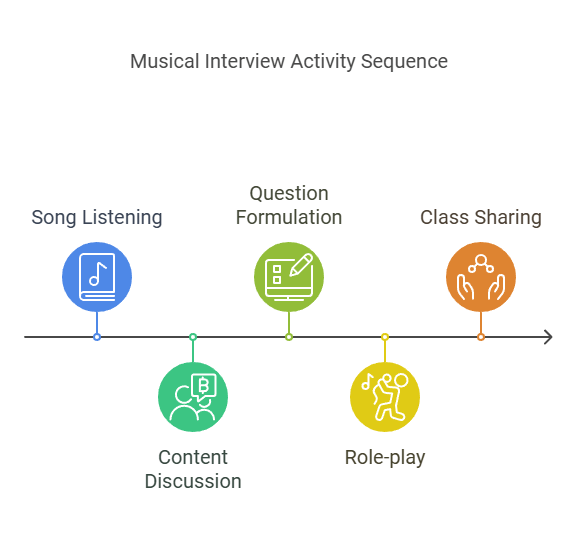
This creative activity combines listening comprehension with speaking practice:
- Song Listening: Play a chosen song for the class.
- Content Discussion: Discuss the song’s content and themes as a group.
- Question Formulation: In pairs or small groups, students create interview questions they would ask the singer, based on the song’s lyrics and themes.
- Role-play: Students take turns role-playing as the interviewer and the singer, using their prepared questions.
- Class Sharing: Groups share their most interesting questions and answers with the whole class.
This activity encourages students to engage deeply with the song’s content while practicing question formation and improvisation skills.
Benefits and 21st Century Skills:
- Creativity: By creating interview questions based on song lyrics and themes, students exercise their imagination and innovative thinking.
- Communication: Role-playing interviews allows students to practice both asking and answering questions clearly and coherently, enhancing their verbal skills.
- Collaboration: Working in pairs or groups to create questions and conduct interviews fosters teamwork and idea-sharing, crucial skills for the modern workplace.
- Critical Thinking: Formulating meaningful questions based on song content requires students to analyze and synthesize information, developing higher-order thinking skills.
For a detailed lesson plan and printable resources for this activity, check out the full blog post on [Musical Interview]
Implementing Motivation in Your Classroom
By incorporating these activities, you can significantly boost student motivation and engagement. Remember, variety is key. Mix and match these activities to keep your lessons fresh and exciting. Don’t be afraid to let your students’ interests guide your song choices – this gives them a sense of ownership over their learning experience.
Consider creating a “Song of the Week” feature where students can suggest and vote on songs to explore in class. This not only increases engagement but also exposes the class to a diverse range of music and language use.
As we’ve seen, music has the power to motivate students in numerous ways. By tapping into the emotional and cultural aspects of songs, we can create a learning environment that students eagerly anticipate. Music not only captures attention but also creates lasting connections to the language, making the learning process more enjoyable and memorable.
Moreover, these music-based activities naturally lend themselves to developing crucial 21st-century skills. As students analyze lyrics, discuss themes, and collaborate on music-related projects, they’re not just learning English—they’re honing critical thinking, creativity, communication, and collaboration skills.
The next post will explore the second principle of the MUSIC framework: Understanding.
It will go deep into how songs can enhance comprehension and provide context for language learning, building on the motivation cultivated through these techniques.
Follow, Like, and Subscribe for More ESL Inspiration:
Want to Bring Flow Into Your Classroom?
Know more HERE!
 Song Activity Factory
Love the content, would much rather do without all of the AI generated images…
LikeLike