

Strategy Insights: ESL Song Analysis via Billie Eilish
The Core Shift: Transmute traditional language acquisition into a visionary exploration of emotional intelligence and critical thinking through the pedagogical flow of modern music.
- Main Concept: Multi-dimensional Lyrical Analysis
- Key Framework: 21st-Century Skills Integration
- Category: ESL Pedagogy & Strategy
- Teacher Benefit: Empowers educators to bridge the gap between pop culture and profound cognitive student engagement.
- Expert Author: Márcia Bonfim
- Practical Application: Shifting from rote skill-building to active synthesis via role-play, ethical debates, and creative perspective-flipping.
- Source: Song Activity Factory
Hey there, superstar ESL educators! 🎵🌍
Let’s talk about a song I’ve found to be a fantastic resource in the classroom: “Birds of a Feather” by Billie Eilish.
Sometimes you come across a track that’s more than just a catchy tune; it’s a real goldmine for getting students to connect and think on a deeper level. This is one of those songs.
It’s packed with an emotional depth, rich metaphors, and a complex story that can spark a truly meaningful discussion. Honestly, it’s the kind of material that makes our job exciting.
So, if you’ve never considered using it, I’m here to walk you through exactly how I take this one track and transform it into a powerful lesson. Let’s get started.

So, think of this post as our step-by-step guide.
Together, we’re not just going to look at the lyrics and the story behind the song. We’re going to go so much deeper. We’re going to see how “Birds of a Feather” can help our students move beyond the traditional four skills of listening, speaking, reading, and writing.
This is about helping them develop the tools to think more critically, to connect with emotional intelligence, and to find the confidence to bring their OWN creativity to life—all while they engage with a truly powerful piece of modern music.
So, if you’re ready to bring this kind of deep, meaningful energy into your lessons, let’s get started!
Got a minute? Let’s talk about Birds of a Feather! 🎵

First things first, if “Birds of a Feather” by Billie Eilish isn’t on your playlist yet, you need to add it. Seriously.
It was the second single from her album Hit Me Hard and Soft, and it’s been everywhere since it dropped last year. You might have caught it in the Heartstopper Season 3 trailer on Netflix, which tells you everything about its emotional vibe. And then she performed it at the closing ceremony for the 2024 Summer Olympics closing ceremony! Talk about a huge cultural moment.
But let’s be honest, the real reason I love this song for our classes goes way beyond the charts (even though hitting number five on the Billboard Hot 100 is a big deal!). What makes this track a true goldmine is its raw, emotional honesty. Billie’s vocals and the poignant lyrics are the perfect spark for real discussions about love, connection, and loyalty.
So, are you starting to see the potential? “Birds of a Feather” isn’t just a song—it’s a conversation, an entire experience, waiting to happen in your classroom. Let’s get into how we can make that a reality.
How About A Cool Podcast By Google Notebook LM Feat BIRDS OF A FEATHER?
Song Breakdown: Exploring the Themes and Wordplay in “Birds of a Feather”
Before we plan any activities, we need to know the song’s story inside and out. It’s not enough to just define the words; we have to get the feeling and the meaning behind each line.
So, this section is my breakdown of what’s happening in “Birds of a Feather,” line by line.
Think of this as our prep work. It’s for us, the teachers, to have the full picture we need before we can confidently guide our students.
[Verse 1]
“I want you to stay / ‘Til I’m in the grave / ‘Til I rot away, dead and buried / ‘Til I’m in the casket you carry”
Right from the start, Billie dives deep into some serious devotion here. She’s not just talking about wanting someone to stick around for a while—she wants them to stay until the very end, literally until she’s “dead and buried.” The imagery is intense, almost a bit dark, but it shows how deeply she’s committed. This isn’t a casual request for companionship; it’s a plea for unwavering loyalty that transcends time and even life itself.
“If you go, I’m goin’ too, uh / ‘Cause it was always you (Alright) / And if I’m turnin’ blue, please don’t save me / Nothin’ left to lose without my baby”
Here, Billie’s saying she’s all in—if her partner leaves, she’s going too. It’s that ride-or-die kind of love. And when she says, “if I’m turnin’ blue, please don’t save me,” it’s like she’s admitting life wouldn’t be worth living without them. It’s a raw, vulnerable confession of just how much her partner means to her.
[Refrain]
“Birds of a feather, we should stick together, I know / I said I’d never think I wasn’t better alone”
The classic phrase “birds of a feather” comes in here, symbolizing how people who are alike naturally stick together. Billie reflects on how she used to think she was better off on her own, but now she’s realizing that maybe she was wrong. It’s a relatable moment—how many of us have thought we didn’t need anyone, only to realize how much we crave connection?
“Can’t change the weather, might not be forever / But if it’s forever, it’s even better”
This part feels like Billie’s being real about the unpredictability of relationships. She knows things might not last forever, but if they do, that’d be amazing. It’s this mix of realism and hope that makes the song feel grounded yet optimistic. She’s not banking on forever, but she’s definitely hoping for it.
[Pre-Chorus]
“And I don’t know what I’m cryin’ for / I don’t think I could love you more / It might not be long, but baby, I”
Here, Billie’s getting a little emotional, and she’s not even sure why. It’s like when you’re overwhelmed by your feelings, and you can’t quite put your finger on it. She’s already at the peak of her love—she couldn’t possibly love this person more, and that realization is hitting her hard.
[Chorus]
“I’ll love you ’til the day that I die / ‘Til the day that I die / ‘Til the light leaves my eyes / ‘Til the day that I die”
This is where Billie drops the ultimate promise—she’s going to love this person until her last breath. The repetition of “’til the day that I die” drives home just how serious she is. It’s a simple, but powerful declaration of love that feels both romantic and a little haunting.
[Verse 2]
“I want you to see, hm / How you look to me, hm / You wouldn’t believe if I told ya / You would keep the compliments I throw ya”
In the second verse, Billie’s trying to get her partner to see themselves the way she sees them. She’s showering them with compliments, but they’re not having it—they don’t believe her. It’s frustrating when someone you love can’t see their own worth, and Billie’s clearly feeling that frustration here.
“But you’re so full of sh*t, uh / Tell me it’s a bit, oh / Say you don’t see it, your mind’s polluted / Say you wanna quit, don’t be stupid”
Now she’s calling them out—she’s not holding back. Billie’s partner is downplaying themselves, and she’s had enough of it. The line “your mind’s polluted” suggests that their self-doubt is clouding their judgment. She’s telling them straight up: don’t be ridiculous, you’re amazing, and you need to see that.
[Pre-Chorus]
“And I don’t know what I’m cryin’ for / I don’t think I could love you more / It might not be long, but baby, I”
The pre-chorus comes back, and it’s just as emotional as before. Billie’s still unsure why she’s crying, but her love is as intense as ever. It’s that feeling of being overwhelmed by love and the fear that it might not last.
[Chorus]
“I’ll love you ’til the day that I die / ‘Til the day that I die / ‘Til the light leaves my eyes / ‘Til the day that I die”
The chorus repeats, and it’s still that bold promise of undying love. Billie’s making it clear that no matter what happens, her love isn’t going anywhere.
[Post-Chorus]
“I knew you in another life / You had that same look in your eyes / I love you, don’t act so surprised”
The post-chorus takes things to a more spiritual level. Billie’s suggesting that their connection goes beyond this lifetime, like they’ve known each other before. It’s a cool, almost mystical twist that adds depth to the relationship. And when she says, “don’t act so surprised,” it’s like she’s saying this love was inevitable—it was always meant to be.
In a nutshell, “Birds of a Feather” is Billie Eilish laying her heart bare. It’s a song about intense love, vulnerability, and the fear of losing someone who means everything. Through vivid metaphors and raw emotion, Billie captures the highs and lows of being in love, making it a track that’s both relatable and deeply personal. The song’s honesty and emotional depth make it perfect for sparking discussions about love, relationships, and self-worth in an English language teaching context.
Decoding the Language: Key Vocabulary and Phrases for English Songs for ESL Learners 📚🔍
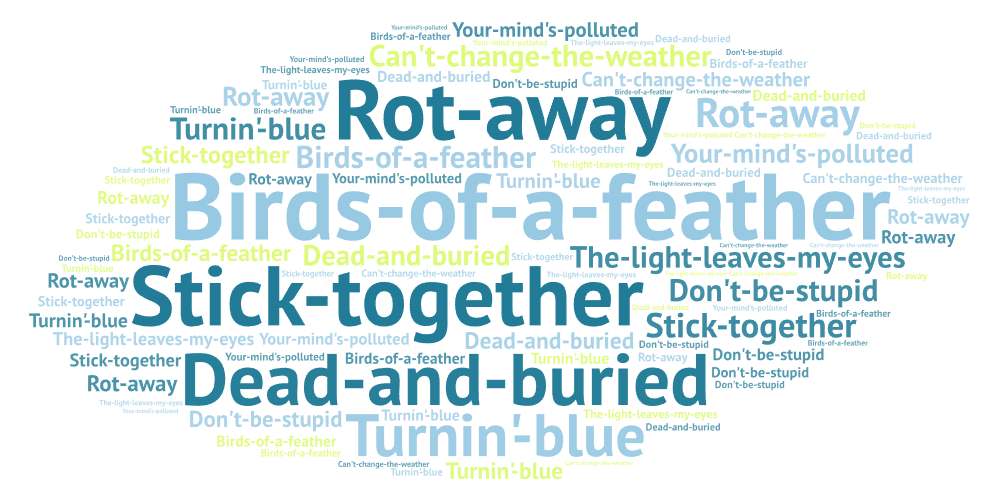
Explore essential vocabulary and phrases from ‘Birds of a Feather’ to enrich your ESL students’ language skills and understanding:
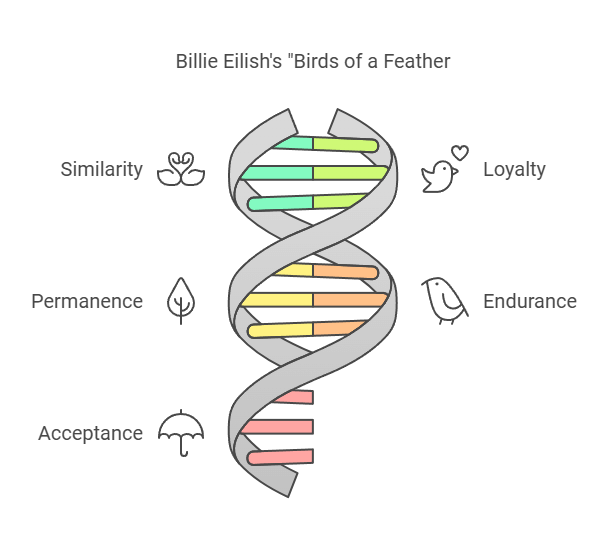
1. “Birds of a feather”: A common idiom meaning that people who are similar tend to stick together. It’s a metaphor for strong connections based on shared traits or emotions.
2. “Stick together”: This phrase emphasizes the idea of staying united or supporting each other, especially in tough times. It’s a key expression for loyalty in relationships.
3. “Rot away, dead and buried”: A vivid, almost morbid image that suggests permanence—even after death. It highlights a deep, unbreakable bond.
4. “Turnin’ blue”: This phrase refers to physical signs of death or extreme distress, symbolizing a willingness to endure anything for love, even death.
5. “Can’t change the weather”: A metaphor that suggests some things are beyond control, much like the unpredictability of relationships. It’s a way of expressing acceptance of uncertainty.
6. “The light leaves my eyes”: A poetic way of describing death, symbolizing the end of life but also the end of love only when life itself ends.
7. “Your mind’s polluted”: A metaphor for distorted thinking, likely due to self-doubt or negative influences. It suggests that the partner’s perspective is clouded or unhealthy.
8 “Don’t be stupid”: A blunt, direct phrase used to snap someone out of irrational behavior or thinking. It’s a strong call for the partner to see reason.
These phrases from “Birds of a Feather” by Billie Eilish offer crucial insights into themes of love, loyalty, and emotional intensity. For ESL learners, understanding these expressions will help them grasp not only the literal meanings but also the deeper emotional and metaphorical layers of the song.
Try this Lyrical Grammar Quiz based on the song with your Students!
Spotlight on Grammar: Key Structures in English Songs for ESL Learners 📚✏️
“Birds of a Feather” is a goldmine of grammatical patterns, making it an ideal tool for boosting your ESL students’ grasp of English grammar. The song’s rich lyrics offer a variety of structures that can be broken down and explored, giving learners practical examples of how to use English in meaningful ways. Whether it’s verb tenses, conditionals, or idiomatic expressions, this song provides plenty of opportunities for your students to enhance their language skills in an engaging and memorable way.
Imperative Mood: “Don’t be stupid”, ‘don’t act so surprised’ – Clear examples of the imperative mood, used to give a direct command. This structure is essential for teaching how to express instructions or strong advice in English..
Real Conditional: “If you go, I’m goin’ too, uh”, “And if I’m turnin’ blue, please don’t save me”, “But if it’s forever, it’s even better” – These are examples of real conditional sentences, which describe situations that are possible or likely to happen.
Modal Verb (Possibility): “It might not be long” “Might not be forever” – The modal verb “might” expresses possibility or uncertainty about the future. This structure is important for conveying situations that are not certain or definite.
Simple Future: “I’ll love you ’til the day that I die” – This is an example of the simple future tense, used to express a promise or intention about a future action. It’s a key structure for discussing future commitments or plans.
Reported Speech: “I said I’d never think I wasn’t better alone” – This sentence uses reported speech, where the speaker recounts something they said in the past. It’s crucial for learners to understand how to report what others (or themselves) have said in a past context.
Unreal Conditional (Second Conditional): “You wouldn’t believe if I told ya” “You would keep the compliments” – These are examples of the second conditional, used to talk about hypothetical or unreal situations. This structure is important for expressing what would happen if things were different.
Simple Past: “I knew you in another life” “You had that same look in your eyes” “‘Cause it was always you” – These sentences use the simple past tense to describe completed actions or states in the past. Understanding the simple past is essential for learners to talk about past experiences or events.
By focusing on these grammatical elements, the lyrics of “Birds of a Feather” by Billie Eilish provide a valuable resource for teaching both the mechanics of English grammar and the expressive potential of language. The song’s diverse range of structures allows learners to engage with real-life language use in a meaningful context, making it easier to grasp complex grammatical concepts. Through these lyrical examples, educators can create lessons that are not only informative but also emotionally resonant, helping students connect grammar to authentic communication.

Engage Your Students with “Birds of a Feather”: Activities for 4 Skills & 21st-Century Learning 🎶💡
Use ‘Birds of a Feather’ to foster 21st-century skills like creativity, critical thinking, collaboration, and communication in your ESL classroom. Here’s how you can incorporate these skills into your lesson plans, even if you’re new to using songs in the classroom:
1. Flip the Script: Writing from the Opposite Perspective (Boost Creativity & Critical Thinking) ✍️
Activity:
Challenge students to rewrite the entire song from the opposite perspective. In “Birds of a Feather”, the speaker expresses a desire for eternal togetherness and dependency, but in the rewritten version, the speaker would express a desire for independence and separation. Students should focus on reversing the metaphors, tone, and emotional themes. For example:
“If you go, I’m goin’ too” could become “If you go, I’m staying here”, symbolizing a break from dependency.
The metaphor of “Birds of a feather” could transform into something like “Wolves in the wild” to represent independence and self-reliance.
Encourage students to rewrite key parts of the song, focusing on how the speaker now values personal freedom over intense attachment. They should also consider how this shift would affect the metaphors, imagery, and tone. Would the language become more empowering? Would the emotional weight shift from sorrow to liberation?After completing their rewrites, students will share their new versions with the class, explaining the creative choices they made and how they altered the emotional arc of the song.Outcome:
Critical Thinking: Students will analyze how altering the perspective changes the emotional and narrative structure of the song. They’ll need to think deeply about how metaphors and tone can be reversed while still maintaining coherence.
Creativity: By reimagining the entire narrative, students will engage in a creative process that pushes them to think beyond the original message.
Emotional Intelligence: This exercise will help students explore the complexities of relationships, dependency, and autonomy, making them reflect on the emotional consequences of both connection and separation.
2. Heart vs. Mind: Debating the Ethics of Love and Sacrifice (Enhance Critical Thinking & Communication) 💬
Activity: Organize a class debate around the ethical implications of the song’s message. The central question: “Is it ethical to sacrifice oneself for love, as suggested in the lyrics ‘If you go, I’m goin’ too’?”
Divide the class into two teams—one defending the idea of unconditional love and sacrifice, the other arguing for the importance of individual boundaries and self-preservation. Each team must present philosophical, psychological, or even literary arguments to support their stance.Outcome:
This activity fosters high-level critical thinking and communication skills. Students must not only analyze the song’s themes but also engage with complex ethical questions, presenting well-reasoned arguments and counterarguments.
3. Step Into Their Shoes: Role-Playing a Therapy Session (Boost Communication & Emotional Intelligence) 🎭
Activity:
In pairs, students role-play a therapy session where one student is the speaker (the song’s character) and the other is the therapist. The therapist’s goal is to help the speaker unpack their emotional struggles (e.g., dependency, vulnerability) through probing questions and active listening.
Steps:
- Introduction:
Briefly discuss the role of a therapist (empathy, active listening) and explore the emotional themes in the song (e.g., dependency, fear of loss). Introduce open-ended questions (e.g., “How do you feel about being without your partner?”). - Role Assignment:
Assign students into pairs. One is the speaker (reflecting on the song’s emotions), the other the therapist (guiding the conversation with empathy and reflective questions). - Role-Play:
Students engage in a 10–15 minute session. The therapist asks questions to help the speaker explore their emotions. The speaker responds authentically, staying true to the song’s themes. - Reflection:
After the session, have students reflect on the process. Speakers can discuss how it felt to express their emotions, while therapists can share how they guided the conversation and used empathy.
Outcome:
Students develop emotional intelligence, empathy, and communication skills by exploring complex emotions and practicing active listening.

4. Dear Singer: Crafting a Letter in Response (Unleash Creative Writing & Emotional Exploration) 💌
Activity: In pairs, students imagine that the person the singer is singing about writes a letter in response to the song “Birds of a Feather”. The letter can either accept or reject the singer’s intentions (e.g., deep love, dependency, vulnerability). Students discuss and decide together how the recipient feels about the singer’s message and then collaboratively write the letter.Steps:
Song Analysis: Review the lyrics and discuss the emotions and intentions expressed by the singer (e.g., love, fear of loss, dependency). What is the singer asking for or expressing?
Pair Discussion: In pairs, students decide whether the recipient of the song will accept or reject the singer’s intentions. They should consider the emotional complexity of the relationship and the recipient’s perspective.
Letter Writing: Students write a letter from the recipient to the singer. The letter should reflect the recipient’s feelings and decision, whether they accept the singer’s vulnerability or push back against the dependency expressed in the song.
Sharing and Reflection: Pairs can share their letters with the class or in small groups, discussing the different ways in which the recipient might respond to the singer’s emotions. Reflect on how relationships can involve both acceptance and boundaries.
Outcome: Students explore emotional nuances, practice creative writing, and engage in discussions about relationships, boundaries, and emotional resilience.
By incorporating these ideas for each 21st-century skill into your ESL song analysis lessons, you can create engaging and meaningful learning experiences that help your students develop critical skills for success in the modern world. Remember to start small, be open to trying new things, and have fun with the process! 🎉🙌

Conclusion: Enhance Your ESL Teaching with the Power of Music 🎵🌍
And there you have it, folks! A guide to transforming Billie Eilish’s “Birds of a Feather” from an emotional ballad into an engaging ESL teaching tool. By exploring the song’s lyrics, themes, and language, we’ve uncovered a treasure trove of opportunities to help students improve their English skills and develop 21st-century competencies. 💪📚
The true magic happens when you and your students dive into the song together—discussing, analyzing, and even creating. Feel free to adapt and expand on the ideas presented here to fit your teaching style and your students’ needs. The possibilities for music-based learning are endless! 🌈✨
I’d love to hear your experiences with “Birds of a Feather” in your ESL lessons. Share your successes, challenges, and any creative twists you’ve added in the comments below. Together, we can build a community of music-loving ESL teachers who inspire and learn from each other. 🤝💕
Finale: Empower Your ESL Lessons Through the Melody of Learning 🎉🎵
Congratulations, fellow music-loving ESL teachers! You’ve completed this inspiring journey into Billie Eilish’s “Birds of a Feather.” I hope you’re feeling energized and ready to bring the power of music into your classroom like never before. 💪🎶
Let the rhythm of this song inspire your students as you blend language learning with the magic of music! 🎶📚 FOR MORE ESL SONG ANALYSES VISIT THIS PAGE
Follow, Like, and Subscribe for More ESL Inspiration:
Want to Bring Flow Into Your Classroom?
Don’t stop here! Explore the power of songs to transform your ESL classroom.

 Song Activity Factory
3 comments