Strategy Insights: Analyzing Alex Warren’s “Ordinary”
- Main Concept: Utilizing the “spiritual language” and heavy metaphors of modern pop ballads to anchor deep discussions on transformation, trust, and commitment.
- Key Framework: The MUSIC+ Framework (part of the BEAT+ Method), applied through the “Lyrical Story Worlds” activity which uses visual shorts to trigger critical analysis.
- Teacher Benefit: Provides the “Confidence to Lead” by offering a line-by-line interpretation guide, effectively silencing “assessment anxiety” through clear, 21st-century skill objectives.
- Practical Application: Teaching Reported Speech and First Conditionals through lyrical storytelling, paired with collaborative storyboarding tasks for B2/C1 learners.
Let’s face it… as teachers, we’re always on the hunt for that PERFECT song, right?
You know the one. That song that’s fresh, that has a real soul, AND is filled with amazing language you can actually TEACH with. A song that goes deeper than just another boring gap-fill. But finding it? It can feel like searching for a needle in a haystack.
That’s why I just had to tell you about a gem I’ve been working with: “Ordinary” by Alex Warren.
I’m sure you’ve heard it—it’s been all over the charts and TikTok, so your students will DEFINITELY know it. But the real magic for us isn’t just that it’s a hit.
It’s the song’s HEART.
What’s this song really about? Beneath the surface, it’s packed with powerful metaphors and beautiful imagery that can spark incredible conversations. And knowing what’s really going on in the lyrics is what gives you the confidence to bring it to your class.
Because when a student asks, “Teacher, what does this part mean?” you want to be able to guide them to a truly insightful answer.
So, that’s what we’re going to do. I want to walk you through the song’s powerful themes so you feel totally ready to lead those meaningful discussions.
PLUS, after we break down the meaning, I’ve got a complete, step-by-step creative activity for you—with all the resources ready to go, and totally FREE—that your students are going to love.

SONG BACKGROUND
Okay, so what’s the story here? “Ordinary” is a really powerful pop ballad by American singer-songwriter Alex Warren. He released it on February 7, 2025, and it’s the first single from his debut album, You’ll Be Alright, Kid.
But what’s it really about?
It’s all about the power of love to transform our everyday, ordinary lives into something that feels… well, EXTRAORDINARY.
And the way he does it is with this beautiful, almost spiritual language. I mean, when he sings about “kissin’ the ground of your sanctuary,” he’s turning simple human moments into something sacred, something powerful. He even has that amazing line about angels being “jealous knowin’ we found” a love so rare. It just gives you chills!
And this is why the song is pure gold for our classrooms.
This is how we move beyond the gap-fill and get our students really talking. It gives them a chance to dig into the lyrics, to infer meaning, and to connect these huge ideas of love and transformation to their OWN lives. It’s not just a language lesson; it helps them find their own voice and think critically, which is what we’re all about!
LINE-BY-LINE LYRICS ANALYSIS OF “ORDINARY” BY ALEX WARREN
All right, now it’s time to get to the heart of it all! What do these beautiful words actually mean? Let’s go line by line and really uncover the story Alex Warren is telling, so you can feel totally prepared to guide your students through it.
“They say, ‘The holy water’s watered down / And this town’s lost its faith / Our colors will fade eventually'”
The song starts with this really powerful feeling of disillusionment. When he says the “holy water’s watered down,” it’s a metaphor, right? It suggests that things that were once sacred or meaningful have lost their power. The idea of a town that’s “lost its faith” just deepens that feeling of emotional or spiritual decay. And that line about our “colors fading”? That’s life losing its energy and vibrancy over time, especially when you feel like hope is gone. He’s painting a picture of a pretty bleak world here.
“So, if our time is runnin’ out / Day after day / We’ll make the mundane our masterpiece”
And this is where the speaker decides to fight back… with LOVE. Even if time is running out, even if everything is fading, the choice is to turn the ordinary—”the mundane”—into something extraordinary and beautiful. It’s about finding REAL meaning in the small moments you share with someone. I just love that. It’s an intentional act of creating your own masterpiece out of everyday life.
“You’re takin’ me out of the ordinary”
And here it is. The SOUL of the entire song, all in one line. This is the central metaphor. Love isn’t just a feeling; it’s an action. It’s something that lifts the speaker out of the pain and dullness of everyday life. Think about what “ordinary” really means here—it’s not just a routine, it’s an emotional numbness, and this love is the antidote.
“I want you layin’ me down ’til we’re dead and buried”
Wow. This line is SO dramatic, but in a beautiful, poetic way, right? It’s an expression of lifelong commitment, vulnerability, and physical closeness. This isn’t just a fleeting romance; this is a love that is all-consuming, a bond that is meant to last a lifetime.
“I’m on the edge of your knife, stayin’ drunk on your vine”
Let’s look at these two powerful metaphors. First, “on the edge of your knife.” There’s a real danger in being so open and vulnerable in love, isn’t there? It shows that this connection has the power to either hurt or heal. Then, “drunk on your vine.” This has those biblical echoes of wine and the vine, suggesting a feeling of spiritual surrender and being completely intoxicated by love.
“The angels up in the clouds are jealous knowin’ we found / Somethin’ so out of the ordinary”
I just love this! He’s taking their love and lifting it up to heavenly proportions. It’s a beautiful exaggeration to show that what they have is so special, even divine beings would be envious. It makes their human connection feel mythic and truly sacred.
“You got me kissin’ the ground of your sanctuary / Shatter me with your touch, oh Lord, return me to dust”
What an incredible choice of words. A “sanctuary” isn’t just any place; it’s a holy place, a safe space. He sees his partner as a source of reverence and transformation. And those lines, “shatter me” and “return me to dust”—they might sound destructive, but they’re not about pain. They’re about a complete spiritual surrender. It’s about being broken open by love in order to be reborn.
“Hopeless hallelujah / On this side of Heaven’s gate”
How can a “hallelujah” be hopeless? It’s such a cool contradiction. This phrase is all about finding overwhelming joy right in the middle of despair. The speaker is celebrating a divine-like love right here on Earth—”this side of Heaven”—as if they’ve found paradise in another person.
“Oh, my life, how do ya / Breathe and take my breath away?”
This is just pure, breathless awe and admiration. The partner is being presented as life itself, someone who both gives breath and takes it away. It’s a stunning metaphor for emotional intensity and how deeply connected they are.
“At your altar, I will pray / You’re the sculptor, I’m the clay”
See what he’s doing here? He’s taking us right back to that spiritual place. An altar. A place of prayer. It’s all about devotion. But then he gives us that other image, “You’re the sculptor, I’m the clay”. To me, that’s about trust. A deep, REAL trust where you let someone you love help shape you into who you’re meant to be.

“Somethin’ so heavenly, higher than ecstasy / Whenever you’re next to me, oh my, my”
And it all comes down to this feeling. It’s heavenly. It’s even “higher than ecstasy”. He’s not just talking about a normal kind of happiness. This is something else entirely. Something spiritual.
“World was in black and white until I saw your light / I thought you had to die to find”
And then this line… Wow. “My world was in black and white until I saw your light”. We’ve all heard that idea before, but it’s so perfect here. Life was just dull, without any color or energy. But the next line is what really gets me: “I thought you had to die to find”. I mean, think about that. He’s saying this kind of love, this amazing, transcendent feeling… he thought it was something you could only get in the afterlife. Finding it here, now, in another person? It changes EVERYTHING.
TEACHING TAKEAWAY
So, as you can see, “Ordinary” is so much more than just another love song. It’s a modern anthem wrapped in this beautiful, poetic, and spiritual language.
It’s the perfect song to spark some REALLY rich discussions in your class, whether you’re teaching teens or adults. You could explore amazing themes like:
- How we can turn the ordinary into something EXTRAORDINARY
- What emotional and spiritual intimacy really means
- Finding symbolism and metaphor in the songs we love today
- How songwriters use spiritual language to talk about romantic love
- The way relationships can completely transform us
This is the kind of song that gets learners to think deeply, to make those personal connections, and to express ideas that have real nuance. It’s a fantastic tool to move your students beyond just passively listening and into the kind of meaningful learning that builds those 21st-century skills we care so much about.
VOCABULARY AND KEY PHRASES ANALYSIS
Okay, we’ve talked about the big ideas, but now let’s zoom in on the specific words and phrases that make this song SO special. These are the little gems you can really dig into with your students to unlock a deeper level of understanding.
- “Make the mundane our masterpiece”
This poetic expression encourages finding beauty and meaning in ordinary, everyday moments. Mundane means dull or routine, while masterpiece refers to something exceptionally beautiful or skillful—making this contrast both powerful and memorable. - “You’re takin’ me out of the ordinary”
A metaphor for transformative love. The phrase out of the ordinary means something rare, unusual, or extraordinary—perfect for describing deep emotional impact. - “On the edge of your knife”
An idiomatic metaphor expressing emotional risk or vulnerability. Being on the “edge of a knife” suggests a delicate, dangerous position—evoking intensity and suspense. - “Stayin’ drunk on your vine”
Symbolic language likening love to wine—intoxicating, pleasurable, and addictive. It’s a vivid metaphor that blends romance and surrender. - “Kissin’ the ground of your sanctuary”
A powerful image of devotion. Sanctuary implies a sacred, safe space, and “kissing the ground” suggests reverence or total admiration. - “Shatter me with your touch”
The verb shatter typically means to break something violently, but here it evokes emotional intensity—being so moved or overwhelmed that one feels broken open in a transformative way. - “Return me to dust”
This phrase references mortality and humility. It may echo religious language (“from dust you came, to dust you shall return”), conveying the depth of surrender and awe in love. - “Hopeless hallelujah”
A paradoxical phrase combining despair (hopeless) with praise or joy (hallelujah). It suggests finding beauty or meaning in brokenness—a concept often explored in poetic language. - “You’re the sculptor, I’m the clay”
A metaphor for transformation in love. The partner is seen as someone who shapes and molds the speaker emotionally or spiritually, like a sculptor does with clay. - “World was in black and white until I saw your light”
A common but powerful metaphor for awakening or enlightenment. Black and white represents dullness or lack of emotion, while light symbolizes joy, love, or clarity.
When you explore these phrases with your students, you’re giving them more than just vocabulary. You’re giving them the tools to talk about deep emotions and complex ideas. It’s a huge step toward real fluency—not just in English, but in the language of the HEART!
GRAMMAR FOCUS: HOW TO TEACH WITH “ORDINARY”
I know, I know… grammar isn’t always the most exciting topic! But what I LOVE about this song is how it uses some really clear structures to build all that deep emotion we’ve been talking about. Looking at the grammar isn’t just about rules; it’s about seeing how the song’s magic really works.
Let’s take a quick look.
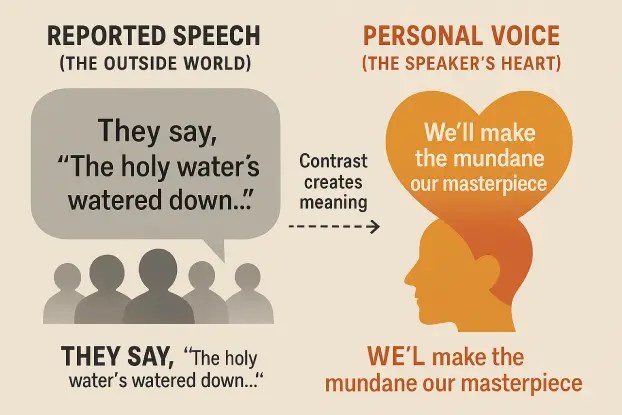
Reported Speech: (Telling Someone Else’s Story):
The song opens with “They say, ‘The holy water’s watered down…'”. This is such a fantastic and natural example of reported speech! It’s a perfect way to show our students how we quote what other people are thinking or saying, and it helps us see the difference between the outside world’s voice and the speaker’s own heart.
The First Conditional (Cause and Effect):
Then you have that powerful line, “if our time is runnin’ out… We’ll make the mundane our masterpiece”. He sets up a possible future event (if this happens…) and connects it to the result (…then this is what we’ll do). It’s ideal for teaching cause and effect in a way that feels emotional and real, not like a dry textbook example.
Present Continuous Tense (Action in the Moment)
Notice how often he uses the present continuous, like in “You’re takin’ me out of the ordinary”. Using that “-ing” form makes everything feel so immediate, like it’s happening RIGHT NOW. It gives the song incredible energy and pulls you right into the experience as it unfolds.
The Imperative Mood (Making a Powerful Plea)
When he sings “Shatter me with your touch… return me to dust”, he’s using the imperative. He’s not just making a suggestion; he’s making a powerful, dramatic plea. It’s a great way to show students how we use commands to express intense desire or complete surrender.
Metaphorical Comparisons (Stating a Deeper Truth)
The grammar in a line like “You’re the sculptor, I’m the clay” is actually very simple. He’s using the simple present tense (“You’re,” “I’m”) to state the metaphor as if it’s a fact. And by doing that, he makes the idea feel so much more powerful and true. It shows how simple structures can be used to build incredibly deep, figurative meaning.
So you see? When we look at it this way, we can show our students that grammar isn’t just about rules. It’s the key to unlocking the real emotion in the music. It’s a tool for expression, and that’s a lesson that goes way beyond the classroom.
Okay, so now that we’ve really explored the heart and soul of “Ordinary,” it’s time for the FUN part!
I want to share one highly creative idea I had for using this song with your B2 and C1 level students, based on my MUSIC+ Framework.
FREE ESL LESSON PLAN: “LYRICAL STORY WORLDS” (B2/C1)
ESL Song lesson Overview
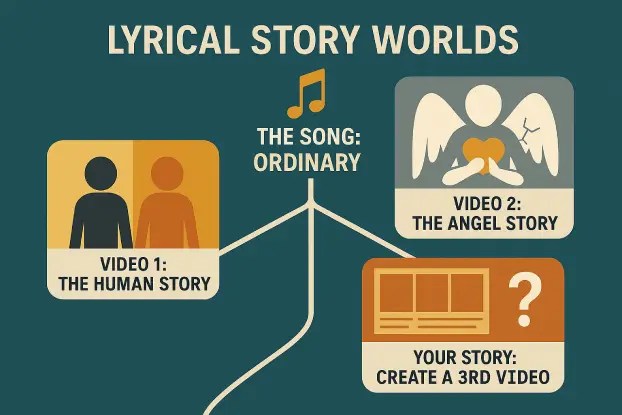
This is a highly visual and interpretive lesson that I call “Lyrical Story Worlds.” Imagine this: You start by showing your students two beautiful, silent animated shorts, each one telling a different story of transformation and connection. They compare the themes, and then you reveal that both videos were inspired by the same song.
They listen first for the feeling, the gist of it all, and then again with the lyrics, connecting the words to the stories they just saw. From there, you guide them through the song’s amazing figurative language, they debate which video is a more powerful interpretation, and then—the best part—they collaborate to create a concept for a THIRD video. The whole activity builds to the final reveal of the official music video, letting them compare all three artistic visions.
A Note on the BEAT+ Method: This lesson plan was crafted using the principles of the MUSIC+ Framework, a core pillar of my BEAT+ Method. This method is designed to give you a clear and practical system for transforming any song into a rich, effective, and truly engaging learning experience that your students will love. Click here to learn more about the full BEAT+ Method.
Details
- Language level: B2/C1 and above
- Learner type: Teens and Adults
- Skills: Listening (gist, detail), Speaking (discussion, comparison, debate), Reading (lyrics), Writing (summary), Vocabulary (figurative language), Critical Thinking, Interpretation.
- Topic: Love, transformation, connection, visual storytelling, figurative language, interpreting art.
- Language: Vocabulary related to emotions, transformation, and spiritual/religious imagery (e.g., holy water, altar, pray, hallelujah, sanctuary, dust, angels, black and white).
- Materials: Free Genially presentation including two animated short videos, the official music video for “Ordinary,” and lyrics.
- Duration: Approx. 60 minutes
Objectives
- Interpretation & Analytical Skills: Critically analyze and compare different visual narratives (animated shorts and music video) and connect them to lyrical themes.
- Language Skills Development: Enhance integrated skills: listening for gist and detail; speaking for discussion, comparison, and debate; reading for interpretation; and writing short summaries.
- Vocabulary Expansion: Understand and discuss the use of figurative and symbolic language, particularly religious imagery, in a non-religious context.
- Creative Synthesis: Collaborate to create and present a new interpretation of the song’s theme through storyboarding and summary writing.
Step-by-step Instructions
Step 1: The Initial Viewing – No Context (10 min)
Video Descriptions (for teacher reference):
- Video 1 (Human Story): A classic human story where the connection between two lonely people transforms their bleak, black-and-white world into a vibrant, colorful one.
- Video 2 (Angel Story): An inversion of the theme, where a perfect angel observes the raw power of human love and chooses to shatter his sterile perfection to experience it.
Show Video 1 (human story) without any introduction.
In pairs or small groups, have students discuss:
- What’s happening in the video?
- What is the main message or theme?
- How does the visual style (e.g., black and white vs. color) support the meaning?
Next, show Video 2 (angel story).
Have groups discuss the new video and compare it to the first:
- What similarities and differences do you notice between the two stories?
Step 2: Compare & Contrast (7 min)
Draw or display a Venn diagram on the board.
Instruct the groups to populate the diagram, comparing and contrasting the two videos. Elicit ideas and fill in the diagram for the whole class to see.
Teacher’s Reference / Example Answers:
- Similarities: Lonely character, transformation, symbolic catalyst (petal/look), a choice is made, discovery of something “extraordinary.”
- Differences: Earth vs. Heaven, Human vs. Angel, External vs. Internal change, Figurative vs. Literal symbolism.
Step 3: The Big Reveal & First Listen (13 min)
Part A: The Reveal (1 min)
Tell students: “These two very different stories were both inspired by the same song.” Allow their curiosity to build.
Part B: First Listen (Listening for Gist) (4 min)
Give the instruction: “We’re going to listen to the song now. What does the song feel like? Which video does it resemble more in tone or emotion?”
Play the audio for “Ordinary” once.
Part C: Second Listen (Listening for Detail) (8 min)
Distribute the lyrics sheet (or slide 4 of the genially presentation).
Give the instruction: “Now, we’ll listen again. This time, underline any lines that feel powerful or that remind you of something from the two videos.”
Play the song a second time.
Step 4: Connecting the Dots (10 min)
Part A: Vocabulary Focus (5 min)
In groups, have students focus on the song’s use of spiritual and religious imagery.
Ask them to discuss what these words suggest emotionally: Holy water, altar, pray, hallelujah, sanctuary, dust, angels.
Prompt a brief class discussion: “Why would the songwriter use religious language to describe a relationship?”
Part B: Lyric-to-Video Interpretation (5 min)
Assign each group a different line or short section from the lyrics.
Their task is to analyze: What does this line mean? How is it represented in both videos?
Examples for teacher guidance:
- Lyric:“The angels up in the clouds are jealous…”
- Video 1: A metaphor for intensely beautiful human love.
- Video 2: A literal depiction of an angel being jealous.
- Lyric:“My world was in black and white…”
- Video 1: The world literally changes from grayscale to color.
- Video 2: A figurative description of the angel’s sterile, emotionless world.
Step 5: Creative Output & Synthesis (15 min)
Part A: Debate (4 min)
Pose the prompt for a whole-class debate or structured group discussion: “Which of the two animated videos is a more powerful interpretation of the song? Why?”
Part B: Creative Writing & Storyboarding (6 min)
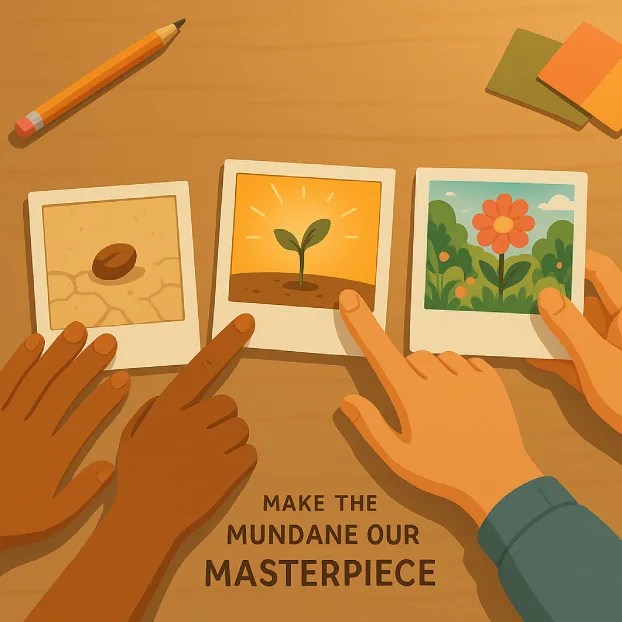
Set the task: “Imagine a third video based on this song. What’s the story?”
In groups, students must:
- Write a short summary of their new video concept (5–6 sentences).
- Create a simple 3–4 frame storyboard illustrating the key moments.
- Choose one line from the song to be their video’s tagline.
Part C: Presentations (5 min)
Have each group briefly present their third video concept to the class, explaining their storyline and how their chosen tagline connects to the song’s theme.
Step 6: The Official Video Reveal & Synthesis (5 min)
Part A: The Reveal (2 min)
Tell the class: “You’ve all just acted as directors and lyric interpreters. Now, let’s watch how the artist himself tells this story. This is the official music video, which features the artist Alex Warren and his wife, Kouvr.”
Play the official music video for “Ordinary.”
Part B: Final Synthesis Discussion (3 min)
Lead a final class discussion with these prompts:
- How does the official video’s story compare to the themes in the animated shorts?
- Does the official video change your mind about which version is the most powerful?
- Which of the three versions (animated 1, animated 2, or official) best captures the feeling of being “taken out of the ordinary”?
Conclusion
So there you have it! A deep dive into the heart and SOUL of Alex Warren’s “Ordinary.”
You now know that IT IS POSSIBLE to go beyond the dreadful gap-filling activity and create a full and meaningful lesson plan with a song that your students already love. My hope is that this analysis and the “Lyrical Story Worlds” activity will get your students not just practicing their English, but putting their own creative and critical thinking skills into high gear!
When we use songs this way, we’re doing more than just teaching. We’re connecting with our students on a deeper level. We’re showing them how to find the meaning behind the words and helping them find their own voices.
Aim to be fluent not only in English, but also in the language of your own SOUL. There is no telling how far you can go or how many people’s lives you can help this way!
That’s it for this week. I hope these ideas can help you in your life! Happy teaching!
Did you enjoy this creative approach? This lesson is a real-world example of the principles from my complete methodology. To dive deeper into the MUSIC+ Framework and discover more strategies, check out my complete guide: How To Use Songs To Teach English.
Frequently Asked Questions (FAQ)
How do you use popular songs to teach English creatively?
Start by choosing a song with strong themes and metaphors, like “Ordinary.” Instead of gap-fills, create tasks that require interpretation, like asking students to visualize the lyrics, debate the song’s message, or create their own story based on the theme.
What are good song activities for teaching vocabulary to teens?
Focus on figurative language and idioms within the lyrics. Have teens match metaphors like “You’re the sculptor, I’m the clay” to their meanings, or ask them to rewrite poetic lines in simple English. This makes song activities for teaching English vocabulary more engaging.
How can song-based ESL activities engage reluctant students?
Use songs your students already know and love to lower their anxiety. Interactive song activities that involve group work, visual interpretation, and creative tasks can motivate students who are hesitant to speak.
Can I adapt this song activity for lower-level ESL students?
Yes. For A2/B1 levels, simplify the task. Focus on more concrete vocabulary and have them identify the main emotions in the song. You could ask them to draw the “black and white” world and the “colorful” world described in the lyrics.
What 21st-century skills does this ESL song activity teach?
This lesson plan focuses directly on song activities for teaching English 21st century skills . Students practice critical thinking (analyzing videos), creativity (designing a new concept), collaboration (group work), and communication (discussion and debate).
How can I use this song to improve English speaking skills?
Use the lesson’s debate and discussion prompts to foster conversation. The creative task where students present their video concept is a perfect, low-pressure way to practice presentation and English speaking skills.
Author Bio:
About the Author:Márcia Bonfim is an ESL/EFL teacher and creator of the Song Activity Factory. She helps educators create engaging lessons using her signature BEAT+ Method, which features the MUSIC+ Framework. You can discover her complete methodology summary here.
 Song Activity Factory
2 comments