⚡ Textbook Rescue: The 20-Min Reported Speech Kit
- Media / Artist: Amy Grant
- Target Level: C1 (Teens and Adults)
- Duration: 20 Minutes (The “Espresso Shot” Format)
- Grammar Focus: Reported Speech
- Key Outcome: Students apply complex reported speech structures to mediate subjective viewpoints and analyze symbolic contrasts.
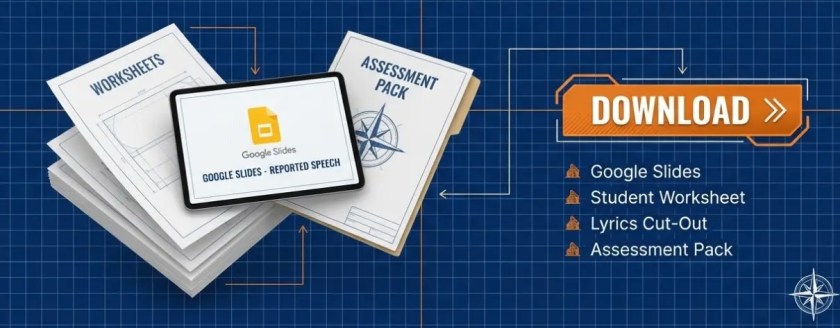
- Materials: Google Slides, Student Worksheet, Lyrics Cut-Out, and Assessment Pack
Featured Song (used in this lesson)
There’s a moment every experienced teacher recognizes.
You walk into a C1 class — teens or adults, sharp, capable, already fluent enough to be dangerous — and you mention a song lesson.
The reaction isn’t enthusiasm.
It’s polite tolerance.
They’re not rejecting music.
They’re rejecting low cognitive demand.
At advanced levels, students don’t disengage because lessons are “too fun.”
They disengage because the task architecture doesn’t respect their thinking.
The Real Problem Isn’t Songs — It’s the Old Model
Most song-based lessons still follow the same inherited sequence:
listen → worksheet → check answers
Even when the song is meaningful, the instructional design remains shallow.
Lyrics become gap-fills.
Grammar becomes backshifting drills.
Discussion stays at “Do you like it?” level.
Music becomes atmosphere — not text.
This isn’t a teacher failure.
It’s a system design limitation — one reason the 🌍 Pedagogical Song Index (2026) exists: to help teachers select music as structured input, not background entertainment
Advanced learners can get the gist without engaging the language. And once they do, the lesson is cognitively over.
Songs don’t fail at C1.
Design does.
The Pedagogical Shift: From Activities to Learning Architecture
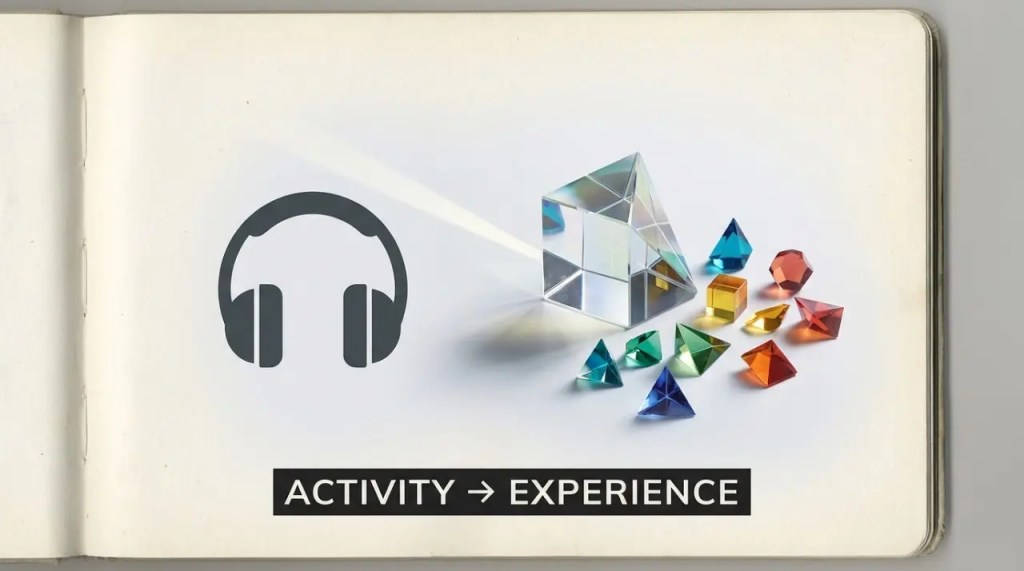
High-level ELT is moving away from activities and toward experience-based learning design.
Old Model → New Model
- activity-based → experience-based
- listening check → communicative mediation
- grammar target → skill integration
- worksheet → interaction design
- music as fun → music as cognitive input
At C1, songs must function as complex texts, not entertainment.
That’s the reframe.
The Hidden Instructional Layers Behind a Strong Song Lesson
A song lesson that works at C1 isn’t “creative.”
It’s engineered.
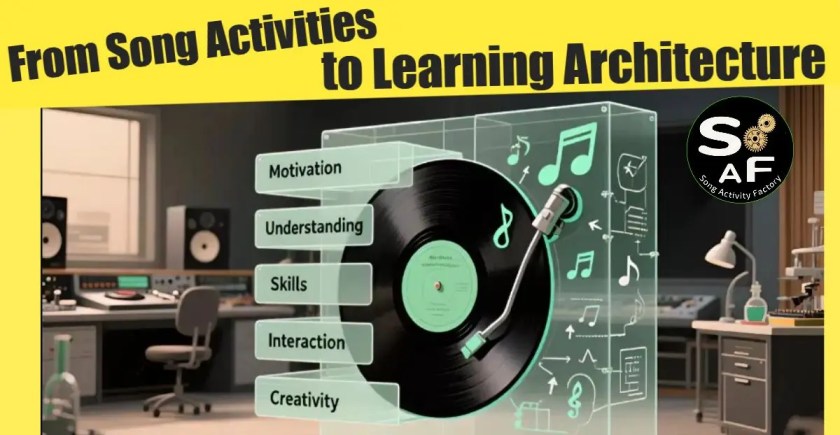
Effective lessons activate multiple layers at once:
- Motivation layer – emotional + conceptual hook
- Understanding layer – meaning before form
- Skill activation layer – grammar as a communicative tool
- Interaction design layer – structured reasoning, not opinion-sharing
- Creative output layer – pushed, justifiable expression
This is the architecture behind the lesson below.
C1 Reported Speech as Meaning-Making
Amy Grant – “The 6th of January”
Most C1 lessons treat reported speech as a technical rule.
This one treats it as a lens for understanding memory, identity, and generational change.
Using Amy Grant’s “The 6th of January,” students explore how language retells the past from the perspective of the present.
As they listen and mediate the singer’s reflections, they see how reported speech creates:
- distance
- reinterpretation
- emotional perspective
The lesson moves beyond backshifting drills and into meaning.
Learners connect cultural memory, lost ideals, and modern reality while developing the ability to report complex viewpoints with nuance and control — a core C1 skill.
Lesson Snapshot
Level: C1
Learners: Teens & Adults
Primary Skill: Writing
Secondary Skills: Listening, Speaking & Interaction
Subskills: Prediction, Listening for Detail, Discussion, Mediation, Creative Writing
Grammar Focus: Reported Speech
Themes: Counterculture, Consumerism, Historical Memory
Duration: 20 minutes
Materials:
👉 Google Slides
👉 Student Worksheet
👉 Lyrics Cut-Out
👉 Assessment Pack
Learning Objectives
By the end of the lesson, students will be able to:
- analyze symbolic contrasts between historical counterculture and modern consumer environments
- apply complex reported speech structures to mediate subjective viewpoints
- synthesize auditory and visual narratives to track shifts in cultural identity
- sustain high-level discussion on collective disillusionment using rhetorical prompts
Step-by-Step Lesson Flow (20 Minutes)
Here’s the lesson flow overview. The downloadable PDF includes full teacher notes, ready-to-use materials, and implementation support.
Step 1 – Motivation+ & Understanding+ (3 min)
What students do
Students examine two images: a 1969 festival crowd and a modern, empty supermarket aisle. They discuss which image feels more like a “dream” and imagine how someone might try to find their way back to the past if they felt lost in the present.
Why it works
This establishes emotional and conceptual grounding before listening. Students enter the song already thinking about memory, loss, and perspective.
Step 2 – Understanding+ & Skills+ (7 min)

What students do
Students listen to the first part of the song and identify three narrative spaces:
- the mind
- a store
- a road
They match the “ghosts” or memories the singer encounters to each location.
Why it works
Narrative clarity reduces cognitive overload and prepares students to notice how language constructs meaning.
Step 3 – Skills+ & Understanding+ (3 min)
What students do
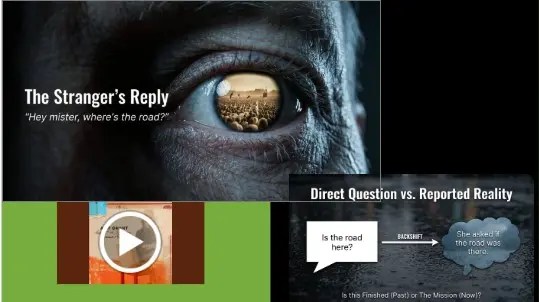
Students focus on the dialogue with the older man and rewrite his words using reported speech:
Subject + reporting verb + (that) + past / past perfect
Why it works
Reported speech stops being a form exercise.
It becomes a tool for interpreting memory and history.
Step 4 – Interaction+ & Creativity+ (5 min)
What students do
In groups, students debate possible ways the character could move forward. Using structured prompts, they justify which path makes the most sense — preparing them for the writing task.
Why it works
Students reuse thematic language spontaneously and bridge spoken reasoning into written mediation.
🎵 Optional Encore: Play the full song for enjoyment once discussion ends.

Assessment With a Soul: Measuring Thinking, Not Just Answers
This assessment approach is part of my broader Assessment With Songs methodology, designed to evaluate mediation, reasoning, and communicative control — not isolated language points.
One reason teachers hesitate to use songs is simple:
“How do I assess this?”
This lesson includes a full Assessment Pack: Mediating the Dream.
It doesn’t test recall.
It evaluates how students:
✔ interpret meaning
✔ connect past and present
✔ justify viewpoints
✔ use reported speech communicatively
The Summative Task
Students complete the Dream Mediation Mission — a short written explanation of how they would mediate the situation in the song.
The rubric focuses on:
- coherence of ideas
- effective reported speech
- critical justification
- creativity and insight
Language and thinking are assessed together — as they should be at C1.
Ongoing Assessment
- Reported Reality Checks
- Path Proposer Justifications
- Connection Compass Exit Ticket
Students also complete a self-assessment to reflect on readiness and language control.
Why This Works
From a learning science perspective, this lesson:
- activates deeper processing
- increases retention
- lowers affective filters
- promotes transfer to writing and discussion
- supports real communicative performance
This is not “using a song.”
It’s designing a learning environment.
This lesson sits within the ⚡ Textbook Rescue Series – BEAT+ Singles, where songs are treated as compact learning architectures rather than full thematic units. Each “single” is designed for high-pressure classroom moments — short, focused, and cognitively demanding — without sacrificing depth or meaning
What This Means for Teachers
C1 teaching isn’t about finding better materials.
It’s about shifting roles:
- from content deliverer
- to learning architect
Songs, texts, tools, and tasks become components of a system — not isolated ideas.
Final Thought
Modern ELT is no longer about choosing engaging resources.
It’s about designing richer cognitive and emotional learning architectures.
When we treat music as a serious text,
advanced learners rise to meet it.
What You’re Getting (Free)
Download the Free Instructions PDF, including:
👉 Google Slides
👉 Student Worksheet
👉 Assessment Pack
DOWNLOAD THE PDF (Direct Access)
No registration required. Just click and save.
Author Bio
About the Author
Márcia Bonfim is an ESL/EFL teacher and the creator of Song Activity Factory. She helps educators design cognitively engaging lessons using her signature BEAT+ Method, built around the MUSIC+ Framework.
Her work focuses on transforming songs from “fun extras” into structured learning systems that develop real communicative performance at higher levels.
 Song Activity Factory