Lesson at a Glance: Past Continuous vs. Present State with Mike Posner
- Media / Artist: Mike Posner (“I Went Back To Ibiza”)
- Target Level: B1 – Teens and Adults
- Duration: 60 minutes
- Language Focus: ESL Song Lesson Plan (Past Continuous vs. Present State)
- Key Outcome: Generate creative digital content that synthesizes a life update using modern 2026 influencer formats.
- Materials: Google Slides, Student Worksheet, Lyric Sheet Cut Out, and Assessment Pack.
- Framework: BEAT+ Method and MUSIC+ Framework
Where Timeline Lessons Break Down
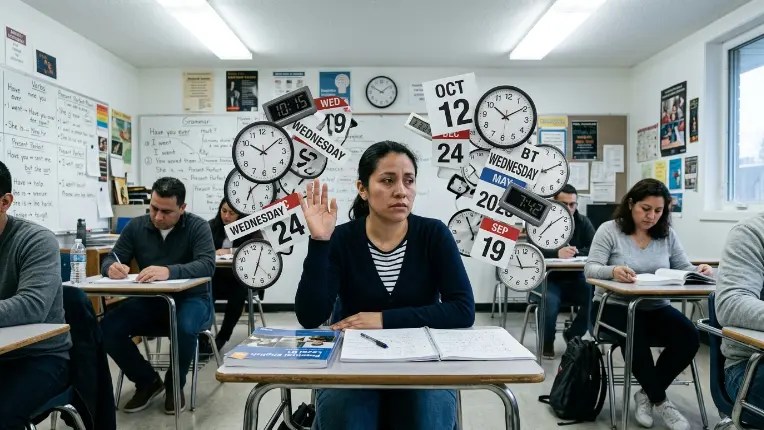
You walk into a B1 class and present a textbook drill on past continuous versus present states. You expect chronological clarity. Instead, your students stare back in polite confusion, mixing up tenses randomly.
Tense confusion in a B1 classroom is never a language problem. It’s a task design failure.
The primary source of this difficulty is abstract language without context. Traditional materials ask learners to contrast what they were doing yesterday with what they are doing today.
These low-stakes tasks feel meaningless. This fails to create any meaningful decision pressure for your learners.
Why This Keeps Happening
You spend hours fighting correction fatigue to build a seamless grammar presentation. Yet, the energy evaporates instantly when the timeline practice begins. It is incredibly easy to internalize this hesitation as a personal failure.
This is not your fault. It is a design flaw.
Traditional materials force students to map timelines with no real consequences. The task fails because the system allows it to fail.
To bypass this friction, we use “I Went Back To Ibiza” by Mike Posner. It reframes abstract grammar into a high-stakes narrative system.
The lyrics explore the contrast between past destructive decisions and present sobriety. The song creates immediate tension by forcing learners to compare past actions with present states..
The target language only emerges because of that specific tension. Without the song, the task would lose its power entirely. This is a song-driven learning system, not a standard lesson with a song added.
Inside the Turning Point
The execution begins conceptually by asking students to analyze a blind dossier of a celebrity’s past trauma. The task escalates as they predict if the upcoming song is a genuine apology or a strategic PR move.

When the audio plays, students lean in closely. Not because the melody is catchy—but because they spot the grammatical mismatch. That is the turning point.
Students are forced to perform a linguistic audit. They correct a PR team’s false formal transcript into the exact past continuous and present state verbs heard on the track.
This creates a moment where learners translate chronological facts into a narrative timeline. Finally, they synthesize their debate into a four-sentence public accountability release.
How Controlled Autonomy Organizes Sequence
The secret engine driving this lesson is Controlled Autonomy. This is a structured, repeatable system built on the MUSIC+ Framework.
We isolate learners into a Press Room team with strategic discourse roles. The PR Agent anchors theories in past continuous syntax. The Biographer challenges the semantic assumptions using evidence board phrases.
This invisible mechanism organizes timeline confusion into sequence. It stabilizes their chronological mapping because they must deploy target syntax to structure a public accountability statement. Without this structured pressure, the task collapses into random tense guessing.
Assessment With a Soul & Institutional Rigor
We evaluate their work using a mathematical constraint-based micro-writing system. Students must write exactly four sentences using the target grammar.
This guarantees Assessment with a Soul. The grammar emerges naturally, completely removing the need for heavy correction.
To satisfy institutional demands, we deploy an Extended Portfolio homework module. Students expand their short in-class accountability statement into a 150-word narrative entry.
The rigor is preserved. The cognitive load is redistributed.
Access the Complete Lesson Assets For Free
When you use authentic media to displace the vulnerability, you don’t have to force engagement. You don’t need to build this from scratch, either. I’ve mapped out this complete 60-minute lesson.
About the Author
Márcia Bonfim is an ESL/EFL teacher and the creator of Song Activity Factory. She helps educators design cognitively engaging lessons using her signature BEAT+ Method, built around the MUSIC+ Framework. Her work focuses on transforming songs from “fun extras” into structured learning systems that develop real communicative performance at higher levels. 👉 You can explore a full overview of her methodology here.

