
Strategy Insights: The Understanding Principle (U in MUSIC+)
- Main Concept: Building a comprehension “home” for language. Instead of isolated lists, songs provide a living environment where vocabulary and grammar are tied to human stories.
- Key Framework: The Three Pillars of Understanding
- Context: Using the flow of a song to make grammar and phrasal verbs “stick” through narrative purpose.
- Culture: Treating lyrics as windows into global perspectives and different ways of living.
- Emotion: Tapping into the neurological power of melody to lower anxiety and create lasting memories.
- Teacher Benefit: Saves energy by replacing repetitive drilling with authentic purpose. It transforms the teacher from a lecturer into a facilitator of “lightbulb moments.”
The Five-Tool Toolkit for Active Interpretation
| Activity | Core Focus |
|---|---|
| Musical Insights | Prediction, guessing missing words, and emotional reflection. |
| Lyrical Reading | Analyzing lyrics as poetry/literature before hearing the melody. |
| Word Connections | Building vocabulary networks through association games and debates. |
| Watch & Catch | High-energy competition matching visual cues to language elements. |
| Musical Neighborhood | World-building by assigning songs to specific physical environments. |
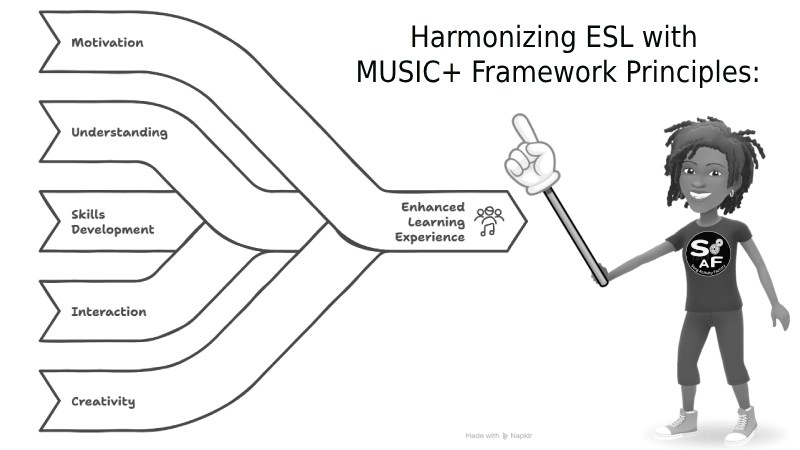
Hello there, English teachers! If you’ve been following our blog series, you know we’ve already introduced the MUSIC+ framework and explored our first principle: Motivation. The students are hooked, they’re engaged, and the energy is there. But what happens next?
We’ve all seen it. That initial excitement can quickly turn into frustration if students feel lost or overwhelmed. That great energy we built can hit a wall of confusion, and then… it’s gone.
This is precisely why the second principle in the MUSIC+ framework is so critical. It’s the bridge over that wall. It’s all about creating UNDERSTANDING.
Would you like to watch a video instead of reading this blog post? Enjoy:
Why Understanding Matters in Music-Based Learning
Understanding is so much more than just knowing the words on a page, isn’t it?
It’s about our students truly hearing a song and connecting with the heart behind it. Let’s face it, songs aren’t just catchy tunes; they are packed with culture, with real emotion, and with the kind of authentic language they’ll never find in a textbook.
The real magic happens in that moment a student hears a line and has that flash of recognition… that feeling of, “I know what that means!” Not because they translated it word-for-word, but because they actually felt it.
This is why we have to move beyond simple, passive listening. With interactive song activities, we spark a different kind of engagement. We’re moving from just hearing the music to active, thoughtful learning. We’re building a kind of comprehension that lasts because it’s rooted in these three key elements:
1. Context: Language That Lives

Think about it. When we teach vocabulary or grammar straight from a textbook, the life is often stripped right out of it. It’s just a list of words.
We’ve all seen our students memorize a phrasal verb like “give up” for a test, but what happens a week later? Let’s be honest, it’s usually gone. But then they hear that SAME phrase in the powerful chorus of a song, tied to a real emotion, a story, a melody… and suddenly, it connects. It has a place to live in their minds.
That’s because songs show how language is meant to flow. They show that grammar isn’t just a set of boring rules—it’s about REAL expression, real feeling. This is how our students start to see that English isn’t just a school subject; it’s a living part of the world.
And for us teachers? It saves so much time and energy! This kind of learning is far more effective than repetitive drilling, and it makes new language memorable because it’s being used with authentic purpose.
2. Culture: Windows to the World

Let’s remember, a song is so much more than just words and a melody. Every single one tells a story.
Inside those lyrics, we find a window into another person’s world, into their heart and soul. A simple line in a pop song can open up a huge conversation about relationships, identity, humor, or even the politics of another culture.
And when our students explore these messages, let’s be honest, we’re not just ‘teaching English’ anymore. We are helping them learn to see the world through someone else’s eyes.
By working together to understand these different stories, they start to build something so much deeper: real empathy and the ability to collaborate. They are preparing themselves for a world full of different perspectives. In the end, songs simply help our students understand how different people live, feel, and think.
3. Emotion: Feel It to Learn It
Isn’t it amazing? You can probably still sing a song from your childhood, but that grammar rule from last Tuesday’s class? Poof. Gone.
That’s the incredible power of emotion and melody. It’s not an accident. When we tie words to a rhythm, to music, to a real human feeling, we’re connecting with our students on a whole different level—mind, heart, and soul.
A song about heartbreak, for example, doesn’t just teach vocabulary; it places that vocabulary inside an experience our students can actually feel.
This is where the deep connection happens, creating those lasting memories that make the language stick. I’ve seen it so many times… even the shyest students, the ones who struggle with traditional work, start to open up when a real emotion enters the room.
Music brings a truly human energy into the classroom. It lowers that wall of anxiety and helps students build their listening and speaking skills in a way that is, for them, deeply personal and meaningful.
Practical and Creative Song Activities for ESL Classrooms to Enhance Understanding
Here are five of my favorite activities to bring the Understanding principle to life:
1- Musical Insights
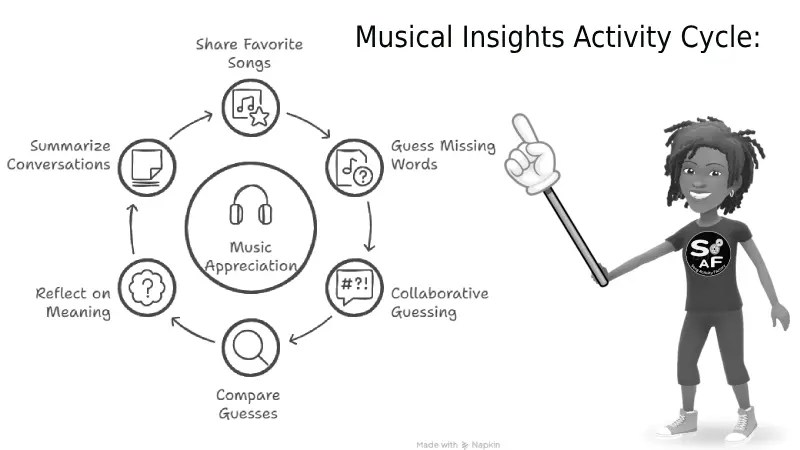
This full lesson brings lyrics to life through curiosity, prediction, and emotional reflection:
- Start by sharing one of your favorite songs and why you like it, then ask students to do the same
- Show a verse from a song with missing words and have students guess what’s missing based on context
- Repeat with a second verse, but have students work in pairs
- Play the actual song and let students compare their guesses
- Go deeper: What do they like? Who might enjoy this song and why? When would they listen to it?
- Have students write brief summaries of their conversations
This activity isn’t just about understanding lyrics; it’s about understanding how students connect to music and make meaning. This kind of interactive learning is ideal for teaching English listening skills, helping students sharpen prediction, interpretation, and critical thinking while staying fully engaged.
Related song-based ESL Resources:
For a detailed lesson plan and printable resources for this activity, check out the full blog post on [Musical Insights: How to Teach English with Pink’s “All Out of Fight”: A Fun Lesson Plan]
2- Lyrical Reading
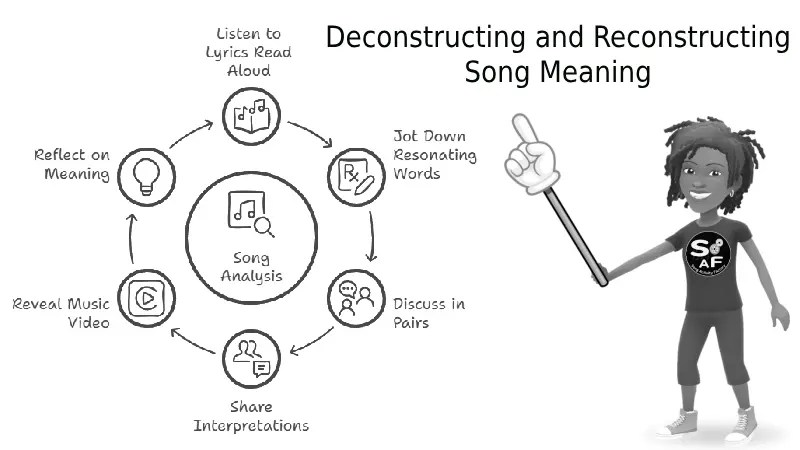
This activity peels back the layers of a song to uncover its core message:
- Play the lyrics read aloud like a poem, without melody
- Have students jot down words or phrases that resonate
- Students discuss in pairs to piece together the song’s message
- Teams share interpretations and guess the genre
- Reveal the actual music video
- Ask reflective questions: Does the singer sound hopeful? Is the message positive?
By separating lyrics from music, students see how melody influences meaning, and by reconnecting the two, they discover how art and language intertwine.
Related song-based ESL Resources:
For a detailed lesson plan and printable resources for this activity, check out the full blog post on [Lyrical Reading: Em Beihold – Nobody Else]
3- Musical Word Connections
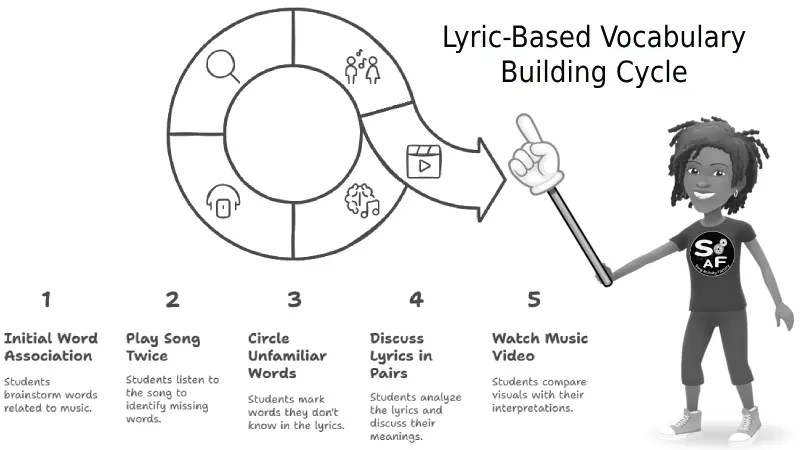
This activity turns lyrics into a playground for vocabulary building:
- Start with a simple question: “What’s the first thing that comes to mind when you hear the word ‘music’?”
- Have students play a word association game in small groups
- Play the song twice and ask students to identify which word from their game isn’t in the lyrics
- Project the lyrics as the song plays again, having students circle unfamiliar words
- In pairs, students tackle deeper questions about the song, using lyrics as evidence
- Watch the music video and debate if the visuals match their interpretations
This activity helps students weave vocabulary into networks of meaning.
Related song-based ESL Resources:
For a detailed lesson plan and printable resources for this activity, check out the full blog post on [Musical Word Connections: James Blunt]
4- Watch and Catch
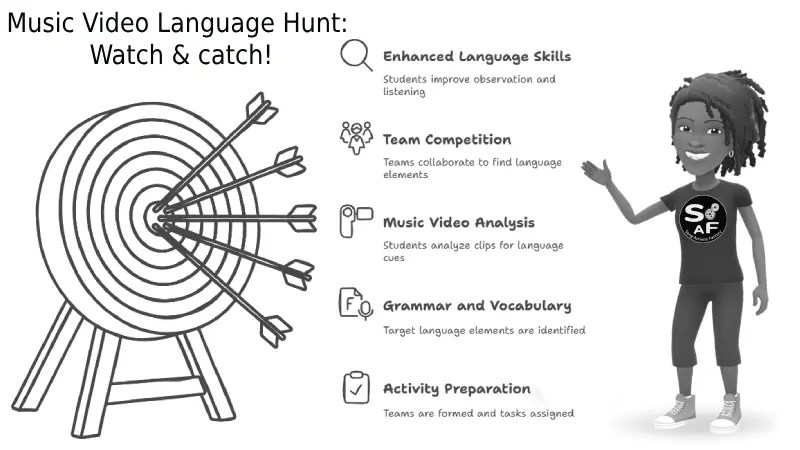
This high-energy team competition sharpens observation and listening skills:
- Divide students into teams and assign them to spot specific language elements in music videos
- Display target grammar and vocabulary on the board and brainstorm examples
- Play each clip three times while teams note visual cues and phrases
- Teams reveal their findings and explain their choices
- Award points for correct answers
This activity helps students practice listening under pressure and connect language to visual context.
Related song-based ESL Resources:
For a detailed lesson plan and printable resources for this activity, check out the full blog post on [Watch & Catch: ESL Lesson with Chart-Topping Music Videos]
5- Musical Neighborhood
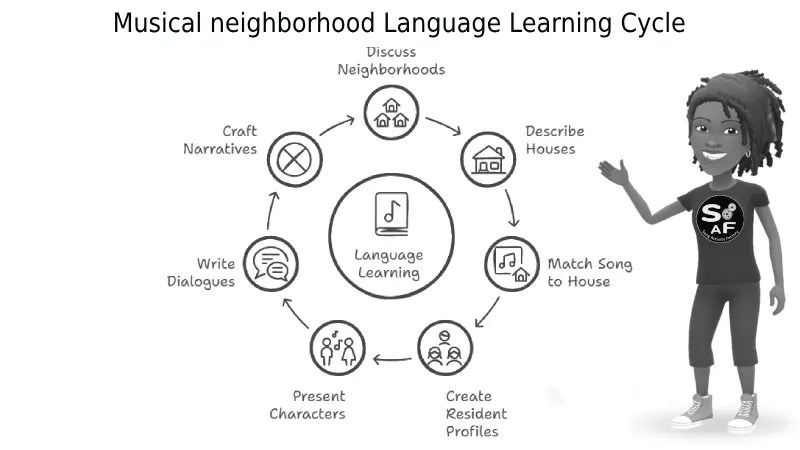
This activity weaves lyrics into real-world contexts:
- Start by discussing neighborhoods and living environments
- Project images of three distinct houses and have students describe them
- Play a song and ask students to decide which house fits the song’s mood
- Have pairs create detailed profiles for fictional residents
- Students present their characters and analyze the song’s vocabulary and themes
- Partners write dialogues between residents from different houses
- Assign homework where students craft narratives where residents cross paths
This activity builds worlds with words, helping students live the language rather than just learn it.
Related song-based ESL Resources:
For a detailed lesson plan and printable resources for this activity, check out the full blog post on [Musical Neighborhood: Coldplay’s ‘Humankind’]
Moving From Passive Listeners to Active Interpreters
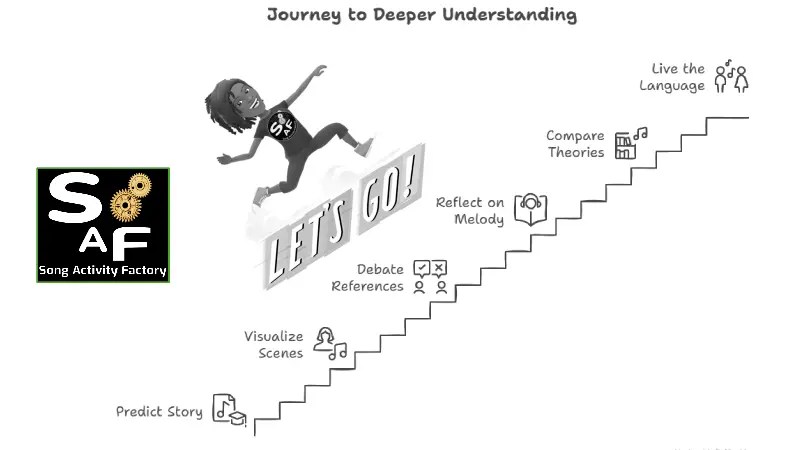
Understanding isn’t a checkbox; it’s a journey. When students treat songs as stories, they unlock deeper meaning in every lyric. They dissect narratives, uncover hidden emotions, and connect themes to their own lives.
Deeper learning thrives on multimodal engagement:
- Visualizing scenes from lyrics
- Debating cultural references in pairs
- Reflecting on how melodies amplify a song’s message
Incorporating these strategies not only saves teachers time but also empowers students to build multiple skills simultaneously—listening, speaking, reading, and writing—making lessons more effective and engaging.
Ready to try it? Start small—pick a song, ask students to predict the story before listening, then compare their theories to the lyrics. Notice how curiosity fuels deeper engagement. Adapt, iterate, and watch passive learners become powerful interpreters.
When understanding becomes an experience, language isn’t just learned; it’s lived.
Stay tuned as the next installment in the MUSIC+ Framework will be here soon! Next, in the principle 3: Skills, you will discover how songs can enhance listening, speaking, reading, and writing skills, with tailored activities for each.
Want to Bring Flow Into Your Classroom?
Don’t stop here! Explore the power of songs to transform your ESL classroom.


 Song Activity Factory
One comment