Lesson at a Glance: Alex Warren’s Ordinary
- Media / Artist: Alex Warren
- Target Level: B2 / C1
- Duration: 60 minutes
- Language Focus: ESL Song Lesson Plan (MUSIC+ Framework)
- Key Outcome: Students will critically analyze visual narratives, interpret figurative/religious imagery, and collaborate to storyboard a new creative interpretation.
- Materials: Genially presentation, Animated short videos, Official music video, Lyrics
Have you ever felt the pulse of a powerful song and just KNEW it could be something more in your class? Something with more soul, more purpose, more life than just another predictable gap-fill? If you’ve ever struggled to find song-based lesson plans that truly connect with your students, this one is for you.
This post is a gift from my heart to yours. It’s a powerful, creative song activity for the ESL classroom called “Lyrical Story Worlds,” designed not just to teach, but to awaken. It’s here to help you engage your B2/C1 teens and adults, build their critical thinking skills, and create a TRULY memorable learning experience. It’s a perfect example of how to teach English with music in a way that is overflowing with meaning, energy, and JOY.
What is the “Lyrical Story Worlds” Activity?
So, what is this journey we’re about to embark on?
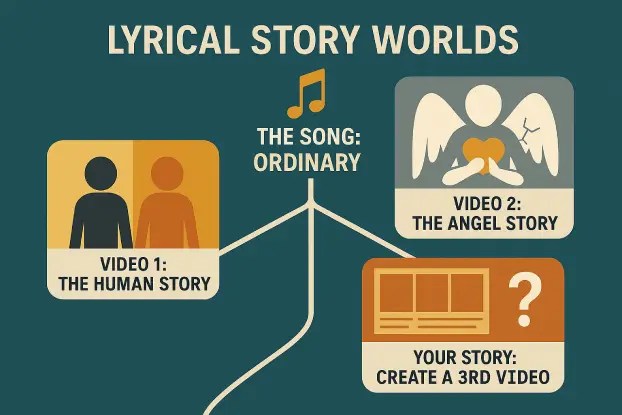
Imagine this: You press play, and your students watch two different silent animated videos. Each one tells a unique and beautiful story of transformation. They are captivated, right? But then, the real magic begins. You reveal that both of these visual worlds were inspired by the very same song: Ordinary by Alex Warren (for a full ESL Song Analysis see here).
Can you feel that shift in energy? That spark of curiosity?
Suddenly, they are no longer just passively learning; they are detectives of meaning. This discovery opens a door for them to analyze lyrical themes, passionately debate artistic interpretations, and even step into their own creative power by designing a concept for a third video themselves. It’s about seeing how one single song can paint a thousand different pictures. It’s about celebrating the unlimited potential within art and within each of our students.
ESL Song lesson Overview
This is a highly visual and interpretive lesson that I call “Lyrical Story Worlds.” Imagine this: You start by showing your students two beautiful, silent animated shorts, each one telling a different story of transformation and connection. They compare the themes, and then you reveal that both videos were inspired by the same song.
They listen first for the feeling, the gist of it all, and then again with the lyrics, connecting the words to the stories they just saw. From there, you guide them through the song’s amazing figurative language, they debate which video is a more powerful interpretation, and then—the best part—they collaborate to create a concept for a THIRD video. The whole activity builds to the final reveal of the official music video, letting them compare all three artistic visions.
A Note on the BEAT+ Method: This lesson plan was crafted using the principles of the MUSIC+ Framework, a core pillar of my BEAT+ Method. This method is designed to give you a clear and practical system for transforming any song into a rich, effective, and truly engaging learning experience that your students will love. Click here to learn more about the full BEAT+ Method.
Details
- Language level: B2/C1 and above
- Learner type: Teens and Adults
- Primary Skill: Integrated Skills
- Secondary Skills: Speaking & Interaction, Writing
- Subskills: Listening for Gist, Interpretation, Creative Writing
- Topic: Love, transformation, connection, visual storytelling, figurative language, interpreting art.
- Language: Vocabulary related to emotions, transformation, and spiritual/religious imagery (e.g., holy water, altar, pray, hallelujah, sanctuary, dust, angels, black and white).
- Materials: Free Genially presentation including two animated short videos, the official music video for “Ordinary,” and lyrics.
- Duration: Approx. 60 minutes
Objectives
- Interpretation & Analytical Skills: Critically analyze and compare different visual narratives (animated shorts and music video) and connect them to lyrical themes.
- Language Skills Development: Enhance integrated skills: listening for gist and detail; speaking for discussion, comparison, and debate; reading for interpretation; and writing short summaries.
- Vocabulary Expansion: Understand and discuss the use of figurative and symbolic language, particularly religious imagery, in a non-religious context.
- Creative Synthesis: Collaborate to create and present a new interpretation of the song’s theme through storyboarding and summary writing.
Step-by-step Instructions
Step 1: The Initial Viewing – No Context (10 min)
Video Descriptions (for teacher reference):
- Video 1 (Human Story): A classic human story where the connection between two lonely people transforms their bleak, black-and-white world into a vibrant, colorful one.
- Video 2 (Angel Story): An inversion of the theme, where a perfect angel observes the raw power of human love and chooses to shatter his sterile perfection to experience it.
Show Video 1 (human story) without any introduction.
In pairs or small groups, have students discuss:
- What’s happening in the video?
- What is the main message or theme?
- How does the visual style (e.g., black and white vs. color) support the meaning?
Next, show Video 2 (angel story).
Have groups discuss the new video and compare it to the first:
- What similarities and differences do you notice between the two stories?
Step 2: Compare & Contrast (7 min)
Draw or display a Venn diagram on the board.
Instruct the groups to populate the diagram, comparing and contrasting the two videos. Elicit ideas and fill in the diagram for the whole class to see.
Teacher’s Reference / Example Answers:
- Similarities: Lonely character, transformation, symbolic catalyst (petal/look), a choice is made, discovery of something “extraordinary.”
- Differences: Earth vs. Heaven, Human vs. Angel, External vs. Internal change, Figurative vs. Literal symbolism.
Step 3: The Big Reveal & First Listen (13 min)
Part A: The Reveal (1 min)
Tell students: “These two very different stories were both inspired by the same song.” Allow their curiosity to build.
Part B: First Listen (Listening for Gist) (4 min)
Give the instruction: “We’re going to listen to the song now. What does the song feel like? Which video does it resemble more in tone or emotion?”
Play the audio for “Ordinary” once.
Part C: Second Listen (Listening for Detail) (8 min)
Distribute the lyrics sheet (or slide 4 of the genially presentation).
Give the instruction: “Now, we’ll listen again. This time, underline any lines that feel powerful or that remind you of something from the two videos.”
Play the song a second time.
Step 4: Connecting the Dots (10 min)
Part A: Vocabulary Focus (5 min)
In groups, have students focus on the song’s use of spiritual and religious imagery.
Ask them to discuss what these words suggest emotionally: Holy water, altar, pray, hallelujah, sanctuary, dust, angels.
Prompt a brief class discussion: “Why would the songwriter use religious language to describe a relationship?”
Part B: Lyric-to-Video Interpretation (5 min)
Assign each group a different line or short section from the lyrics.
Their task is to analyze: What does this line mean? How is it represented in both videos?
Examples for teacher guidance:
- Lyric:“The angels up in the clouds are jealous…”
- Video 1: A metaphor for intensely beautiful human love.
- Video 2: A literal depiction of an angel being jealous.
- Lyric:“My world was in black and white…”
- Video 1: The world literally changes from grayscale to color.
- Video 2: A figurative description of the angel’s sterile, emotionless world.
Step 5: Creative Output & Synthesis (15 min)
Part A: Debate (4 min)
Pose the prompt for a whole-class debate or structured group discussion: “Which of the two animated videos is a more powerful interpretation of the song? Why?”
Part B: Creative Writing & Storyboarding (6 min)
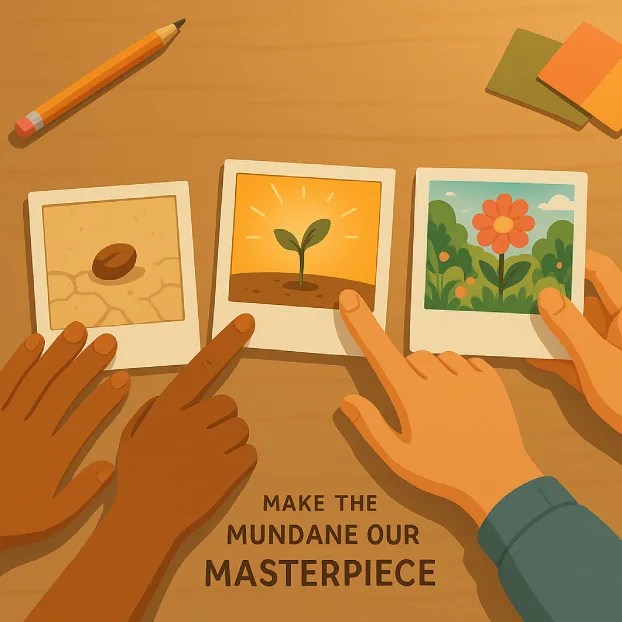
Set the task: “Imagine a third video based on this song. What’s the story?”
In groups, students must:
- Write a short summary of their new video concept (5–6 sentences).
- Create a simple 3–4 frame storyboard illustrating the key moments.
- Choose one line from the song to be their video’s tagline.
Part C: Presentations (5 min)
Have each group briefly present their third video concept to the class, explaining their storyline and how their chosen tagline connects to the song’s theme.
Step 6: The Official Video Reveal & Synthesis (5 min)
Part A: The Reveal (2 min)
Tell the class: “You’ve all just acted as directors and lyric interpreters. Now, let’s watch how the artist himself tells this story. This is the official music video, which features the artist Alex Warren and his wife, Kouvr.”
Play the official music video for “Ordinary.”
Part B: Final Synthesis Discussion (3 min)
Lead a final class discussion with these prompts:
- How does the official video’s story compare to the themes in the animated shorts?
- Does the official video change your mind about which version is the most powerful?
- Which of the three versions (animated 1, animated 2, or official) best captures the feeling of being “taken out of the ordinary”?
Conclusion
You now know that IT IS POSSIBLE to go beyond the dreadful gap-filling activity and create a full and meaningful lesson plan with a song that your students already love. My hope is that this “Lyrical Story Worlds” activity will get your students not just practicing their English, but putting their own creative and critical thinking skills into high gear!
When we use songs this way, we’re doing more than just teaching. We’re connecting with our students on a deeper level. We’re showing them how to find the meaning behind the words and helping them find their own voices.
Aim to be fluent not only in English, but also in the language of your own SOUL. There is no telling how far you can go or how many people’s lives you can help this way!
That’s it for this week. I hope these ideas can help you in your life! Happy teaching!
Did you enjoy this creative approach? This lesson is a real-world example of the principles from my complete methodology. To dive deeper into the MUSIC+ Framework and discover more strategies, check out my complete guide: How To Use Songs To Teach English.
Frequently Asked Questions (FAQ)
How do you teach 21st-century skills with a song?
You can teach 21st-century skills like critical thinking and collaboration by having students analyze lyrical meaning, compare different artistic interpretations (like in music videos), and work together to create their own new narratives based on the song’s themes.
What are some interactive song activities for English teachers?
Interactive song activities move beyond listening. Have students debate the meaning of lyrics, create storyboards for their own music videos, or use vocabulary from the song to write new stories. The goal is to make the students active creators, not just passive listeners.
How can song-based lesson plans engage reluctant students?
Songs engage reluctant students by connecting with their interests and emotions. A lesson that uses popular music and focuses on creative tasks like storytelling and debate feels more relevant and less like a test, which boosts motivation and participation.
Can I adapt this song activity for a lower level?
Yes. For B1 students, you could pre-teach more of the vocabulary, provide sentence starters for the discussion, and focus the creative task on writing a simple paragraph instead of a full storyboard. The core concept of comparing visual stories is highly adaptable.
How do you teach figurative language in an ESL class?
Songs are a fantastic tool for teaching figurative language. Choose a song with clear metaphors or similes. Ask students to first identify the figurative language and then discuss what it means literally versus what it suggests emotionally or thematically.
What makes this a time-saving song activity for ESL teachers?
This lesson is a time-saving song activity because it comes with a pre-made Genially presentation that includes all the videos and lyrics you need. The structure is clear and requires minimal preparation to deliver a high-impact, 60-minute lesson.
How does this lesson improve English listening skills?
This activity develops English listening skills by scaffolding the process. Students first listen for gist and emotion without lyrics, then listen again for detail with the lyrics. This trains them to understand both the overall feeling and the specific language of a song.
Author Bio:
About the Author:Márcia Bonfim is an ESL/EFL teacher and creator of the Song Activity Factory. She helps educators create engaging lessons using her signature BEAT+ Method, which features the MUSIC+ Framework. You can discover her complete methodology summary here.
 Song Activity Factory
One comment