Lesson at a Glance: Second Conditional (Katy Perry)
- Media / Artist: Katy Perry
- Target Level: B2
- Duration: 60 minutes
- Language Focus: ESL Song Lesson Plan (MUSIC+ Framework)
- Key Outcome: Students accurately apply the Second Conditional in communicative contexts and interpret complex metaphors within lyrics and visual media.
- Materials: Google Slides, Assessment Pack, Instructions.pdf
Have you ever felt that soul-crushing disconnect? That moment when a complex grammar point, like the second conditional, just flattens your classroom energy?
We’ve all been there. We pull out the same dry, tired examples—’If I were a bird, I would fly’—and yes, they are technically correct. But they are emotionally DEAD. They don’t connect.
After 30 years in the classroom, I KNEW there had to be a better way. A way to teach grammar that truly connects to the HEART, not just the head. What if you could teach those hypotheticals through the real, messy, powerful feelings of heartbreak, resilience, and healing? What if that’s how we made it stick?
That’s EXACTLY why I designed this lesson structure using Katy Perry’s song, “Bandaids.” It’s a core example of how the BEAT+ Method—my complete, research-backed pedagogical system—transforms grammar practice. It stops being a dry exercise and becomes a meaningful human experience.
Here is the exact, 60-minute lesson plan—built on the MUSIC+ Framework from my method—that you can take and use in your B2 class tomorrow.
Lesson Overview
This engaging 60-minute lesson uses Katy Perry’s song “Bandaids” to explore themes of healing, resilience, and relationships, with a specific focus on the Second Conditional. Students will first connect emotionally with abstract images, then decode the song’s central “Band-Aid” metaphor. Through focused listening, they’ll grasp the song’s gist before diving into explicit grammar instruction and practice of the Second Conditional using lyrical examples. Collaborative problem-solving and visual analysis of the music video deepen comprehension, culminating in creative transformation tasks where students reinterpret the song’s narrative. The lesson integrates all MUSIC+ principles, providing a balanced and engaging learning experience.
Details
- Language level: B2
- Learner type: Teens and Adults
- Primary Skill: Integrated Skills
- Secondary Skills: Speaking & Interaction, Writing
- Subskills: Interpretation, Discussion, Creative Writing
- Topic: Healing, resilience, relationships, regret, moving on, emotional processing
- Duration: 60 minutes
Objectives
- Grammar Proficiency: Students will accurately identify and apply the Second Conditional in both controlled practice and communicative contexts.
- Thematic Interpretation: Students will enhance their ability to interpret metaphorical language and abstract themes within song lyrics and visual media.
- Collaborative Communication: Students will engage in peer-to-peer discussions, negotiating meaning and offering advice related to the song’s themes.
- Creative Expression: Students will transform the song’s narrative through creative writing or dialogue, expressing personal responses and critical analysis.
Step-by-Step ESL Lesson Plan for “Bandaids” by Katy Perry
Step 1 (5 min) – Motivation+: The Emotional Echo
First, display an image of something beautiful but broken or mended, such as a Kintsugi vase, an old gnarled tree, or sunlight breaking through storm clouds (slide 1).

Give students 30 seconds to observe it in silence.
Then, spark a discussion with these prompts:
- What story does this image tell?
- What feelings does it evoke?
- What does it say about healing or finding beauty in imperfection?
Invite two or three students to share their initial thoughts with the class.
Step 2 (5 min) – Understanding+: Decoding the Metaphor
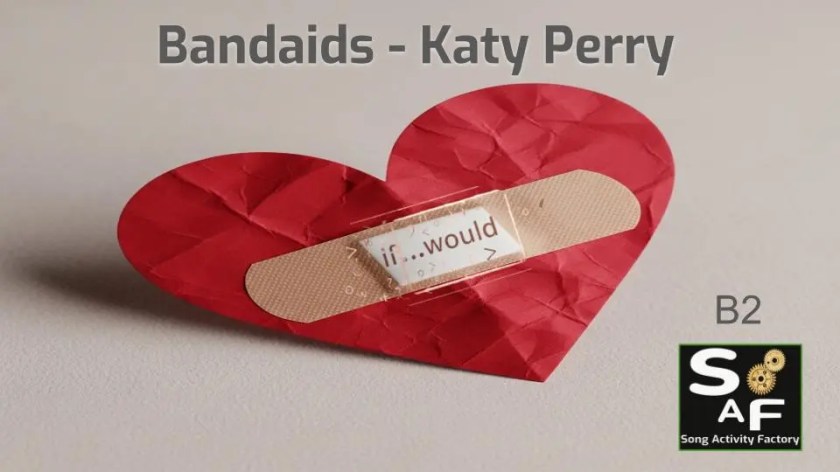
Start by introducing the song title: “Bandaids” by Katy Perry. Show the class a real Band-Aid or a picture of one (slide 2).

Put students in pairs for a quick Think-Pair-Share activity. Ask them:
- What are Band-Aids used for?
- What are their good and bad points?
Guide the conversation towards the metaphorical meaning by asking:
- How could a Band-Aid be a metaphor for feelings or relationships?
- What might a song called ‘Bandaids’ be about?
Ask each pair to share one quick idea with the group.
Step 3 (7 min) – Understanding+: Gist Listening & Metaphor Confirmation
Tell students it’s time to listen to the song (slide 3). As they listen for the first time, give them two key tasks:
- Uncover how the Band-Aid metaphor is used.
- Identify what “bleeding” or a “broken heart” represents in the lyrics.
Play the full song. Afterward, do a quick comprehension check with the whole class:
- What is the ‘broken heart’ or ‘bleeding’ in the song?
- What are the ‘Band-Aids’ the singer refers to?
Step 4 (12 min) – Skills+: Grammar in Focus – The Second Conditional
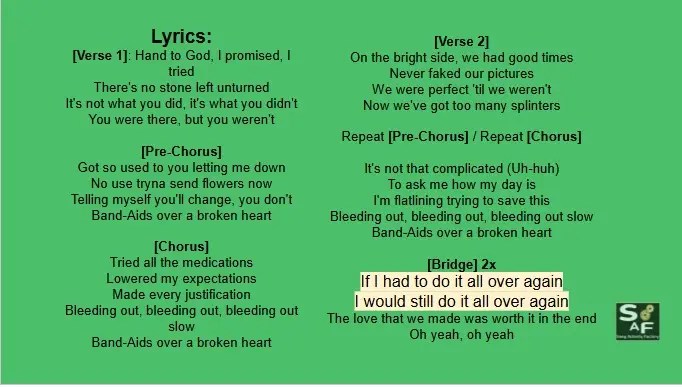
Hand out or project the song lyrics for everyone to see (slide 4). Draw their attention to a specific line: “If I had to do it all over again, I would still do it all over again.”
Use this line to review the Second Conditional structure (If + Past Simple, …would + base verb) and discuss what it means in the context of the song.
To get them practicing, provide these sentence starters (slide 5):
- “If the singer could change one thing…”
- “If I were in that situation…”
- “If I had a friend going through this…”
Instruct students to complete the sentences and then share their ideas with a partner.
Step 5 (13 min) – Interaction+: Collaborative Problem-Solving & Advice
Organize the class into small groups of 3 or 4 for a “group therapy session.”
Pose these discussion prompts to get them started (slide 6):
- “Do you agree with ‘The love that we made was worth it in the end’? Why?”
- “What advice would you give her for healing?”
As they discuss, encourage them to use the Second Conditional structure they just practiced (e.g., “If I were her, I would…”).
Walk around the room to listen in and offer support. To wrap up the activity, ask one person from each group to summarize their key advice for the rest of the class.
Step 6 (5 min) – Understanding+: Visualizing the Message
Play one or two highly symbolic clips from the music video, such as the café explosion, the quicksand scene, or the Band-Aids imagery (slide 7).
Ask the class: “How do these visuals connect to the song’s ideas of pain, repair, or emotional healing?”
Lead a brief whole-class discussion, helping students link the powerful visuals directly to the lyrics.
Step 7 (10 min) – Creativity+: Beyond the Band-Aid
Divide students into pairs or small groups and let them choose one of the following creative tasks:
- Option A: Rewrite a verse from the other person’s perspective.
- Option B: Write a short dialogue or monologue reflecting on the experience.
- Option C: Design a metaphorical “healing plan” (like an emotional prescription or a recovery map).
Remind them to include vocabulary from the song or the Second Conditional. Allow 7–8 minutes for them to work.
Finally, invite a few groups to share their creations, either by presenting to the class or posting them on a digital board.
Step 8 (3 min) – Understanding+: Final Reflection & Personal Connection
For a final reflection, ask students to think silently or discuss with a partner using these prompts:
- “One thing I’ve learned about relationships after listening to ‘Bandaids’ is…”
- “If I were to give advice based on the song, I would say…”
Ask for a few volunteers to share their brief takeaways with the class to wrap up the lesson.
The Question That Causes ‘Assessment Anxiety’: How Do You Grade This?
This is the moment many teachers dread. You’ve just facilitated a beautiful, deep lesson. Your students wrote creative dialogues (Step 7) and shared personal advice (Step 5). But how do you measure it? How do you put a grade on empathy or a creative dialogue without it feeling arbitrary?
I’ve solved this. This is my core mission. Transformative teaching must be paired with soulful, systematic assessment.
For every lesson I create, a complete assessment toolkit is designed. For this “Bandaids” lesson, that toolkit includes:
- A Summative Assessment Rubric to grade the final creative task (Step 7), measuring not just “Application of Second Conditional” but also “Creative Transformation” and “Clarity”.
- Formative Assessment Tools like the “Group Therapy Observer Checklist” (for Step 5) to track participation and grammar use during the lesson.
- A Student Self-Assessment Tool (“My Healing Journey”) to empower students to reflect on their own learning.
It gives you the confidence to grade this meaningful work with clarity and fairness, finally ending ‘assessment anxiety.’
Your Next Step: Teach (and Assess) with Soul
You don’t have to invent these tools from scratch. I want you to feel this sense of confidence in your own classroom. I’m giving you the complete “Guest Pass” to my method.
You are getting this complete, 8-step lesson plan and the full “Assessment with Soul” toolkit (including the rubric, formative checklists, and student self-assessment tool) described in this post.
Experience for yourself how a systematic, MUSIC+ lesson can transform your classroom and end your ‘assessment anxiety’ for good.
Author Bio:
About the Author:Márcia Bonfim is an ESL/EFL teacher and creator of the Song Activity Factory. She helps educators create engaging lessons using her signature BEAT+ Method, which features the MUSIC+ Framework. You can discover her complete methodology summary here.


One comment