
⚡ Textbook Rescue: The 20-Min Third Conditional Kit
- Media / Artist: Taylor Swift
- Target Level: B2 (Upper-Intermediate)
- Duration: 20 Minutes (The “Espresso Shot” Format)
- Grammar Focus: Third Conditional (Hypothetical Past)
- Key Outcome: To transform the Third Conditional from a “cold math equation” into a tool for agency. Students will analyze the tragic fate of Ophelia and use If + Past Perfect + Would Have to rewrite her story into one of survival and power.
- Materials: 4-Slide Presentation, Student “Rescue” Worksheet, “The Fate of Ophelia” Audio/Video.
🎯 The Mission Objectives
By the end of this session, your student-reporters will be able to:
- Contrast visual narratives to introduce the concept of historical revisionism and agency.
- Identify narrative outcomes and specific verbs through gist listening.
- Construct Third Conditional sentences to articulate hypothetical past scenarios and “what if” moments.
- Compose a creative social media update that applies complex grammar to a literary character’s perspective.
The Confession: Finding Flow in the Chaos
I have a confession to make.
For years, I have preached the gospel of the “Symphony”—that perfect, 60-minute immersive song lesson. I have encouraged you to take your students on a Hero’s Journey, to dedicate a full hour to the transformative magic of music.
And I stand by that. Those lessons are powerful. They are the Sunday Dinners of education—nourishing, deep, and memorable.
However, we must face the reality of the NOW.
It is Tuesday morning. It is 7:45 AM. You are tired. Your students are walking zombies. And you have a strict curriculum coordinator breathing down your neck. You have 4 pages of the textbook that MUST be covered by Friday.
In that moment, you look at my 60-minute lesson plans and your heart sinks. You think: “Márcia, I love this, but I literally do not have the time.”
So, what happens? You put the song away. You open the textbook. And the classroom goes silent. The energy drops. The spark fades.
The Pivot: From “Curriculum” to “Caffeine” for the Soul
I realized something profound. By asking you to commit to a full hour every time, I was asking for a luxury you do not always have. You do not need a 5-course meal every single day.
Sometimes, you just need a strong shot of espresso to get through the morning. You need a jolt of energy to raise the vibration of the room.
You need speed. You need precision. You need a RESCUE MISSION.
That is why, starting today, I am shifting gears. I am not abandoning the deep dives — for they feed the soul — but I am handing you a new tool for your arsenal.
Introducing: The BEAT+ Singles (My Textbook Rescue Kits)

These fast, high-impact micro-lessons are part of the ⚡ Textbook Rescue Series – BEAT+ Singles — a growing collection of 20-minute, zero-prep interventions designed to revive the most lifeless parts of your textbook.
Forget “Song Lessons” for a moment. Think of these as Sparks of Light.
I designed these 20-minute micro-lessons with one clear purpose: To fix the specific, lifeless parts of your textbook and breathe ENERGY back into them.
I am no longer just helping you “teach songs.” I am using songs to help you solve your daily struggles in the classroom:
- The Problem: Your textbook unit on “The Environment” is preachy, boring, and disconnected from reality.
- The Fix: My 20-Minute “Igniter” using Billie Eilish to spark real, passionate debate before you even open the book.
- The Problem: The speaking activity in the book results in dead silence.
- The Fix: My 20-Minute “Creator” task where they write a viral tweet for a pop star, tapping into their own creativity.
⚡ The Textbook Rescue Series
When you see that Lightning Bolt (⚡) on the blog, you know you’re looking at a lesson from the Textbook Rescue Series — fast, targeted BEAT+ Singles built for real classroom pressure:
- It takes 0 minutes to prep.
- It takes 20 minutes to teach.
- It targets a specific Grammar Point or Vocabulary Set.
- It fits seamlessly inside your normal lesson flow.
You do not have to throw away your syllabus. You just need to IGNITE it.
The First Mission: The Grammar of Survival
This week, I am launching with a classic grammar nightmare: The Third Conditional.
Textbooks treat this grammar like a cold math equation: If + Past Perfect + Would Have… It is dry, confusing, and emotionally dead.
But what if we treated it as the Grammar of Survival?
I used Taylor Swift to rewrite a tragedy. We will look at the story of Ophelia, and use grammar not just to fill gaps, but to save her life. This isn’t just about rules; it is about AGENCY. It is about showing students that their words have power.
And we are going to do it in exactly 20 minutes.
👁️ The Student’s Journey (The Narrative Arc)
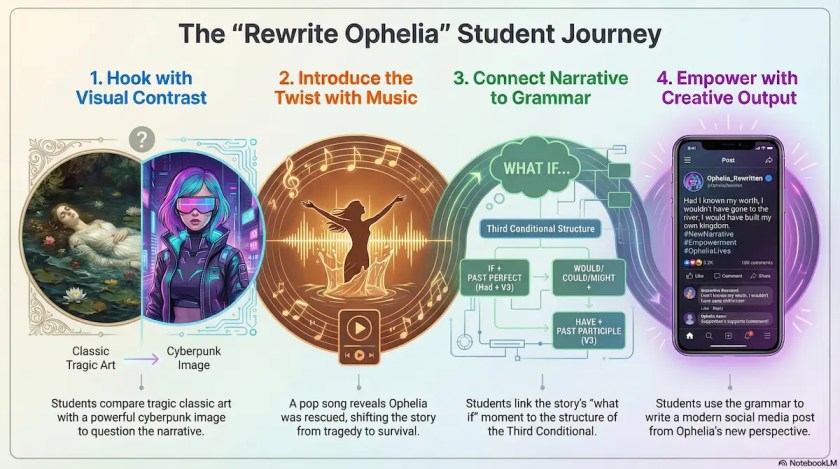
Class Begins. The screen lights up. You see two images side-by-side: on the left, a classic, tragic painting of a woman floating in dark water surrounded by flowers. On the right, a neon-lit, cyberpunk woman standing defiantly on top of a high-tech tower. The teacher asks, “Who controls the story in each picture?” You immediately sense the contrast: one is a victim of fate, the other is a survivor. You are hooked by the visual clash between “Old Tragedy” and “New Power.”
The Story Unfolds. The room fills with sound. A mid-tempo pop beat kicks in—atmospheric and moody. You listen to the first two minutes. The singer mentions “Ophelia” and “scorpions,” but then the twist hits: “You dug me out of my grave.” Your mission on the worksheet is simple: Check the box. Did she drown, or was she rescued? You realize this isn’t the Shakespeare you read in English lit; this is a rewrite. She survived.
The Mechanics of Fate. Now you zoom in. How did she change the ending? The teacher highlights a specific line: “And if you’d never come for me, I might’ve drowned.” You realize that rewriting the past requires a special tool: The Third Conditional. It’s not just grammar; it’s the “Sliding Doors” moment. On your worksheet, you don’t fill in blanks. Instead, you connect two halves of the logic: “If she had stayed in the water…” links to “…she would have perished.” You see the math behind the regret and the relief.
The Twist & Output. The teacher throws a challenge: “Ophelia has a smartphone in that tower. What does she post to tell Hamlet she’s moving on?” You have to use the grammar you just analyzed. You write a status update: “If I had listened to the critics, I would have stayed underwater. But the air up here is cleaner. #Survivor #NewEra.” You leave the class feeling empowered, having used complex grammar to give a voiceless character a brand new ending.
📝⚡ Step-by-Step Classroom Lesson Flow
Here’s the lesson flow overview. The downloadable PDF includes full teacher notes, ready-to-use materials, and extra implementation support.
Step 1: The Tale of Two Ophelias – M+ & U+ (5 Minutes)

What students do:
Students look at two contrasting images of the same character—one representing her traditional tragic ending and the other showing a version where she takes control of her story. They compare the two images and discuss the idea of “rewriting” the past.
Why this step helps:
It sets the scene with a strong visual hook. By comparing the two versions of the character, students start thinking about the concept of “what could have been” before they encounter the target grammar.
Step 2: The Narrative Soak (Gist Listen) – U+ & S+ (5 Minutes)
What students do:
Students listen to the first half of the song. While listening, they track the story to see if the character follows her traditional path or if her fate changes. They mark whether she stays in danger or escapes.
Why this step helps:
This focuses on the “big picture” of the story. Building a general understanding of the narrative first helps students feel more comfortable when they eventually zoom in on specific language details.
Step 3: The Logic Repair (Grammar Focus) – S+ & U+ (5 Minutes)

What students do:
Students listen to a specific line of the song where the singer imagines a dark alternative to what actually happened. They identify the structure:
Third Conditional → If + past perfect → would have / might have + past participle
They then work to connect the imagined “if” scenario to the actual reality of the story.
Why this step helps:
It connects the grammar rule to a specific moment of high drama in the song. This makes it easier for students to see how the structure is used to talk about imaginary pasts and missed possibilities.
Step 4: The Status Update – C+ & S+ (5 Minutes)

What students do:
Students write a short social media post from the character’s perspective to update someone on her new life. In their post, they must use the structure:
Third Conditional → If + past perfect → would have / might have + past participle
to show how things have changed.
Why this step helps:
This gives students a chance to use the grammar in a modern, creative way. Writing as the character helps them practice the structure while focusing on clear communication.
🎵 OPTIONAL EXTENSION (The Encore) Context: Only if time allows and energy is high.
Teacher Script: “We fixed the grammar, and we fixed her story. Since we have a few minutes left, let’s watch the full video and see the ‘New Ophelia’ in action. Just enjoy the vibes.” Action: Play the full Music Video (Non-instructional).
The “Assessment with a Soul” Closer
When you assess this task, do not just look for the correct past participle. Look for the shift in perspective. Did they use the grammar to express relief? Did they understand that changing the condition changes the result?
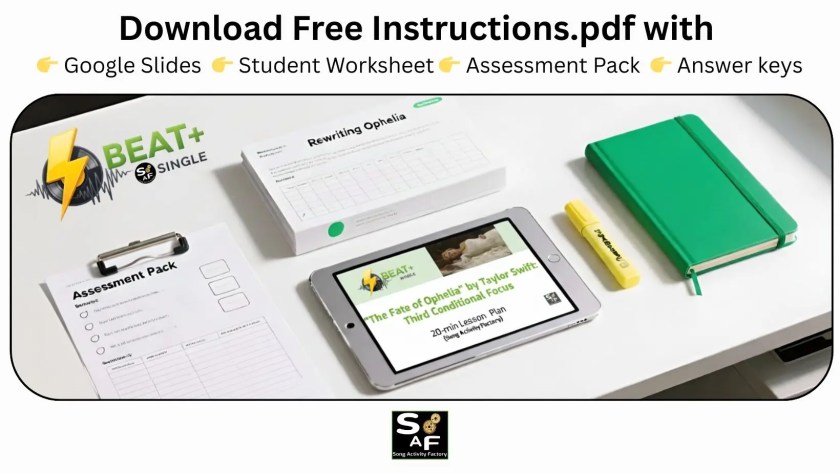
(No registration required. Just click and save.)
Author Bio:
About the Author:Márcia Bonfim is an ESL/EFL teacher and creator of the Song Activity Factory. She helps educators create engaging lessons using her signature BEAT+ Method, which features the MUSIC+ Framework. You can discover her complete methodology summary here.
 Song Activity Factory
I strongly disagree that Taylor S’s song is about somebody who chose to survive. She was saved by the lover in the song and, as such, she entirely depended on a man to survive. Shakespeare’s Ophelia chose death in order to regain control. I would strongly advise to create lesson plans accurate not only in form and grammar, but also in content and analysis.
LikeLike
Hi Hana, thanks for the literary point of view.
You’re right that Ophelia can absolutely be read that way. In this lesson though, I’m not really treating it as literary analysis. I’m using the situation as a context to make the Third Conditional feel real instead of abstract. The “rescue vs. fate” contrast is there to support the grammar focus, not to make a final statement about the character.
Your idea would actually work really well as a follow-up discussion with stronger groups. imagin this question: “Did she truly have agency, or was she still dependent on someone else?” I can see my own students arguing over it!
Thanks a lot for your contribution!
LikeLike