Strategy Insights: Bridging the Grammar-to-Speech Gap
- Main Concept: The Skills+ Principle of intentional noticing and purposeful output.
- Key Framework: The Skills+ stage of the MUSIC+ Framework.
- Teacher Benefit: Prevents the “broken learning loop” where students understand rules but remain silent during real-world L2 encounters.
- Practical Application: Utilizing emotional context in tracks to move beyond mechanical drills toward high-stakes communicative pressure.
From Understanding to Use: The Skills+ Principle
In the earlier stages of the MUSIC+ Framework, we explored two essential classroom truths. First, students need motivation before meaningful learning can begin. Then, once attention is present, they need understanding—a clear bridge into the message, emotion, and meaning behind the language they hear.
But even when those two conditions are in place, many teachers still face the same frustrating reality.
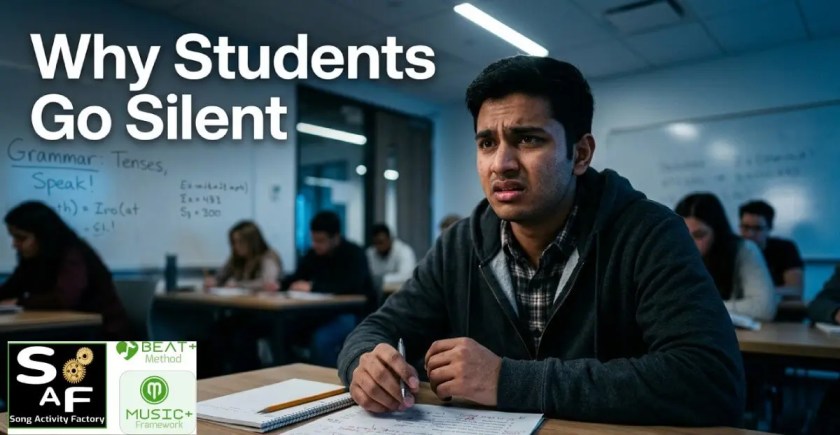
Students understand the lesson. They complete the exercises. They recognize the grammar with confidence.
Then real conversation begins—and the language disappears.
They hesitate, simplify everything, or retreat into silence.
This is the next major challenge in language teaching: helping learners transform passive knowledge into active communication.
That is exactly where the Skills+ Principle enters the framework.
Skills+ is where grammar stops being something students can explain and starts becoming something they can actually use.
It is the stage where students stop merely recognizing language and begin using it with confidence, speed, and purpose. .
What Skills+ Really Means
Skills+ is the stage where language stops being something students merely understand and starts becoming something they can actually use.
Instead of treating grammar as a disconnected system of rules, Skills+ places language inside a meaningful context shaped by emotion, story, repetition, and real communicative purpose. Students no longer study forms in isolation. They encounter them where language naturally lives.
That shift matters because fluency is not built through memorization alone. It develops when learners notice language in action, practice it with intention, and retrieve it under communicative pressure.
Why Traditional Grammar Practice Often Falls Short
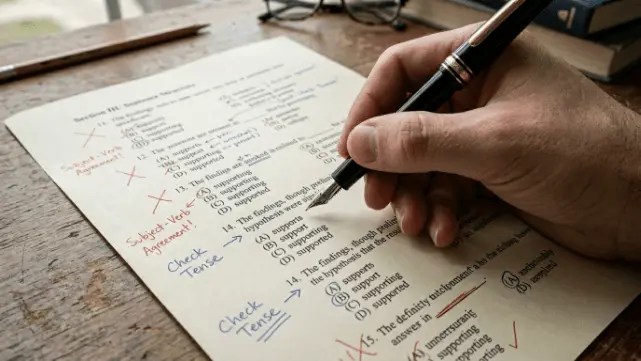
Many grammar lessons succeed at recognition but fail at transfer.
Students complete gap-fills, choose correct options, transform sentences, and demonstrate that they understand the rule. Yet these tasks often end before learners are asked to use the structure meaningfully.
Recognition is valuable, but recognition is not communication.
A student may know exactly how the past perfect works and still never produce it naturally in conversation. That does not mean the learner failed. It usually means the lesson stopped too early.
How Skills+ Changes the Process
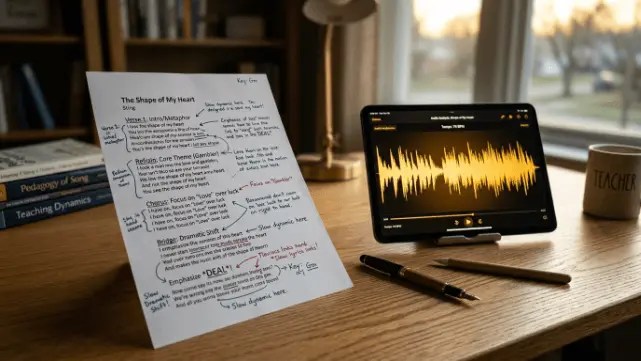
With Skills+, grammar appears inside something memorable and human.
A well-chosen song gives students emotional context, repeated exposure, pronunciation models, natural phrasing, and genuine reasons to interpret meaning. The structure is no longer an abstract grammar point on a worksheet. It becomes part of a real message someone is trying to communicate.
Students begin noticing not only what language is used, but why it is used. That is where deeper learning begins.
What Skills+ Looks Like in Real Lessons
This principle becomes clearer when seen in real classroom practice.
In The Certainty Trap, students use Niall Horan and Myles Smith to practice future probability through prediction, uncertainty, and negotiated outcomes rather than sterile future tense drills.
In The Empathy Trap, students use Sabrina Carpenter to decode sarcasm, emotional contradiction, and psychological tension while activating the present continuous in meaningful discourse.
In both cases, grammar stops being an abstract rule and becomes a tool for interpreting something human.
From Grammar Label to Communication Tool
Consider modal verbs.
In many classrooms, they are introduced as categories to memorize: must, should, might.
Under Skills+, those same forms become tools for real-life communication: giving advice, expressing certainty, protecting boundaries, negotiating choices, or warning someone about risk.
Students engage more naturally when grammar helps them do something meaningful.
Why Songs Accelerate This Process
Songs combine rhythm, repetition, emotion, and meaning in a way few classroom materials can replicate.
Learners hear connected speech, absorb stress patterns, revisit structures naturally through repetition, and connect language to feeling and narrative. This creates stronger memory pathways than mechanical drills alone.
In practical terms, it often means students retrieve the language faster later—especially during speaking.
The Step Many Lessons Miss

Noticing language is powerful, but it is still not enough.
Students need a final task that requires them to use the target structure in speaking or writing. If learners can complete the lesson’s output stage without using the language focus, the learning loop remains incomplete.
Skills+ always moves toward purposeful output.
That is where passive knowledge begins turning into fluency.
Final Thought
If your students know grammar but rarely use it, the issue may not be motivation or ability. It may be the design of the practice itself.
Grammar taught only as information often remains silent. Grammar experienced through meaning becomes usable.
That is the purpose of Skills+.
It helps learners move beyond studying English—and start communicating with it.
Author Bio:
About the Author:Márcia Bonfim is an ESL/EFL teacher and creator of the Song Activity Factory. She helps educators create engaging lessons using her signature BEAT+ Method, which features the MUSIC+ Framework. You can discover her complete methodology summary here.


2 comments