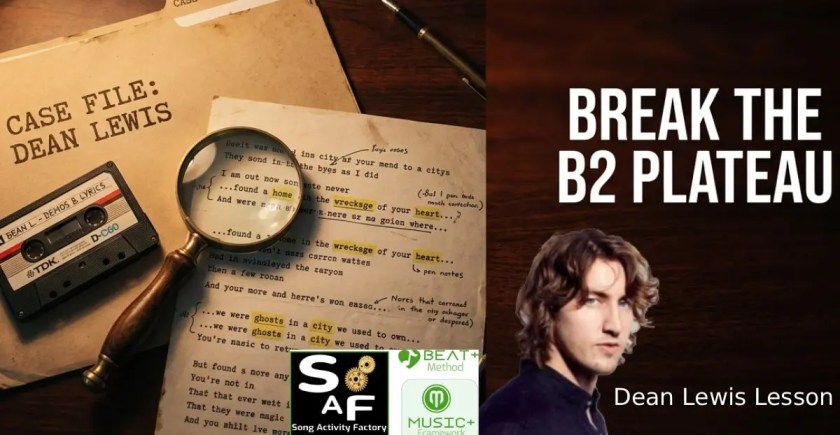
Lesson at a Glance: The Musical Cliffhanger
- Media / Artist:“I am getting well” by Dean Lewis
- Target Level: B2
- Duration: 60 min
- Language Focus: ESL Song Lesson Plan (Past Modals of Deduction)
- Key Outcome: Employ Past Modals of Deduction to justify evidence-based theories, analyze complex visual metaphors, and negotiate meaning through role-based peer mediation.
- Materials: Google Slides, Detective’s Dossier, Assessment Pack
Breaking the B2 Plateau: From Passive Listening to Active Deduction
Every experienced educator has encountered the “B2 Plateau.” It is that frustrating stage where students possess enough vocabulary to survive, but their grammar remains stubbornly functional. They “know” the past modals of deduction. They can pass a multiple-choice test on them with their eyes closed. Yet, the moment they speak or write, those structures vanish. They default to the simple past because, in most classroom contexts, the simple past gets the job done.
If a student can explain a situation by saying, “Maybe he was sad,” they will. They rarely reach for “He must have been devastated” because, as far as they are concerned, the extra grammatical weight adds nothing to the meaning. To move a B2 student into higher-level proficiency, we have to stop treating grammar as a stylistic exercise and start treating it as a functional necessity.
This is where the Musical Cliffhanger comes in. By using Dean Lewis’s “I Am Getting Well” not just as a listening exercise, but as a Detective’s Dossier, we create a high-stakes environment where the correct grammatical form is the only way to justify a theory. This turns a standard past modals of deduction ESL lesson into a mission.
The Logic Gap: Why Passive Listening Fails
The primary reason teaching modals with songs often falls flat is a lack of demand. If a student can guess the ending of a story without using “must have,” they will. Without a Logic Gap, deduction is just a choice rather than a requirement.
Most song-based lessons are far too passive. We provide a gap-fill, play the track, and check the answers. The cognitive demand is often low. In the Musical Cliffhanger, we strip the song of its ending and present it as an unsolved mystery. We provide the evidence: the “Clues of Pain”: and then we stop the clock. By the time the students are allowed to hear the music, they have already made a “grammatical bet” on the outcome. They aren’t just listening to a track: they are checking if their logic held up against the artist’s reality.
The Protocol: The Metaphor Hunt
To start, we present a single, moody image: a pair of boots on dead, gray grass. There is no context, only tension. This small visual hook forces the brain into an immediate state of inquiry. From here, we move into the text analysis phase.
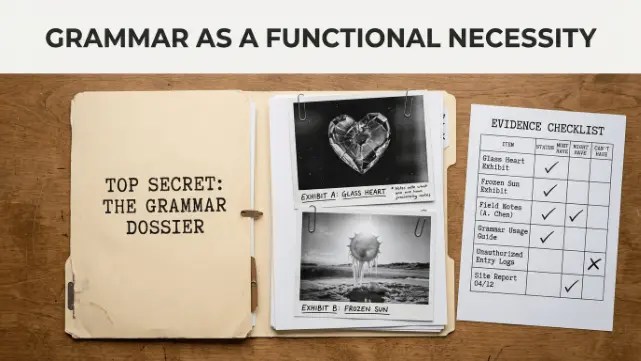
Students are not just reading a story about a character named Leo: they are hunting for three specific clues hidden in the text. This is where we introduce complex visual metaphors like the “Frozen Sun,” “Echoing Silhouettes,” and the “Glass Heart.”
I’ve seen this play out in dozens of classrooms. In a recent session, a group of usually distracted adults spent five minutes debating whether “Echoing Silhouettes” referred to Leo’s family or his own fading memories. This is the goal. When students argue over the meaning of a metaphor, they are doing deep semantic work that no textbook exercise can replicate.

The Grammatical Bet: A B2 Grammar Speaking Activity
Once the evidence is gathered, the atmosphere shifts. We present three possible endings for Leo’s story:
- Option A: He can’t have made it up the hill.
- Option B: He might have collapsed halfway.
- Option C: He must have found a spark of hope.
Because they have underlined evidence, their choice isn’t a random guess. It is a defended position. This is the moment where the grammar becomes the only tool for the job. To argue for Option A, they must use “can’t have” to prove impossibility based on the “Glass Heart” metaphor. To argue for Option C, they must use “must have” to link the “spark in his eyes” to a successful outcome.
Role-Based Learning: The Classroom Ecosystem
One of the greatest challenges in a B2 speaking activity is “correction fatigue.” If the teacher interrupts every sentence to fix a modal error, the flow of the debate dies. If the teacher says nothing, the students fossilize their mistakes.
The solution is to shift the teacher from “corrector” to “consultant” by assigning specific roles within the student groups. I recommend two primary roles to maintain rigor:
- The Grammar Boss: Their mission is to police the form. They ensure every theory uses “modal + have + past participle.”
- The Word Detective: They act as the gatekeeper of evidence. No theory is valid unless it quotes the lyrics or the dossier directly.
This creates a self-correcting environment. When the Grammar Boss tells a peer, “You said ‘he must found,’ it should be ‘must have found,'” the peer listens because the success of their detective team depends on it. The teacher is now free to circulate and capture real-time data on student accuracy without breaking the immersion.
The Reveal: Emotional and Linguistic Payoff
The climax of the lesson is the song itself. After ten minutes of intense debate and grammatical defense, the students finally hear Dean Lewis sing the resolution. This provides a massive emotional payoff that a simple answer key cannot provide. You can feel the shift in the room. The students aren’t just checking if they got a question right: they are seeing if their empathy and logic were correct.
Once the lyrics “I, I am getting well” finally play, the relief is a powerful teaching tool. But we don’t stop there. This is where proceduralization begins. We have the groups go back into the lyrics to prove why the other endings were wrong. “He couldn’t have surrendered because he says he’s trying his best.” By attacking the “wrong” options using the target grammar, students solidify their understanding of how modals of deduction function in the real world.

Assessment with Institutional Rigor
Rigor does not have to mean red-pen fatigue. In this system, we use real-time formative data. While the “detectives” are debating, move through the room with a rapid observation checklist. You are looking for three things:
- Are they using the metaphors from the text?
- Are the Grammar Bosses actually correcting the modals?
- Are they citing evidence for their “might have” and “must have” claims?
The final writing project, whether an epilogue or a letter from Leo’s future self, serves as the ultimate evidence of learning. The rubric should be simple, focusing on the contrast. Can the student use the target structures to bridge the gap between past pain and present healing?
Finally, reflection helps transfer the lesson beyond the activity itself. Using a “Two Stars and a Wish” tool allows students to identify one useful phrase they mastered and one area where they still feel hesitant. This ensures the grammatical gains are not lost once the class ends.
Transform Your Classroom with the Ready-to-Teach System
When you use authentic media to create meaningful thinking, you don’t have to force engagement. You don’t need to build this from scratch, either. I’ve mapped out this complete 60-minute Dean Lewis ESL lesson, including the Google Slides, the Detective’s Dossier, and the Assessment Pack.
By moving away from passive gap-fills and toward active deduction, you help your students climb the B2 hill and reach the fluency they have been stuck below.
About the Author
Márcia Bonfim is an ESL/EFL teacher and the creator of Song Activity Factory. She helps educators design cognitively engaging lessons using her signature BEAT+ Method, built around the MUSIC+ Framework. Her work focuses on transforming songs from “fun extras” into structured learning systems that develop real communicative performance at higher levels. 👉 You can explore a full overview of her methodology here.


2 comments