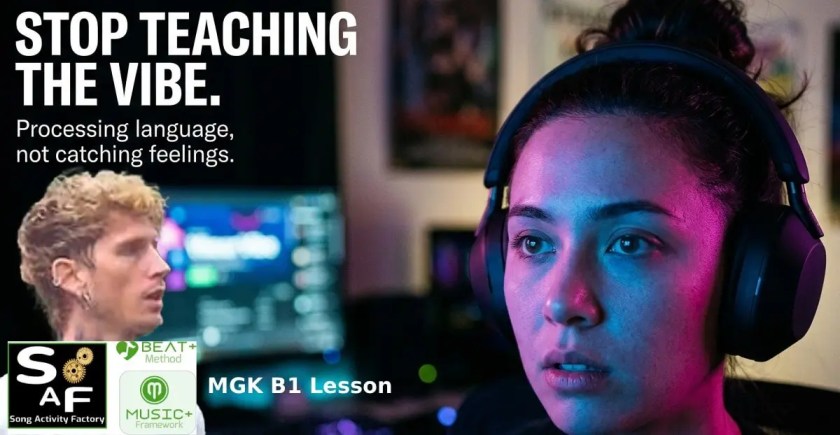
Lesson at a Glance: Evidence-Based B1 Advice
- Media / Artist: MGK (Machine Gun Kelly)
- Target Level: B1
- Duration: 60 min
- Framework: BEAT+ Method and MUSIC+ Framework
- Language Focus: ESL Song Lesson Plan
- Key Outcome: Students identify and use phrasal verbs of recovery like look back or get rid of and B1 advice structures to negotiate collaborative solutions.
- Materials: Google Slides, Student Worksheet, and Assessment Pack.
Facts over Feelings: How to Fix Predictable B1 Advice
Most B1 lessons about feelings fail because students just guess the mood from the music. They see a breakup and say, “He is sad,” without ever looking at the words. They are just catching a vibe, not actually learning English. As a result, the speaking task becomes predictable. They say exactly what you expect: “He should be happy.” Nothing is challenged. No real language is learned.
This lesson changes that. We move away from “how does he feel” and toward “how do you know.” At the B1 level, students are experts at faking comprehension. They use the melody or the singer’s tone to form a generic opinion. This lesson takes those shortcuts away. It is not about entertainment. It is about making students act like investigators who must find linguistic proof for their advice.
Song used in this lesson: “Times of My Life” by MGK. This track is classified as a B1 processing task in the Pedagogical Song Index , where music is mapped based on its instructional value and grammar yield rather than popularity alone.
Why It Happens: The Interpretive Shortcut
Students take the easy way out. They offer simple, generic advice because actually digging into the text is hard work. When a prompt is too open, they stay in their comfort zone. They avoid the exact language of struggle: phrasal verbs of survival like “get me through” or “got rid of”: that they actually need to practice.
In many classrooms, students become experts at “feeling” the song without processing the English. They hear a slow piano and assume the singer is depressed. While they might sound fluent, they are not using new vocabulary. This lesson stops that. By starting with a silent video, students have to look at what is actually happening. This is a core part of the MUSIC+ Framework , which helps teachers move from simple activities to a structured system that turns songs into meaningful learning experiences.
What Happens During This Lesson: From Facts to Phrases

The process begins with a Silent Video. Students watch a man packing a box. No music. No lyrics. They have to describe the action, not the mood. This stops them from jumping to conclusions too early.
When we finally look at the Lyric Teaser, everything changes. They have to read a few lines and decide: Is this guy stuck in the past, or is he trying to get better? At this point, listening is no longer enough. They are looking for evidence. By the time the music starts, they have a theory to prove. During the phrasal verb hunt, they find the exact tools for survival: verbs like “look back” (to remember), “get rid of” (to throw away), and “pullin’ myself back together” (to recover). Instead of guessing meaning, they identify phrasal verbs like “look back” and “get rid of” and use them in advice.
The Battle Card Mechanism: Killing “Safe Language”

Without a structured system, students default to the easiest English possible. They say “I think” or “maybe” to avoid the risk of complex grammar. The Battle Card system is the tool that stops this behavior. It forces students to stop playing it safe and start committing to specific advice structures.
- The Word Detective: This role ensures the group anchors every piece of advice in our target phrasal verbs like “look back” or “pullin’ myself back together.” Without this role, groups fall back into vague, predictable advice.
- The Grammar Boss: This role mandates the use of B1 advice structures like “should” or “have to.” If they do not, the conversation stays in the safe zone of low-level English.
This role-based pressure means students cannot hide behind simple sentences. They must negotiate and defend their views using the exact linguistic tools provided.
Assessment With a Soul: Measuring Control Under Constraint

We check for results, not just participation. This is done through an observable check of the target language in the final writing task. Assessment is not about a vague feeling of success. It is a clear verification of the target language. If the student uses at least one recovery phrasal verb and one advice structure correctly, they have met the target.
This criteria makes grading faster for the teacher while ensuring the lesson meets institutional standards. You can explore the full philosophy of how to Assess ESL Learning with Songs to move beyond simple gap-fills and measure real language growth. The lesson ends with a Power of the Pause. Two minutes of silence allow students to look at their work and identify the one sentence they are most proud of writing today. The cognitive load is redistributed, but the linguistic rigor remains visible.
Access the Full Instructions and Materials
When the task is meaningful, you do not have to force students to talk. I have mapped out this entire 60-minute plan, including the AI-generated silent video and the Battle Card system.
About the Author
Márcia Bonfim is an ESL/EFL teacher and the creator of Song Activity Factory. She helps educators design cognitively engaging lessons using her signature BEAT+ Method, built around the MUSIC+ Framework. Her work focuses on transforming songs from “fun extras” into structured learning systems that develop real communicative performance at higher levels. 👉 You can explore a full overview of her methodology here.
 Song Activity Factory