How to design song-based lessons that bridge the gap between emotional safety and cognitive challenge.
Classroom Design Insights: Navigating Methodological Uncertainty
- Main Concept: Using a narrative cliffhanger to make complex grammar (past modals of deduction) functionally indispensable for solving a mystery.
- Key Framework: Concrete classroom mechanics, silent prose conversions, and structured group debate roles.
- Teacher Benefit: Disrupts the “melodic shortcut” where students guess meaning from a sad tune, forcing them instead to anchor their arguments in specific textual proof.
- Practical Application: Using visual priming, conducting a silent metaphor hunt, executing a Deduction Menu vote, and running peer-led debates governed by specialized interaction roles.
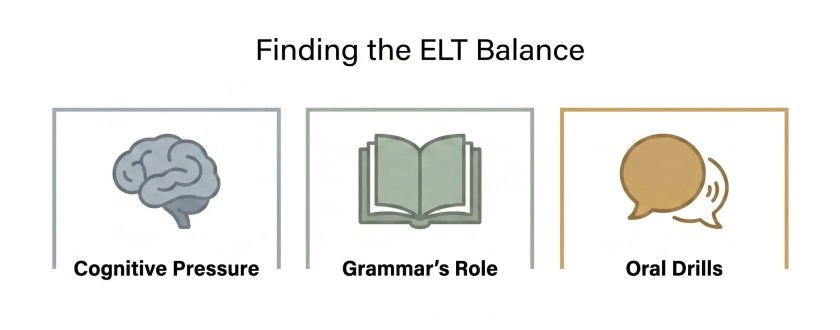
I watched the IATEFL Brighton conference unfold from a distance this year, observing the inevitable wave of professional reflection hit my digital network. A recent viral discussion initiated on LinkedIn by Yulia Efremova stood out because she openly admitted to feeling confused by the contradictory extremes in our profession.
- Do intermediate students actually need to be pushed harder, or do they need us to take the pressure off so they can acquire language effectively?
- Has grammar become the neglected Cinderella of the communicative classroom?
- Should oral drills be reimagined or abandoned altogether?
We often struggle to navigate these ideological extremes in the staff room. However, from the perspective of a materials designer, I have found that the way forward is not choosing a side. The answer rests on how I build the actual task architecture for song-based lessons. I can intentionally structure lesson sequences to balance emotional safety with meaningful cognitive challenge, creating conditions where students are willing to take risks (see The Science of Song-Based Learning).
Grammar as a Necessary Tool
Explicit grammar instruction usually fails when structures are presented as isolated formulas on a worksheet. However, grammar moves from a sterile rule to an active asset the moment a task makes it necessary to solve a problem.
When a student cannot solve a narrative mystery or voice their own perspective without a specific structural tool, the syntax becomes a functional vehicle for meaning. In my materials, I bridge the gap between structural accuracy and communication by using authentic media to create an interpretive puzzle that forces learners to infer meaning.
The Case Study: “I Am Getting Well” in Action
To look at how these mechanics function in a real classroom, let me break down an upper-intermediate (B2) sequence built around Dean Lewis’s track, “I Am Getting Well.” I selected this specific text via the 2026 Pedagogical Song Index because its language, emotional narrative, and processing load make it especially suitable for structured B2 interaction. The goal of this sequence is to use a narrative cliffhanger to make a complex grammar point—Past Modals of Deduction (must have, might have, can’t have + past participle)—completely indispensable to the students.
Lowering Auditory Pressure with Visual Priming
Upper-intermediate learners often experience performance anxiety when confronted with heavy auditory texts dealing with sensitive issues like mental health. To lower that initial pressure, I begin the lesson by removing the immediate burden of listening to fast-paced English.
The sequence begins with a single visual prompt: a cinematic close-up of boots stepping onto dead grass. Before hearing any music or reading any text, students simply observe the image and predict the outcome of this difficult journey. This establishes a baseline of understanding and activates their visual literacy before any linguistic demands are made.
Hiding the Melody: The Prose Conversion
Standard song-based lessons frequently fall into a predictable pattern where students hear a melancholy melody, guess a generic mood like “he is sad,” and completely avoid processing the actual English. To disrupt this shortcut, I strip away the musical track entirely during the input stage.
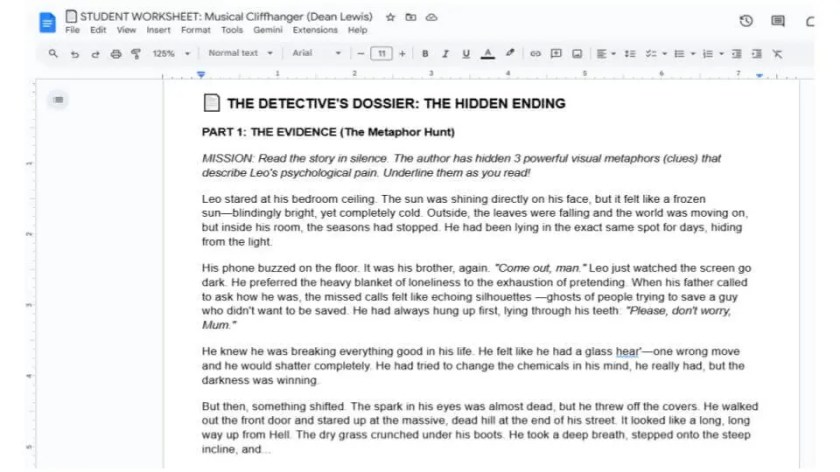
I provide a short prose story adapted directly from the first verse and chorus of the song, formatted as a “Detective’s Dossier” following a character named Leo in a dark room. Students read this text in absolute silence. Their task is to conduct an evidence hunt, underlining exactly three visual metaphors that describe Leo’s psychological pain: the frozen sun, echoing silhouettes, and the glass heart.
By converting the lyrics into a silent prose narrative, the sequence slows down processing speed and requires deep reading comprehension before any listening occurs.
The Blueprint of the Grammar Vote
Once the clues are extracted and verified with a partner, I introduce the narrative cliffhanger. The prose story is abruptly cut off on a steep hill. To discover what choice Leo actually made, students are presented with a “Deduction Menu” and must vote on a predicted outcome:
- Option A: He can’t have made it up the hill. His glass heart was too fragile and the darkness was too heavy.
- Option B: He might have collapsed halfway to the top, still unable to move forward.
- Option C: He must have found a spark of hope to keep climbing past the dead grass.
This is where grammar becomes functionally necessary. Because the students are operating with incomplete information about a past event, they cannot make their predictions using safe, simple present sentences. They need the target past modals to express historical probability based on the visual and textual evidence they collected earlier.
When I finally play the audio track, the listening task carries authentic narrative payoff. Students do not listen to fill in blank spaces on a page; they listen as investigators verifying a hypothesis. Hearing Dean Lewis reveal that he is “getting well” creates a clear moment of comprehension, confirming that Option C was the accurate deduction.
Evolving the Drill via Strategic Peer Roles
Once the target structures and vocabulary chunks are locked on the board, the lesson transitions into a peer-to-peer debate. Handed separate lyric cut-outs, students are arranged into trios to debate why the other endings were wrong based on Leo’s exact words.
To ensure that every student remains linguistically accountable during the discussion, I assign specialized interaction roles supported by tiered sentence starters:
- The Word Detective: Monitors the conversation to ensure the group anchors their arguments in the specific metaphor clues from the text.
- The Grammar Boss: Enforces syntactic accuracy, making sure peers frame their arguments using must have, might have, or can’t have followed by the correct past participle.
- The Time Keeper: Manages the clock and ensures that the group reaches a consensus before the 10-minute timer runs out.
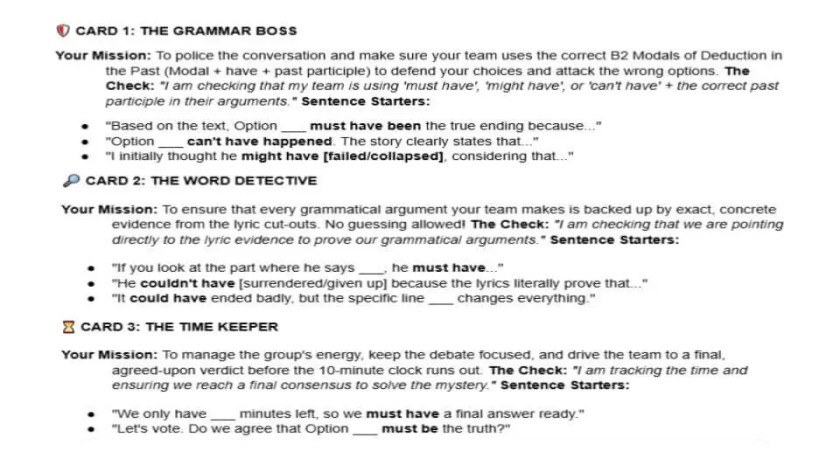
This role-based design allows the speaking task to function as a collaborative alternative to a traditional oral drill. Students repeatedly and naturally reuse the target structures because the task requires them to clarify and defend their ideas using specific textual proof.
Bounded Autonomy and the Power of the Pause
To transition from spoken negotiation to written precision, the lesson layout offers students an explicit choice of three distinct output tasks based on their communication style:
- Option A (The Epilogue): Writing the story of what Leo is doing exactly five years later.
- Option B (The Letter to the Past): Composing a letter from Leo today, addressed to his past self standing on that hill.
- Option C (The Advice Column): Drafting Leo’s response to someone else struggling, using his own survival story to help them.
While students enjoy autonomy over the format and the creative trajectory of their piece, the design maintains strict pedagogical boundaries. Whichever option they select, their text must correctly incorporate at least one past modal of deduction to explain how he survived that day. This clear linguistic constraint keeps the creative freedom safely anchored to measurable grammatical precision (see Assessing ESL Learning with Songs).
The learning cycle finishes with a deliberate shift away from production. I introduce a student self-reflection phase using a silent “Two Stars and a Wish” tool. This moment redistributes the cognitive load, allowing learners to quietly assess their own precision and take independent ownership of their progress.
Conclusion: Designing for Human Connection
True pedagogical innovation does not require us to constantly adopt flashy digital tools or completely abandon established structural principles. Genuine innovation is a matter of rethinking the architecture of the learning experience itself, moving away from tasks that require passive consumption and designing frameworks where students treat language as a vital tool for human interpretation.
The language classroom will always remain a beautifully complex environment. My goal as an educator is not to definitively resolve every methodological debate in ELT, but to design balanced experiences where students genuinely need language in order to think, interpret, and connect with others.
About the Author:
Márcia Bonfim is an ESL/EFL teacher and the creator of Song Activity Factory. She helps educators design cognitively engaging lessons using her signature BEAT+ Method, built around the MUSIC+ Framework. Her work focuses on transforming songs from “fun extras” into structured learning systems that develop real communicative performance at higher levels. 👉 You can explore a full overview of her methodology here.

