Strategy Insights: The Transformative Power of the BEAT+ Method
The Core Shift: Transmute the traditional classroom into a sanctuary of Flow where language acquisition is not a task, but a profound, multi-sensory experience that speaks directly to the soul of the learner.
- Main Concept: Holistic Fluency through Musical Immersion
- Key Framework: The BEAT+ Method (MUSIC+ Framework and SONGS+ Techniques)
- Category: ESL Pedagogy & Strategy
- Teacher Benefit: Reclaim innovative energy and purpose by fostering a win-win environment where students develop 21st-century skills alongside linguistic mastery.
- Expert Author: Márcia Bonfim
- Practical Application: Navigating the pedagogical flow from initial Motivation+ sparks to the peak of Creativity+, ensuring a seamless bridge to real-world communication.
- Source: Song Activity Factory
Let’s be honest. After three decades of teaching English, I’ve seen the incredible, transformative POWER of music in the classroom. But I want to be clear: this isn’t just about having a bit of fun. No. This is about a revolutionary tool that can supercharge your teaching and make your students’ learning truly come alive.
But then reality hits, right? That feeling of being totally overwhelmed by the constant search for new, engaging materials. The fear of falling into a rut of those same old, uninspiring activities is REAL. You start thinking, “My students are getting disengaged… I’m not tapping into their potential… How can I possibly keep up with everything?” You want to do something different, but you lack the time, the ideas, and most of all, the ENERGY. Period.
But what is it that you truly want? What’s the vision that gives you PURPOSE?
You want to create a classroom that is a win-win situation: your students are having fun, learning, and connecting with English in a meaningful way, and YOU get to enjoy the whole process! You want to feel that fire, that innovative energy again. You want the confidence of knowing your lessons have a true PURPOSE, building a bridge for your students to a deeper kind of fluency—a fluency in creativity, in connection, in LIFE itself.
And when you feel that? THAT is when you see your students absolutely THRIVE. To see them take the language and ACT on their own ideas with an enthusiasm you knew was in them all along, helping them bring their own inner harmony out into the world.
Because you’re not just an educator. You are a teacher who INSPIRES. You are the one who makes a real, lasting difference.
Using songs in your lessons can be a true win-win situation, but only when it’s done the right way.
Imagine transforming a simple, catchy chorus into a real discussion about complex ideas. Imagine exploring poetic lyrics to understand not just vocabulary, but deep cultural nuances. This isn’t a fantasy. This is what happens when we move beyond the dreadful gap-filling activities.
In this post, I want to show you the basics so you can start using songs in a more independent and, hopefully, creative way. I want you to be able to listen to ANY song and immediately start thinking about all the possibilities it can unfold. We’ll explore why this approach is not just effective, but ESSENTIAL to fulfilling your true purpose as an educator who inspires.
So, let’s begin, shall we?
The Magic of Music in Language Learning
Have you ever really stopped to think about the sheer POWER of a simple song?
You can struggle all day to remember a single phrase from a textbook, but a song you heard once on the radio? You can sing the chorus word-for-word, without even trying.
Why is that? Why does music stick when simple words just… float away?
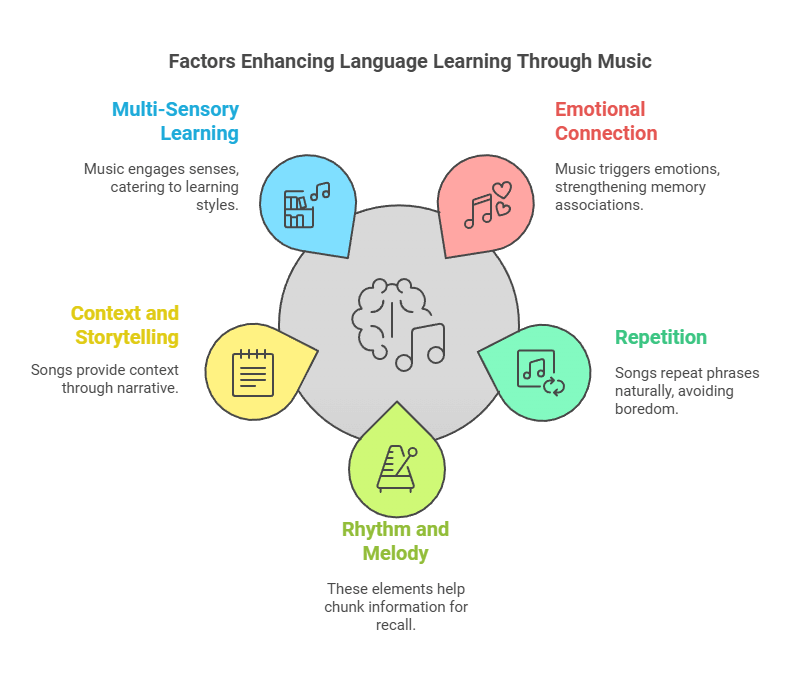
It’s because a song isn’t just a list of words to be memorized. It’s an experience. It’s a feeling. It doesn’t knock on the door of your logical mind; it walks right into your heart. The melody gives the words an emotional color, painting them directly onto the canvas of your memory. And the repetition never feels boring, does it? It’s comforting. It’s how the language becomes a part of you, effortlessly.
This is the secret we can bring into our classrooms. We’re not just teaching vocabulary lists; we are giving our students a full experience. We are helping them feel the language. We are speaking the language of their own SOUL.
The Science Behind the Song
It’s not just anecdotal evidence—science backs up the power of music in language learning:
- Memory Enhancement: A study by Ludke, Ferreira, and Overy (2014) found that participants who learned phrases through singing showed significantly better recall than those who learned through rhythmic speaking or normal speech.
- Pronunciation Improvement: Research by Christiner and Reiterer (2013) demonstrated that individuals with high singing abilities were better at imitating unfamiliar languages, suggesting a link between musical aptitude and pronunciation skills.
- Stress Reduction: A study by Sugiharto (2015) showed that using English songs in the classroom reduced students’ anxiety levels, creating a more conducive learning environment.
- Vocabulary Acquisition: Pavia et al. (2019) found that students who learned vocabulary through songs showed better retention and were able to use new words more accurately in context compared to traditional methods.
These studies underscore what many teachers have intuitively known: music is a powerful ally in the language classroom.
Beyond the Basics: 21st Century Skills
What is our true purpose as English teachers in the world today? Is it really just about grammar rules and vocabulary lists?
No. It is so, so much more than that.
We are preparing our students for real-world communication. We’re giving them the tools to connect, to succeed, and to achieve a fluency not only in English, but in LIFE itself. And this is where songs become such a powerful tool, because they can help develop these crucial skills:
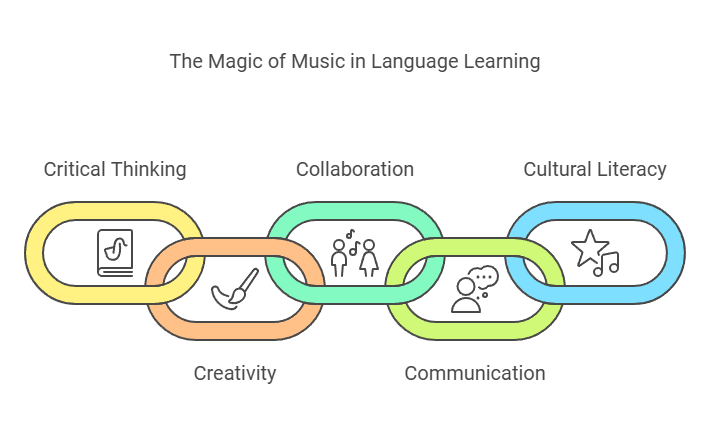
- Critical Thinking: Analyzing lyrics for meaning, metaphors, and cultural references challenges students to think deeply and interpret language in context.
- Creativity: Encouraging students to write their own verses, create music videos, or interpret songs through art fosters creative expression in English.
- Collaboration: Group activities centered around songs, such as creating performances or discussing themes, build teamwork and communication skills.
- Communication: Discussing personal connections to songs and expressing opinions about lyrics enhances students’ ability to articulate complex ideas in English.
- Cultural Literacy: Songs offer windows into different cultures, helping students understand and appreciate diverse perspectives.
- Digital Literacy: Incorporating music videos, online lyric analysis tools, or music creation apps can enhance students’ technological skills.
The Teacher’s Secret Weapon

As teachers, aren’t we always searching for that one thing? That spark that will make our lessons more engaging, more meaningful, and truly memorable?
I believe songs are that secret weapon.
So, why are they so POWERFUL? Here’s why:
- Versatility: Songs can be used to teach virtually any language point, from simple vocabulary to complex grammatical structures.
- Accessibility: With streaming services and YouTube, a world of music is at your fingertips, often for free.
- Time-Efficiency: A single song can provide material for multiple lessons, covering listening, speaking, reading, and writing activities.
- Student Engagement: Music naturally captures attention and interest, making even challenging language concepts more approachable.
- Authentic Material: Songs provide exposure to authentic language use, including colloquialisms, idioms, and cultural references.
- Memorability: The catchy nature of songs means that language points stick in students’ minds long after the lesson ends.
I think we all want to create a classroom that feels truly alive, don’t we? A place that goes beyond just memorizing grammar and vocabulary.
It’s that moment when you use a catchy chorus, and a complex grammar point stops being a rule and becomes a rhythm they can feel. It’s when the poetry in the lyrics opens up a new world, and you’re exploring deep cultural stories together.
That isn’t a fantasy. That is the reality of what happens when you bring the true POWER of music into your lessons. You’re not just teaching English; you’re teaching life.
Introducing The BEAT+ Method: Your Comprehensive Approach
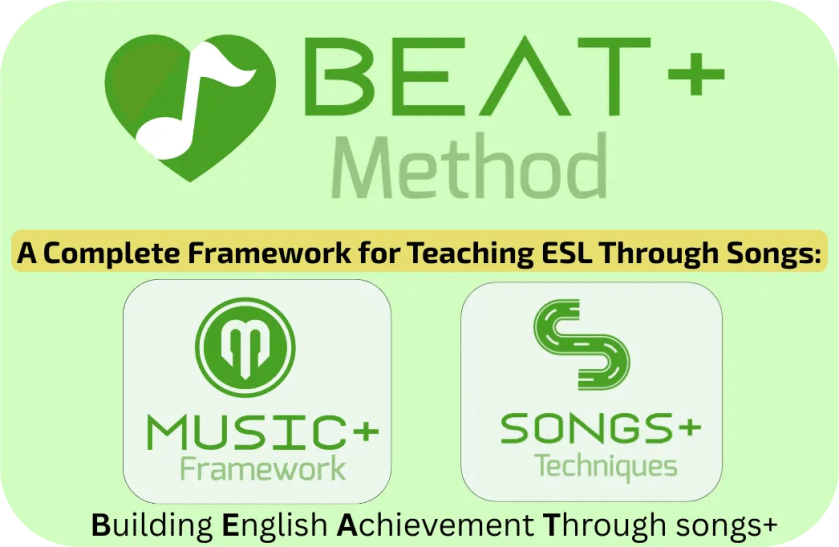
There’s a reason why some song-based lessons feel so much more POWERFUL than others. It’s because the best ones aren’t just a random collection of activities; they have a natural rhythm, a flow that feels a lot like a song itself.
This simple insight is what I’ve developed into a more structured approach, a framework for creativity that I call The BEAT+ Method. The name just fit: Building English Achievement Through Songs.
It’s not about rigid rules, but about giving your lessons that same natural, engaging, and impactful flow. It’s built on two core components:
1. The MUSIC+ Framework: The Guiding Principles
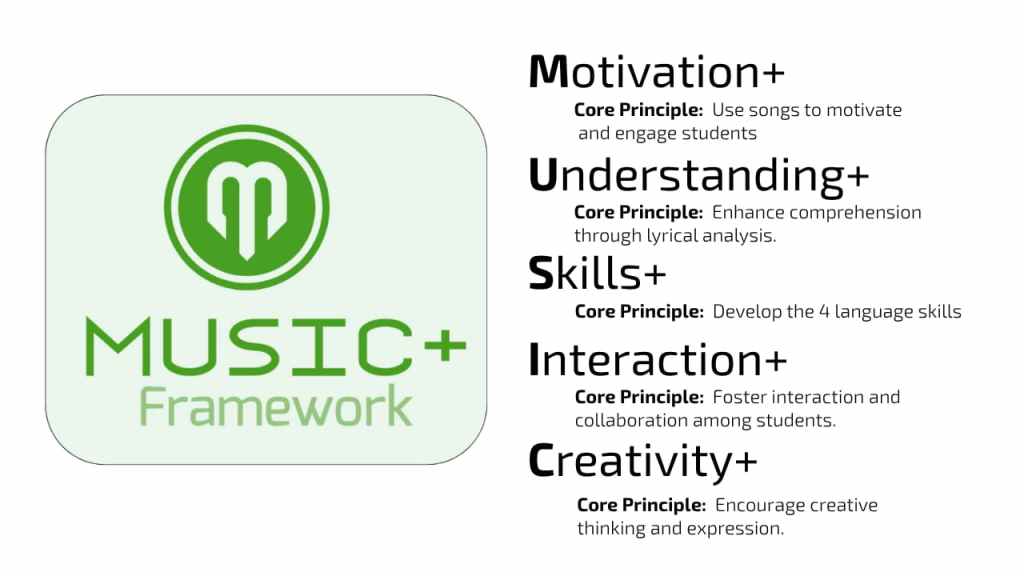
Let’s face it, we’ve all had those moments in class where the energy just isn’t there. But what about those other moments? The ones where a spark suddenly ignites, and you see the entire class become so focused, so completely absorbed, that time itself seems to bend…
That magical state is what we call “Flow.” It’s the very thing we all hope to create for our students. My MUSIC+ Framework is much more than some abstract theory; think of it as a practical map for inviting that special kind of ENERGY into your classroom, intentionally and consistently.
The work of psychologist Mihaly Csikszentmihalyi gave this idea a name, describing it as that beautiful state of total immersion, that sweet spot where a student becomes so focused and engaged that the learning itself feels like the ultimate reward. It’s energizing. Enjoyable. Almost EFFORTLESS.
The whole point is to guide your students right into that sweet spot, transforming your lesson from just another activity into a truly profound and memorable experience.
So, how does each part of MUSIC+ help us build this? Let’s dive in.
Motivation+ (M): The Affective Spark
Everything on this journey begins with a spark, doesn’t it? This is the heart of Motivation+ (M+). Before any deep learning can happen, we have to lower the “affective filter”—that wall of anxiety that blocks learning. We create an emotional pull, an invitation that speaks directly to our students’ curiosity.
So, how do we do it? We bring in something new, something surprising, something that connects DEEPLY to their own lives. When this happens, that fear of making a mistake or “getting it wrong” just starts to melt away. In its place, a clear and engaging purpose appears.
It’s that powerful moment when you see the shift, that inner voice in your students that says, “I want to know more about this!” THAT is the first step into the state of Flow. They are now open, they are energized, and they are truly ready to embrace the beautiful challenge ahead.
Understanding+ (U): The Contextual Scaffold
So, that spark of curiosity from Motivation+ is alive. Wonderful! But how do we keep that beautiful energy from fizzling out into frustration or boredom?
This is where the soul of Understanding+ (U+) comes in. To keep that state of Flow, we have to find the perfect balance. It’s a delicate thing, really. Tip the scale too far towards difficulty, and anxiety creeps in. But make it too easy, and they’re quickly lost to boredom.
This step is all about activating their background knowledge and giving them solid ground to stand on before they take the leap. It’s about consciously providing the context and the mental tools they need to feel COMPLETELY prepared and in control before we dig into the heavy grammar.
When they have that deep feeling of “Okay… I can do this,” they stay right there in that magical sweet spot—that place of energized, joyful focus.
Skills+ (S): The Activation Engine
Okay, so they have the confidence and the context. Now for the real work—and the real fun. This is our Skills+ (S+) phase, which acts as your classroom’s Activation Engine.
This is where Linguistic Noticing happens. We don’t just hand out dry grammar worksheets; we get our hands dirty with the language itself as it appears naturally in the song. By hunting for specific vocabulary or syntax directly in the lyrics, students reactivate their “silent knowledge.” Their focus and their actions merge, turning passive recognition into active, functional tools they are ready to use.
Interaction+ (I): The Activation Loop
But learning isn’t a solo journey, is it? We are not islands. The most powerful energy often comes when we connect with others.
This is what Interaction+ (I+) is all about. This phase forms The Activation Loop. It happens when students are encouraged to truly communicate with each other, peer-to-peer. By using the language tools they just extracted to negotiate meaning and solve problems, they proceduralize the language.
And that shift changes everything. It builds a real, supportive classroom community. The focus suddenly shifts from “Am I getting this right?” to “How can WE figure this out together?” In that space, students can let go and become completely absorbed in the simple, powerful act of communicating with one another.
Creativity+ (C): The Pinnacle of Social Agency
And now, we reach the peak. The moment where all that focus and energy come together in a beautiful act of generative creation.
This is the heart of Creativity+ (C+), where the experience becomes its own reward and students embrace true Social Agency. It’s that moment when students stop being just learners and become creators. They take the song’s content and transform it—producing pushed, original output. They rewrite lyrics to tell their own stories or craft something entirely new. They are completely absorbed in a powerful act of self-expression.
At this point, the reward isn’t about a grade or getting it “right.” The reward is the pure JOY of the creative process itself. This isn’t just a final activity; it’s a transformation. It solidifies everything, shifting their brains from semantic processing to syntactic mastery, ensuring the language is now a true part of their own unique voice.
So you see, this is the real purpose behind the MUSIC+ Framework. You’re the one who creates the conditions for the magic of Flow to happen.
2. The SONGS+ Techniques: Practical Strategies
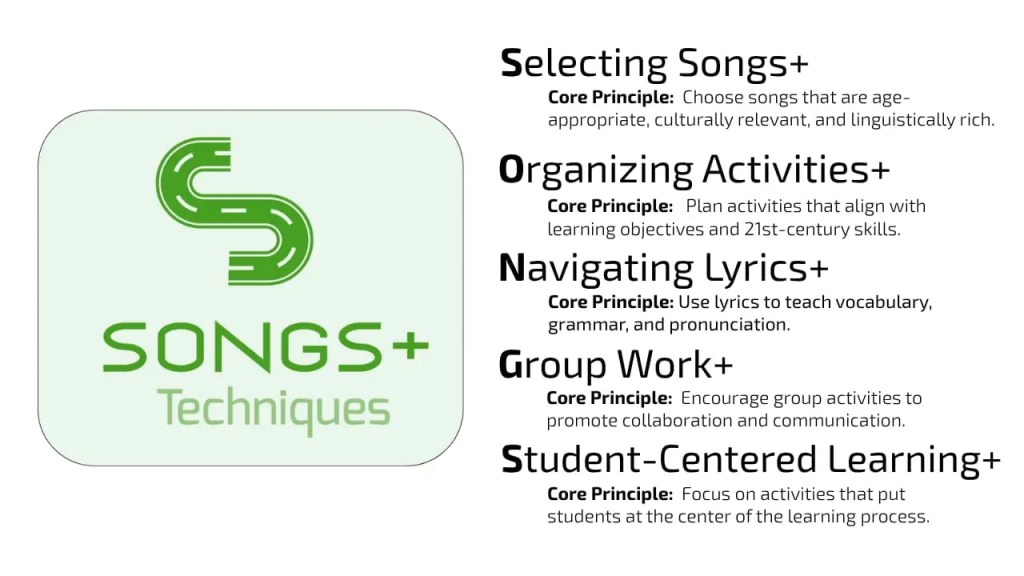
The SONGS+ Techniques provide the practical, hands-on strategies for effectively implementing song-based activities. These cover crucial aspects such as Selecting Songs+, Organizing Activities+, Navigating Lyrics+, Group Work+, and Student-Centered Learning+.
Selecting Songs+ (S)
Choosing the right songs is crucial for successful language learning. Opt for songs that are age-appropriate, culturally relevant, and linguistically rich. Consider the language level of your students and select songs with clear lyrics and themes that resonate with them. A well-chosen song can set the tone for an engaging and meaningful lesson.
Organizing Activities+ (O)
Plan activities that align with your learning objectives and the 21st-century skills you aim to develop. Pre-listening activities can include predicting song themes or discussing related topics. While-listening tasks might involve cloze exercises, matching exercises, or identifying key words. Post-listening activities can range from discussions and creative writing to projects and presentations. Organizing activities thoughtfully ensures a cohesive and effective learning experience.
Navigating Lyrics+ (N)
Use lyrics as a tool to teach vocabulary, grammar, and pronunciation. Highlight new words and phrases, and discuss their meanings and usage. Analyze grammar structures within the lyrics and practice pronunciation through singing. Navigating lyrics in this way helps students internalize language concepts in a fun and memorable manner.
Group Work+ (G)
Encourage group activities to promote collaboration and communication. Have students work in pairs or small groups to discuss song meanings, create dialogues, or perform song-based skits. Group work fosters a sense of community and allows students to learn from each other, enhancing their language skills through peer interaction.
Student-Centered Learning+ (S)
Focus on activities that put students at the center of the learning process. Allow them to choose songs they like, relate lyrics to their own experiences, and take on roles and responsibilities in group activities. Student-centered learning empowers students, making them active participants in their education and increasing their investment in the learning process.
By following the SONGS+ technique, you can turn theoretical knowledge into practical, engaging lessons that resonate with your students. This approach ensures that your song-based activities are not only fun but also highly effective in developing language skills and 21st-century competencies.
 Song Activity Factory
4 comments