
Lesson at a Glance
The Experience: A heart-centered journey through major life milestones that uses Post Malone’s personal storytelling to spark meaningful speculation and emotional resonance.
- Media / Artist: “Yours” by Post Malone (Song and Video Interview)
- Target Level: B1+ to B2
- Duration: About 60 minutes
- Language Focus: Modal Verbs for Speculation, Comparing/Contrasting, and Life Events Vocabulary
- Key Outcome: Students perform a Cambridge-style photograph comparison and produce a reflective paragraph on a significant personal life event.
- Materials: Genially presentation, YouTube video, and downloadable instruction PDF.
Hey there, Music Lovers! Ready to mix up your teaching playlist?
Isn’t it amazing how a single song can just hit you with a whole lifetime of feelings? Music has this incredible power to connect us—to big life moments, to our emotions, and to each other in a way that nothing else can.
That’s the exact feeling I got when listening to Post Malone’s song “Yours.” It’s so full of heart, and I just knew it would be the perfect spark for some really meaningful conversations in our B1+ to B2 ESL classes.
So, I’ve designed a whole lesson journey around it! This isn’t just a listening task; it’s a complete experience. We’ll start with visuals, dive into a video interview, analyze the lyrics, and really get our students reflecting. It’s all about immersing them in content that feels real and emotionally resonant, helping them build all four skills without it ever feeling like work.
Ready to mix up your playlist with something that truly connects?
Follow, Like, and Subscribe for More ESL Inspiration:

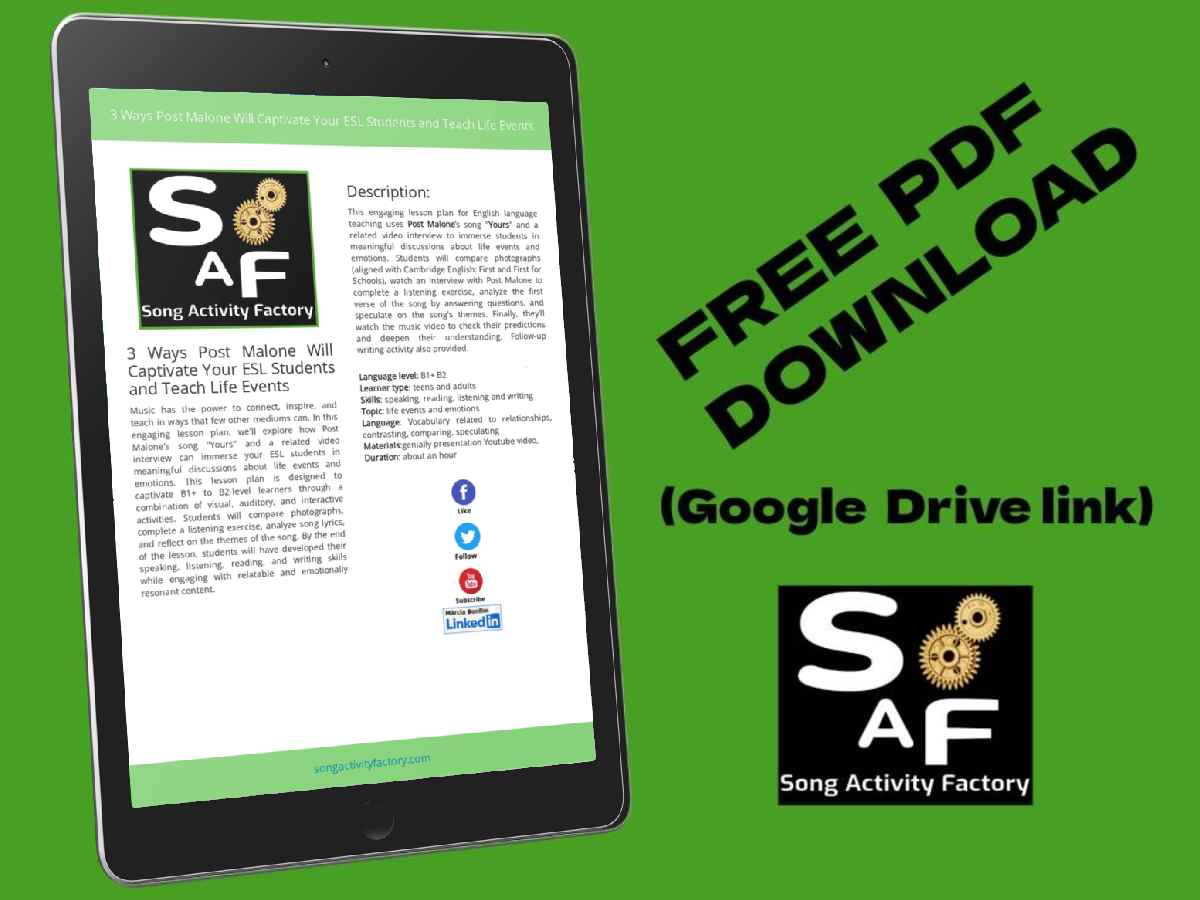
Description:
This engaging lesson plan for English language teaching uses Post Malone’s song “Yours” and a related video interview to immerse students in meaningful discussions about life events and emotions. Students will compare photographs (aligned with Cambridge English: First and First for Schools), watch an interview with Post Malone to complete a listening exercise, analyze the first verse of the song by answering questions, and speculate on the song’s themes. Finally, they’ll watch the music video to check their predictions and deepen their understanding. Follow-up writing activity also provided.
Language level: B1+B2
Learner type: Teens & Adults
Skills: speaking, reading, listening and writing
Topic: life events and emotions
Language: Vocabulary related to relationships, contrasting, comparing, speculating
Materials: Genially presentation, YT video
Duration: about an hour
Download your free teaching resources: instructions.pdf
STEP-BY-STEP LESSON PLAN
PART 1 – Warm-up and Photographs
Step 1 (5 min)
Genially presentation slide 1. LINK Ask students “What kinds of events make people feel strong emotions?” and have them give examples and reasons
Step 2 (10 min)
Slide 2. Photos
The slide shows four pictures showing people in different emotional situations (e.g., saying goodbye, moving away, graduating, a wedding, or a breakup). In pairs, students look at each photo, discuss the emotions people might be feeling in those situations, and choose which photo they like best and why. Give them some time for the task (about 2-3 minutes), then have the pairs share their ideas with the whole class.
Note: In part two of the speaking paper (paper 4) of the Cambridge English: First and First for Schools according to the handbook “(…) candidates are given the opportunity to speak for 1 minute without interruption. Each candidate is asked to compare two colour photographs, and to make a further comment about them in response to a task that is read out by the interlocutor. A prompt is given to the candidates in the form of a direct question; this is written above the photographs. Candidates are expected to point out similarities and differences between the photographs and then move on to deal with the question, answering it with reference to both photographs.”
It might be a good idea to teach/review some useful language for contrasting, comparing, speculating, before your students do the next step.
Step 3 (5 min)
Tell students that they are going to practice speaking for 1 min about a pair of photographs (speaking part 2). Have the pairs decide who is Student A and Student B. Explain that all pairs will be doing the exercise at the same time, and that you are going to be the examiner and give the instructions for the task and also keep track of the time for them. While student A is speaking, Student B must not interrupt and only pay attention in order to comment afterwards.
Review useful expressions and ask students to give you example sentences with them.
Comparing: In the same way, Similarly, Likewise, Also
Contrasting: By contrast, On the other hand, However, Whereas, While
Speculating: I guess, I imagine, I suppose, Perhaps, Possibly, Look(s) like,
Seem(s) like, Might
Step 4 (3 – 5 min)
After your students are ready (divided into student A and Studend B), read out the instructions for student A:
(Candidate A), it’s your turn first. Here are your photographs. They show people in different situations. I’d like you to compare the photographs, and say what they might be feeling in these situations. All right? (Keep track of 1 min while your students do the task – when the time is over say: THANK YOU).
Have the students who were not speaking (student B) to comment on their partner’s performance, whether they compared and contrasted the two pictures, answered the question, used varied expressions etc.
Step 5 (3 – 5 min)
Now it’s student B’s turn. After your students are ready, read out the instructions for student B:
(Candidate B),Now it’s your turn. Here are your photographs. They show people in different situations. I’d like you to compare the photographs, and say and say what they might be feeling in these situations. All right? (Keep track of 1 min while your students do the task – when the time is over say: THANK YOU).
Have the students who were not speaking (student A) comment on their partner’s performance, whether they compared and contrasted the two pictures, answered the question, used varied expressions etc.
Step 6 (optional)
You can have students swap roles and do the exercise again, if you have time.
PART 2 – Video Interview

Step 7 (10 min)
Tell students that they are going to watch a video interview with Post Malone, in which he talks about a song he wrote about someone special in his life. Start by asking: “What do you know about Post Malone?” and What life events do you think could inspire a song?”
First watch. Tell students to ignore the gaps for now. They should watch the video and answer the question: “Who does Post Malone say saved his life?” (his daughter and her mom
Second Watch.
On a blank sheet of paper, students must write down the missing words they hear on the video. Play the video twice.
see video transcript and answers in the instructions.pdf
Part 3 lyrics and music video
Step 8 (5 – 7 min)
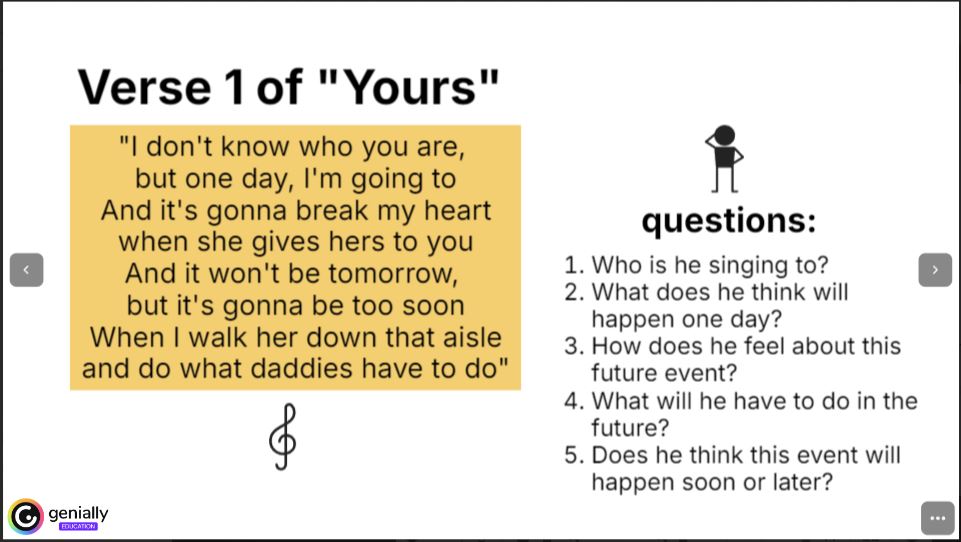
Show slide 4 with the first verse of the song. Help students with the vocabulary. Ask the comprehension questions below. And then Ask your students what kind of song they think it is: fast, slow, sad, happy, etc. and play the video for them to check their ideas (next step).
Step 9 (5 min)
Play the music video for them to check their ideas and have them comment on it to finish the activity
Step 10 (Homework or in class if you have time! )
Follow-up Writing Task:
Objective: To reinforce the themes of life events and emotions discussed during the lesson.
Ask students to write a short paragraph (80-100 words) about an important life event they have experienced. They should include details about: What the event was (e.g., a graduation, a family celebration, or moving to a new place). How they felt during that event (e.g., excited, nervous, happy, or sad). Why the event was important to them.
Example prompt:
“Think of an important life event that you’ve experienced. Describe what happened and explain how you felt during that moment. Why was it significant to you?”
This tech-enhanced lesson plan offers a comprehensive approach to exploring life events and emotions through Post Malone’s “Yours.” By integrating various digital tools and interactive activities, it prepares students for the B2 First exam while developing essential language skills and emotional intelligence.
For other LP feat Post Malone see below
Want to Bring Flow Into Your Classroom?

 Song Activity Factory