Strategy Insights: Assessment with a Soul
- Main Concept: Transforming assessment into the natural, creative pinnacle of a lesson rather than an anxious “tacked-on” requirement.
- Key Framework: The MUSIC+ Framework, designed to induce a psychological “Flow” state where learning feels effortless and self-consciousness disappears.
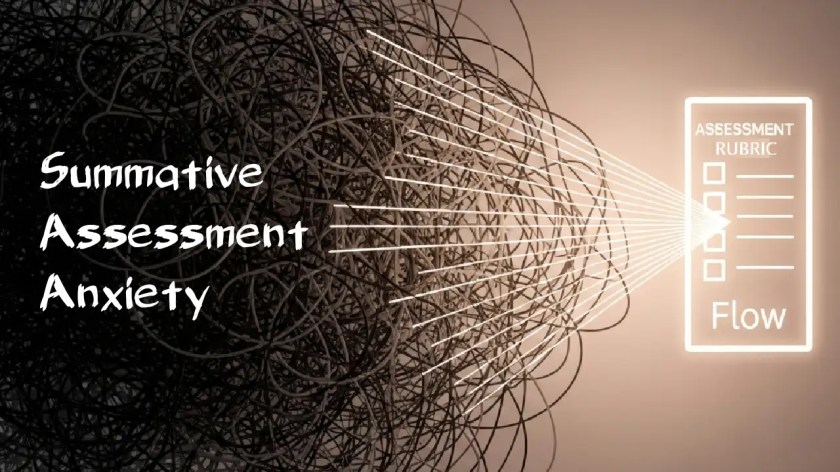
- Teacher Benefit: Reclaims instructional time and silences “assessment anxiety” by providing clear, soul-centered rubrics that yield holistic evidence of learning.
- Practical Application: Using Katy Perry’s “Bandaids” to assess the Second Conditional through narrative transformation, perspective shifts, and metaphorical “healing plans.”
The Assessment Dread is Real. We’ve All Been There.
You know that moment, don’t you?
You’ve just delivered a lesson that felt… well, it felt perfect on paper. The grammar points were clear, the activities flowed beautifully. But then, you mention the word “assessment.”
And you see it in their eyes.
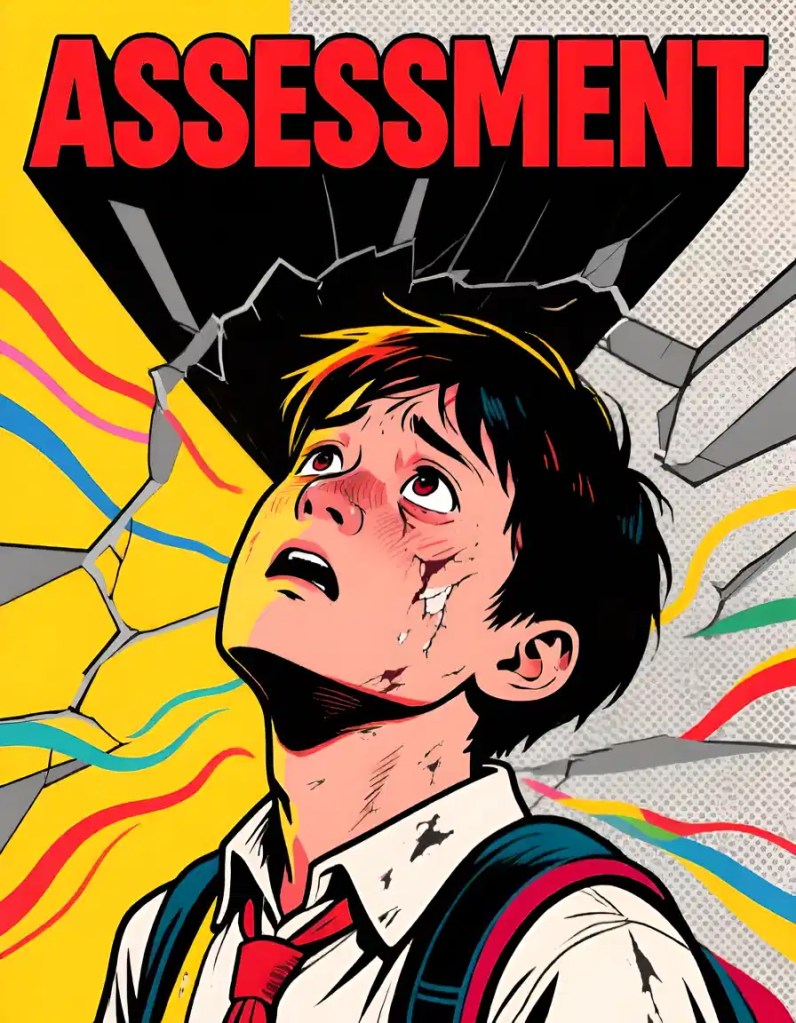
A quiet, SOUL-CRUSHING disconnect. The energy just… vanishes. The life leaves the room.
We’ve all experienced that frustration. We take a living, breathing piece of art—a song—and we flatten it into a passive listening test. We fall into the “gap-fill trap,” turning a potential moment of joy and CONNECTION into just another puzzle of missing words. It’s a process that can kill the soul of the music and leave both you and your students feeling emotionally silent and uninspired. If you’ve felt that, I want you to know: you are NOT alone.
A Paradigm Shift: Moving from Soulless Quantification to “Assessment with a Soul”
It is time for a shift in perspective. A shift in our ENERGY.
What if assessment wasn’t a final judgment, but an invitation? An invitation for our students to express what they’ve truly learned, to connect with the material on a deeper level, and to show you (and themselves!) what they can truly DO with the language.
This, for me, is the very core of Assessment with a Soul.
This approach moves beyond simply assigning a grade and focuses on celebrating a student’s growth. The goal is to transform evaluation from an anxious, soul-crushing requirement into a powerful, clarifying, and even JOYFUL experience. It’s an experience that re-energizes your teaching and validates the hard work you and your students have put in. It’s the kind of meaningful evaluation that likely drew you to teaching in the first place.
The Blueprint for Flow: The MUSIC+ Framework
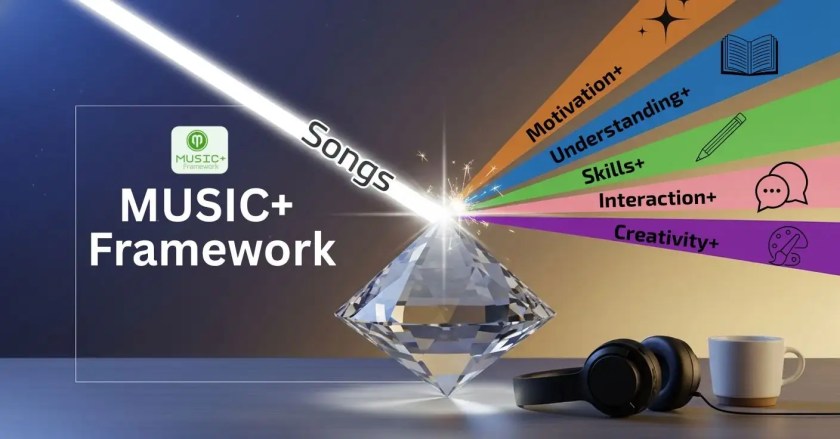
This shift from dread to joy isn’t based on a vague feeling; it’s powered by a clear, intentional system: The MUSIC+ Framework.
This is the real blueprint for creating that optimal learning state we all crave—what psychologists call “Flow.” But what is Flow? It’s that magical mental state, isn’t it? That feeling of complete immersion, that energized focus where our self-consciousness just… disappears. It’s where learning feels effortless, even joyful.
The framework is built on five core principles. Think of them as steps on a path, guiding a lesson from that first spark of curiosity to a final act of true, creative expression:
- Motivation+
- Understanding+
- Skills+
- Interaction+
- Creativity+
When a lesson is truly built on this foundation, when it flows intentionally from Motivation to Creativity, what happens? The assessment is no longer some scary thing tacked on at the end. No. It becomes the natural, inevitable, and even beautiful culmination of a deep and engaging learning JOURNEY.
Putting Theory into Practice: A Summative Project with Katy Perry’s “Bandaids”
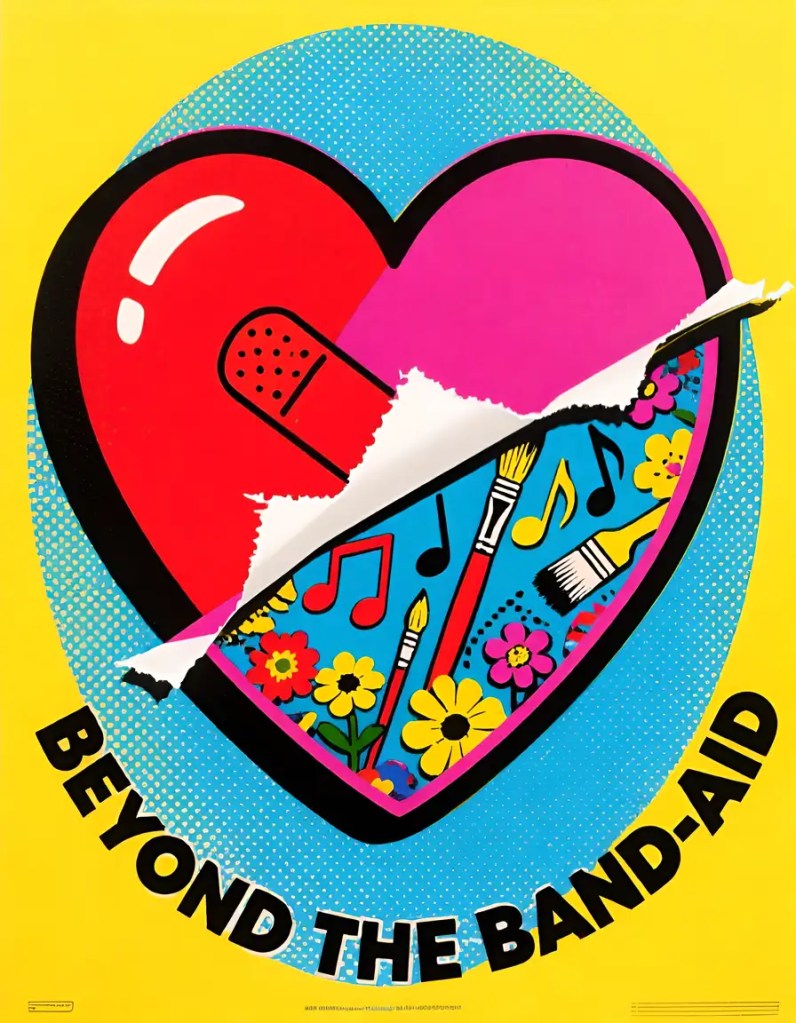
So, what does this look like in a real classroom? How do we put this theory into practice? Let’s look at a tangible example. I have a lesson plan for Katy Perry’s “Bandaids.” It’s a song I love because it focuses on deep themes of healing and resilience, and it’s perfect for teaching the Second Conditional. In this lesson, the summative assessment is designed to be the creative PINNACLE of the entire experience.
The Task: Transforming the Narrative
Instead of a traditional quiz, the summative task is the “Creativity+: Beyond the Band-Aid” step of the lesson. We give students a CHOICE of creative projects, inviting them to transform the song’s narrative and show us what they’ve learned on so many different levels.
They can choose ONE of these paths:
- Rewrite a verse from the other person’s perspective.
- Write a short dialogue or monologue reflecting on the experience.
- Design a metaphorical “healing plan” (like an emotional prescription or a recovery map).
This task assesses skills far beyond what a simple gap-fill could EVER measure. We’re seeing their thematic interpretation, their empathy, their creative problem-solving, and, of course, their grasp of the target grammar.
Making the Magic Measurable: The Soul-Centered Rubric
But how do you “grade” something so creative? How do we make this magic measurable and fair?
This is where a soul-centered rubric comes in. This isn’t about vague, cold criteria. NO. This is about clarity. It focuses our attention on specific, observable skills that are directly linked to the HEART of your lesson.
Summative Assessment Rubric: Transforming the Narrative (Step 7)
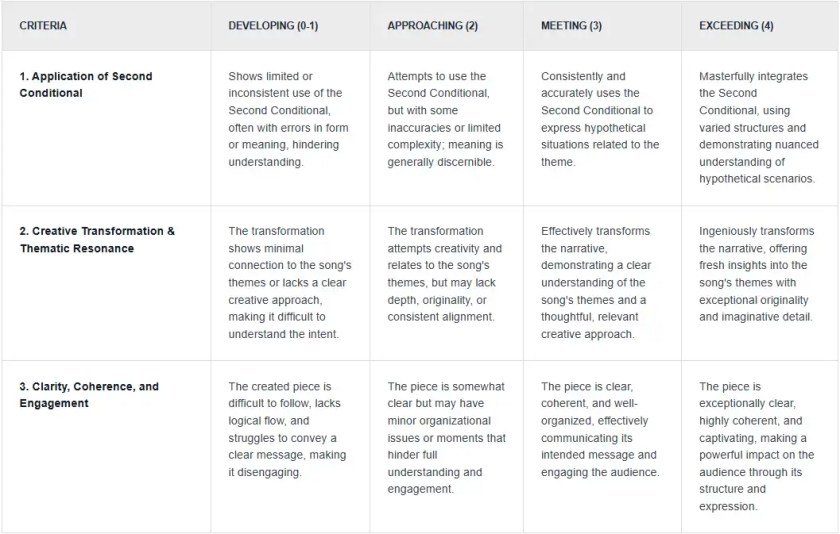
For our “Bandaids” project, the rubric would look for three core areas of energy and growth:
- Application of Second Conditional: Did they actually use the Second Conditional (our Skills+ goal)? Are they showing us they can express those ‘what if’ ideas accurately and naturally?
- Creative Transformation & Thematic Resonance: Did they truly transform the narrative? Did they connect with the song’s core themes of healing and resilience? This is where we see their higher-order thinking, their Creativity+, SHINE.
- Clarity, Coherence, and Engagement: Was their message clear? Did their piece flow? Was it organized in a way that truly engages you as a reader or listener? This is all about the power of their communication.
This kind of rubric does more than just make grading easier (though it does do that!). It gives you CRYSTAL-CLEAR evidence of holistic learning. It’s the proof—to you, to them, to anyone—that validates their effort and your lesson. It proves you can move definitively beyond the gap-fill trap. It shows you are assessing not just simple comprehension, but true, soulful, creative APPLICATION.
The Impact: From Anxiety to a Creative Flow State
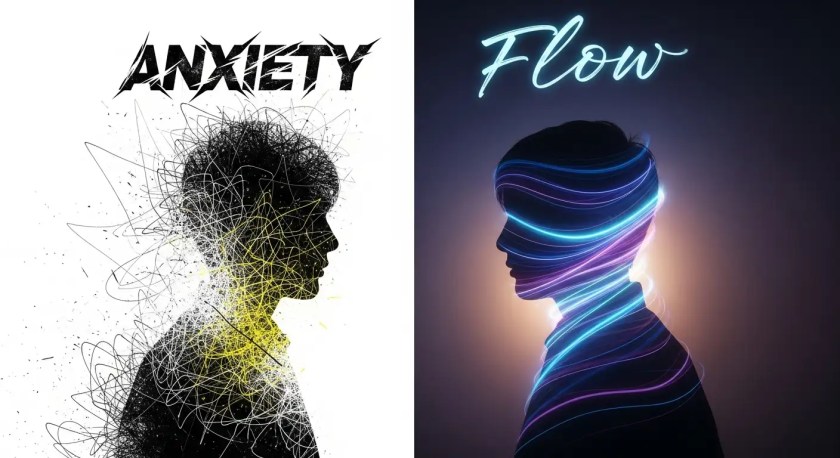
When you begin to approach assessment this way, something truly magical does happen. The whole energy of the classroom transforms. That “assessment dread” is REPLACED by a palpable state of creative “Flow.”
The anxiety just… melts away. Why? Because your students become deeply engaged in work that matters to them. They move from being passive listeners to active CREATORS who are proud to share what they’ve made.
And for you, the teacher? The feeling is just as profound. This method gives you clear, meaningful tools that show you the true picture of your students’ abilities. It quiets your own “assessment anxiety” and reclaims your valuable time… time you can now use to focus on what you do best: inspiring your students and connecting with their hearts.
Ready to Build Assessments with Soul?
We’ve walked this path together, haven’t we? From that all-too-familiar feeling of “assessment dread” all the way to a state of creative “Flow,” where evaluation becomes a moment of connection and CELEBRATION.
This isn’t just theory. I want you to have the exact, tangible tools I described in this post.
I am giving you the complete 8-step “Bandaids” lesson plan AND its full “Assessment with Soul” toolkit—including the exact 3-part summative rubric we just walked through.
This is your “Guest Pass” to see how this system works in your own classroom.
Stop dreading assessment. Start CELEBRATING learning. Reclaim your time and your students’ enthusiasm.
Author Bio:
About the Author:Márcia Bonfim is an ESL/EFL teacher and creator of the Song Activity Factory. She helps educators create engaging lessons using her signature BEAT+ Method, which features the MUSIC+ Framework. You can discover her complete methodology summary here.
 Song Activity Factory