Turning a Song into a B2 Debate System with Kodaline
- Media / Artist: Kodaline
- Target Level: B2
- Duration: 60 min
- Language Focus: ESL Song Lesson Plan
- Key Outcome: Mastery of B2 functional language for giving opinions, agreement, and disagreement through structured peer mediation.
- Materials: Google Slides, Student Worksheet, Lyric Sheet Cut Out, Assessment Pack.
How the B2 Debate Lesson Works
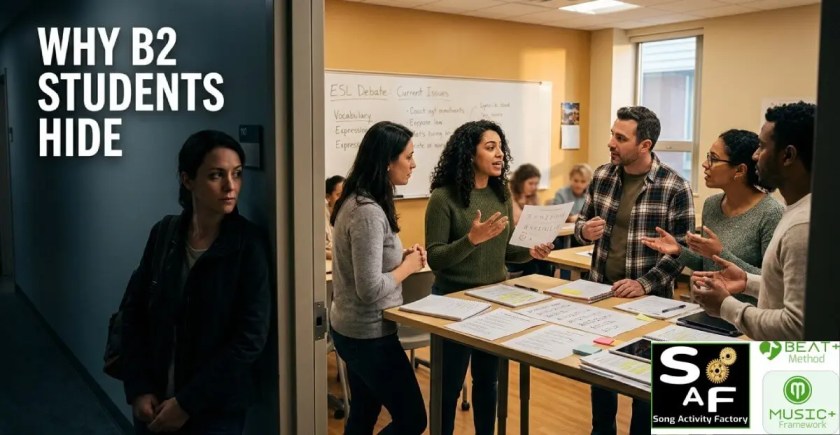
This lesson is built around a principle I call Interaction Pressure. In a typical B2 classroom, students can communicate effectively enough to survive a conversation, which often leads to a linguistic plateau. They rely on “safe” phrases like “I think” or “I agree.” This lesson disrupts that comfort zone by introducing specific interaction roles and formal academic frames. By making the song “We Were Only Young” by Kodaline the source of evidence, the interaction becomes a high-stakes negotiation of meaning rather than a casual chat.
Why It Happens
B2 learners often struggle with functional language not because they lack the vocabulary, but because the cognitive load of a complex topic like “nostalgia” competes with their focus on form. When the discussion gets interesting, the grammar usually suffers first. They choose the path of least resistance to get their point across. Without a mechanical reason to use more complex structures, they simply won’t.
What Happens During This Lesson
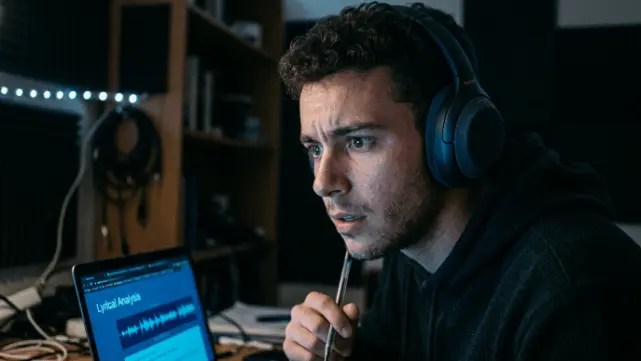
The lesson begins with a diagnostic choice: comparing two quotes on regret to the narrative of the song. Before the students even see the lyrics, they are forced to listen for gist to identify the singer’s emotional state.
Instead of a passive listening task, students engage in the Audio Hunt. They are presented with “flawed audio logs” where the singer’s memories are intentionally altered. To correct these logs, students must listen for exact semantic details: “changed me” instead of “saved me.” This creates immediate lexical stability.
The core of the lesson is the Deep Debate. Students are assigned roles: The Grammar Boss, The Word Detective, and The Time Keeper. They are handed formal discussion frames like “I’m inclined to agree” or “Looking back, I would argue that.” The Grammar Boss ensures these frames are used. The Word Detective ensures every opinion is anchored to a lyric. The result is a classroom where pairs are seen reopening their lyric sheets to verify a clue before they dare to speak.
Why This Structure Works
The mechanism here is accountability. When a student is the Grammar Boss, they are responsible for the group’s linguistic standard. This frees the teacher to observe and facilitate rather than constantly correcting.
The song becomes the activation engine for the discussion. It provides the “chunks” of language (e.g., “wish I had said”) that students then plug into formal frames. This creates a hybrid of authentic emotional expression and academic rigor. The structure prevents the “safe silence” that usually follows a broad question like “What do you think about regret?” More importantly, it changes the emotional conditions under which students speak.

In many B2 classrooms, the real problem is not grammar accuracy. It is emotional risk. Students protect themselves with safe language because stronger opinions require stronger ownership. The moment a learner says, “Looking back, I would argue that…,” they are no longer completing an exercise. They are positioning themselves intellectually. Songs help lower that affective barrier because the emotional content already exists inside the music. This is one of the core principles behind the science of song-based learning and why emotionally charged media often produces stronger communicative output than neutral textbook prompts. The learner borrows the emotional architecture of the song to support more sophisticated language production
Assessment With a Soul & Institutional Rigor
Rigor is preserved through the Hindsight Project. This is not a “write what you feel” task. It is a constraint-based mission. Students must use at least one academic frame and one song chunk in their narrative, letter, or dialogue.
Assessment is handled through a visible rubric that checks for “Activation” and “Social Agency.” This allows teachers to assess ESL learning with songs through observable interaction, evidence-based discussion, and authentic language production instead of isolated grammar drills. The lesson concludes with The Power of the Pause, two minutes of total silence where students circle the one sentence they are most proud of. This metacognitive step ensures that the learning is not just performed, but internalized. The rigor is high, but the cognitive load is redistributed fairly between the materials and the learners.
Access the Free Ready-to-Teach System
When you use authentic media to create meaningful thinking, you don’t have to force engagement. You don’t need to build this from scratch, either. I’ve mapped out this complete 60-minute lesson. Access the full lesson PDF, Google Slides, assessment tools, and classroom assets in the Master Suite below:
About the Author
Márcia Bonfim is an ESL/EFL teacher and the creator of Song Activity Factory. She helps educators design cognitively engaging lessons using her signature BEAT+ Method, built around the MUSIC+ Framework. Her work focuses on transforming songs from “fun extras” into structured learning systems that develop real communicative performance at higher levels. 👉 You can explore a full overview of her methodology here.

