
Strategy Insights: From Noticing Language to Actually Using It
- Main Concept: Balancing emotional safety with cognitive challenge by deploying specific student-facing role cards that push learners to actively stretch their current linguistic boundaries.
- Key Framework: The BEAT+ Method and MUSIC+ Framework, utilizing practical structural rules like structured peer roles (Word Boss, Grammar Boss, Time Keeper) and clear, targeted writing tasks.
- Teacher Benefit: Functions as the clear, structured system that completely eliminates prep guesswork. The structure is already built so teachers do not spend hours wondering what to do next when planning their song-based lessons.
- Practical Application: Implementing a three-role peer discussion to enforce target modals of deduction, followed by clear digital media writing tasks constrained by strict vocabulary and grammar requirements, concluding with two minutes of absolute silence for self-reflection.

This is Part 2 of my two-part series exploring how to design rigorous song-based lessons. (If you missed the beginning, you can find Part 1 here. In Part 1, the opening sequence introduced the Deduction Menu: a structured framework where students predict an unresolved narrative cliffhanger. Traditional grammar drills fail because they strip language of its communicative purpose. By implementing clear, student-led conversation roles and specific language requirements, you can balance classroom participation and push learners to actively use advanced language structures.
Moving from Rules to Essential Language
This small shift completely changes the purpose of the grammar point. The target structures are no longer items on a checklist to be verified by a teacher. They have become functional tools. Students suddenly need the modals of deduction to formalize their hypotheses and argue their points with their peers. Several students immediately changed their predictions after hearing classmates defend Option B.
The real payoff happens during the musical reveal. When the track is finally played and students hear the closing lines, including the symbolic phrase standing on the stars, they are not just listening to music. They are actively listening to see if their specific grammatical prediction was correct. This creates a natural, low-stakes environment to assess learning by simply observing who successfully matches the audio to their written hypothesis.
Breaking the Classroom Monologue
The final challenge in any authentic materials lesson is moving students from receptive comprehension to independent, accurate production. During group tasks, we often see a familiar pattern: one or two extroverted students dominate the conversation, while the quieter students withdraw, escaping the deep language processing required for growth.
To ensure that every student faces an equal speaking requirement during the collaborative discussion, the lesson divides conversational duties into three distinct student-facing roles:
The Word Boss: Responsible for ensuring that every argument made by the group is anchored to a specific word or phrase from the text. The Grammar Boss: Makes sure all speculative theories use the target modals of deduction correctly. The Time Keeper: Manages the group’s progress to ensure all viewpoints are heard within the tight limits of the task.
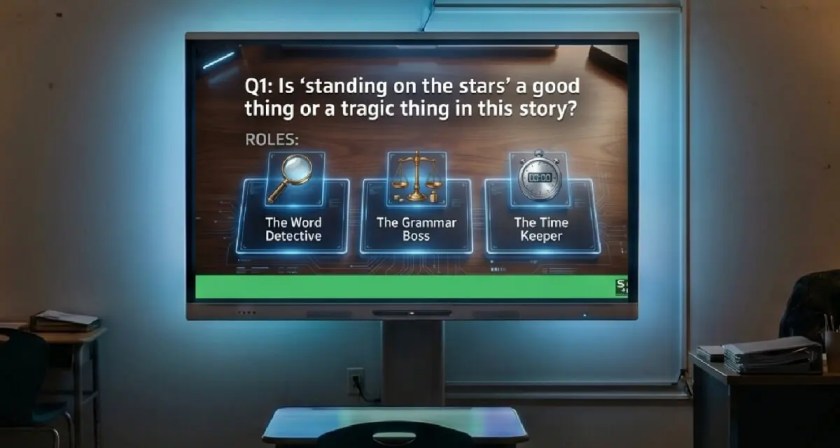
By giving students these specific responsibilities, it discourages a conversational monopoly. This structured peer-to-peer exchange pushes students to actively use the language they noticed earlier. The quieter student now has a concrete reason to speak up, while the dominant student must justify their ideas using the required textual evidence. I watched this play out during a recent trial of these materials. A normally quiet student, acting as the Grammar Boss, tapped his card and stopped a classmate who had written a safe sentence like “She is unhappy”. He prompted the group to upgrade it to “She must be feeling trapped by her choices”. That moment showed the students were beginning to monitor the language themselves. The structure is already built, so you do not spend hours wondering what to do next.
The Power of Targeted Language Requirements
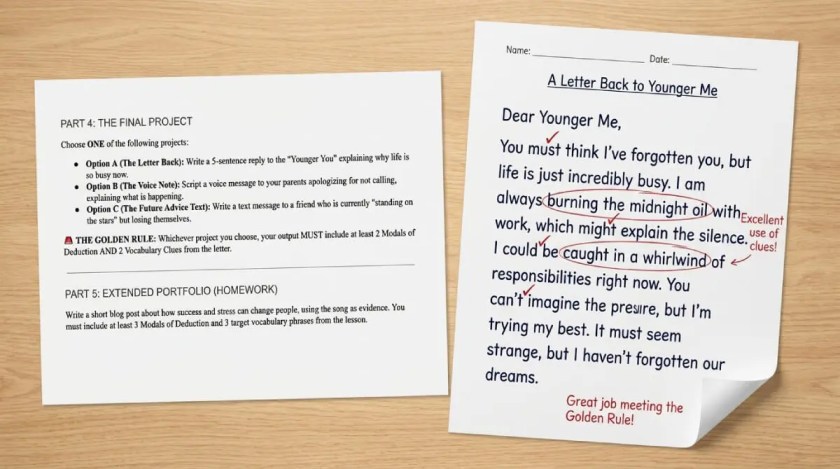
When the lesson moves into independent writing, traditional, open-ended prompts are replaced with a guided choice matrix. Students select a modern format that mirrors current digital media consumption: a Letter Back to their past self, a scripted Voice Note, or a Future Advice Text.
While students enjoy the freedom of choosing their format, their creative expression is bounded by a single structural rule. Simply writing is no longer enough. Their text MUST successfully use at least two target modals of deduction AND two vocabulary chunks extracted earlier. This simple requirement discourages students from retreating into safe, basic language. It effectively replaces the mechanical writing tasks you find at the end of a standard unit. It guides them to stretch their current linguistic boundaries, ensuring that the input from earlier in the lesson is actively processed into personalized output at the end of the hour.
A Quiet Moment of Reflection
The entire lesson cycle concludes not with an energetic activity, but with a deliberate moment of decompression: exactly two minutes of absolute silence. With all inputs removed, students read through their own writing and circle the single sentence they are most proud of constructing.
This quiet moment allows students to notice the difference between their first ideas and final language. Students leave the lesson feeling they expressed something real. Ultimately, the entire system—from the initial silent reading to the final output formats—is designed so students can actively use precise English to find their authentic voice and express who they truly are.
About the Author
Márcia Bonfim is an ESL/EFL teacher and the creator of Song Activity Factory. She helps educators design cognitively engaging lessons using her signature BEAT+ Method, built around the MUSIC+ Framework. Her work focuses on transforming songs from “fun extras” into structured learning systems that develop real communicative performance at higher levels. You can discover her complete methodology summary here.


2 comments