
Strategy Insights: Active Listening & Deduction
- Main Concept: Extracting advanced medical metaphors by correcting a flawed summary, and using modals of deduction to guess the hidden stories of three characters.
- Key Framework: The BEAT+ Method, utilizing sequenced, active steps: analyzing ambiguous visual profiles, matching the song to a character, and fixing a broken text.
- Teacher Benefit: Replaces traditional vocabulary lists with an active listening task. Students begin using the target grammar naturally to defend their opinions before you even write the rule on the board.
- Practical Application: Display three ambiguous visual profiles for students to analyze, play the track so they can match the song to a specific profile, and have students physically cross out incorrect simple words on their worksheet to replace them with the exact medical vocabulary they hear.

Why B2 Modals of Deduction Disappear During Speaking Tasks
Open almost any intermediate textbook to the unit on speculative grammar and you will find the exact same scenarios: a missing wallet, a broken window, or a wet umbrella left in a hallway. While these scenarios technically display the grammar, they strip the target language of any real human stakes. Students mechanically complete the exercises and then immediately drop the syntax when they are asked to speak.
To fix this in my song-based lessons, I stopped relying on disconnected deduction drills. This time, I used Olivia Rodrigo’s “The Cure” to turn abstract grammar into a concrete tool for decoding the highly relatable emotional struggles of modern anxiety.
In Part 1 of this series installment, we will look at how to hook your students’ attention and extract advanced medical metaphors from the audio without handing out a passive translation list.
The Pedagogical Value of “The Cure”
Choosing materials based on classroom context changes everything. Olivia Rodrigo’s “The Cure” is built around a powerful internal contradiction: the speaker is desperately seeking comfort from another person while slowly realizing that external love cannot fix her own toxic thoughts.
This thematic conflict gives a B2 classroom a genuine reason to speak. Young adults instantly recognize the emotional tension, but they lack the advanced vocabulary to express it. Because the entire song deals with hidden, internal struggles, it creates a natural necessity for speculative language. Students must use modals of deduction because they are decoding an unseen mystery.
The Voiceless Profiles
We begin diagnosing the problem before the music even plays. We display three ambiguous visual profiles on the board: an exhausted office worker staring at a laptop in the dark, a student holding their head in frustration surrounded by books, and a young adult standing alone at a crowded party.
We ask the class to guess what specific internal struggles these people might be facing right now. By keeping the images completely ambiguous, we naturally require students to speculate. You will hear them organically attempting to use language like “She might be keeping a secret” or “She must be exhausted” to resolve the visual mystery before the grammar is explicitly taught.

The Anthem Match
Once the students are actively investigating the characters on the board, we play the track. We give them a clear, immediate mission: they must listen to the anxious, defiant tone of the song and decide which of the three visual profiles would adopt this track as their personal anthem. This simple step gives them a concrete reason to listen to the audio. It moves them away from passive hearing and pushes them toward active interpretation, ensuring they are emotionally invested in the singer’s narrative before we start breaking down the lyrics.
The Reverse Translation Trap
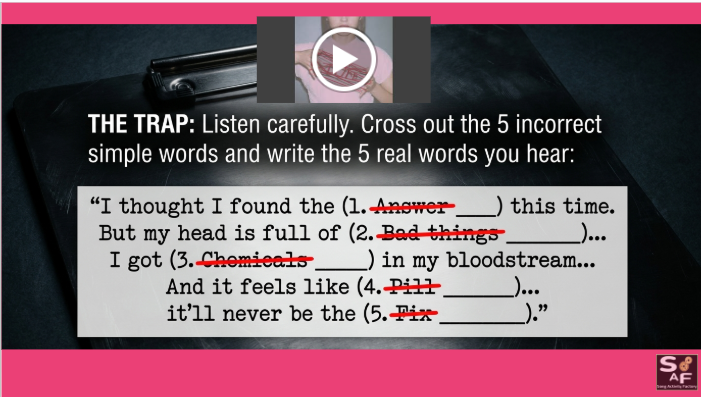
Next, we tackle the advanced medical metaphors hidden in the song. Handing out a translated vocabulary list often kills the exploratory energy in the room. Instead, students receive a broken written summary of the lyrics containing five basic, incorrect words like “answer”, “bad things”, and “pill”.
As they listen to the track again, their task is to physically cross out the incorrect everyday words on their worksheet and replace them with the actual advanced terms they hear in the audio, such as “antidote”, “poison”, and “medication”. This simple task design changes the energy in the room. Instead of staring blankly at a list of definitions, students are forced to listen for precision. They hunt for the exact vocabulary needed to fix the mistakes.
Conclusion
By framing the input phase as a diagnostic mystery, students stop waiting for the teacher to translate the material and start hunting for the linguistic evidence themselves. When you give them a concrete reason to analyze the text, they willingly engage with advanced metaphors. In Part 2 of this series, we will move these extracted words straight into a high-stakes peer debate. I will show you how to hand the assessment mirror back to your students, forcing them to take control of their own linguistic growth.
About the Author
Márcia Bonfim is an ESL/EFL teacher and the creator of Song Activity Factory. She helps educators design cognitively engaging lessons using her signature BEAT+ Method, built around the MUSIC+ Framework. Her work focuses on transforming songs from “fun extras” into structured learning systems that develop real communicative performance at higher levels. You can discover her complete methodology summary here.


One comment