
Strategy Insights: From Practice to Open Debate
- Main Concept: Moving from learning new words to actively using them by engaging in a peer debate and creating a modern digital writing project.
- Key Framework: The BEAT+ Method and the MUSIC+ Framework, which uses specific group roles to manage discussions, provides three creative project options, and concludes with a two-minute silent reflection.
- Teacher Benefit: Removes the guesswork from group work and reduces the need for constant teacher intervention. The structured roles ensure students naturally practice the target language without getting off-topic.
- Practical Application: Grouping students to debate the quality of advice using modals of deduction and a 3-column evidence grid, writing a modern digital response, and concluding with a silent reflection task.

This is Part 2 of my two-part series exploring how to design rigorous song-based lessons using Olivia Rodrigo’s “The Cure”. (If you missed the beginning, you can find Part 1 here).
In Part 1 of this song-based series, we explored how to extract advanced medical metaphors from the audio by using a broken summary. However, noticing vocabulary is only half the battle. The real challenge in any speaking activity is sustained language use. Students often practice B2 modals of deduction beautifully on paper, but the second an open debate begins, they drop the target grammar entirely and retreat to the basic English they already know. Here is how I transition from listening to music into an active, peer-led negotiation that requires syntactic rigor.
The Alignment Council
To ensure students maintain their B2 grammar during unscripted conversation, I place them into small groups of three to form an “Alignment Council”. Their task is to use their modals of deduction to debate and rank the three visual profiles from our previous lesson, deciding who is “most likely to give up” and who is “most likely to fight back”.
To prevent them from abandoning the target language, I assign strict peer accountability roles:
- The Evidence Detective: Their job is to ensure the group uses the new medical words (antidote, poison, cure) to describe the visual situations.
- The Grammar Boss: Their job is to ensure all speculative theories use the target modals of deduction (must be, might be, can’t be) correctly.
- The Time Keeper: Their job is to manage the group’s progress to ensure all three profiles are ranked within the strict 10-minute limit.
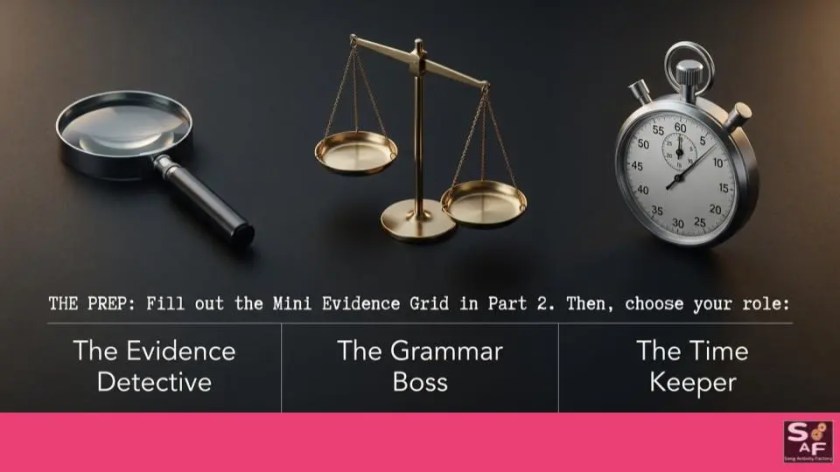
This predictable structure removes the chaos from group work. It prevents stronger students from dominating the floor and ensures quieter learners have a clear, protected reason to speak up. The structure keeps the conversation moving forward without the teacher needing to constantly intervene. Students stop relying on you to correct them and begin policing the linguistic accuracy of the conversation themselves.
The Digital Crisis Output
When the lesson moves into independent writing, traditional open-ended prompts are replaced with a guided choice matrix. Students must use the language to express their own ideas by selecting one of three modern digital formats. They can draft an Instagram wellness post, write a crisis text thread warning a friend, or script a podcast intro about surviving toxic anxiety.
While students enjoy the freedom of choosing their format, their creative expression is bounded by a single concrete constraint. Their text must successfully use at least two target modals of deduction and three medical vocabulary words from the board. This simple requirement discourages students from retreating into safe, basic language and pushes them to stretch their current linguistic boundaries.
The Structural Review
The entire lesson cycle concludes with a deliberate moment of internal review. With the classroom quiet, students read through the digital project they just drafted. Their final instruction is to circle the single sentence they feel demonstrates their strongest, most accurate use of a modal of deduction. This quiet anchoring task pushes them to look at their own writing not just for meaning, but for structural precision.
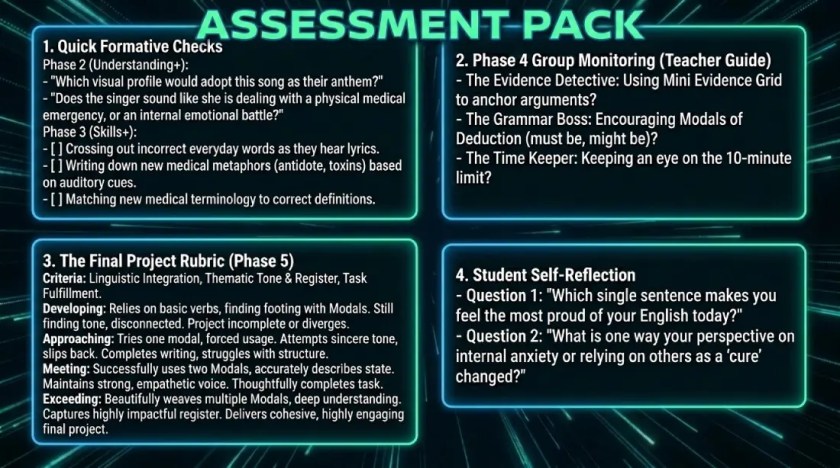
ThIs lesson set comes with an assessment pack to help teachers valuate students’s progress:
Conclusion
When you give students concrete responsibilities tied directly to target academic language, you completely change the classroom dynamic. You will see your students actively deploying precise syntax to resolve a human debate and express their own ideas. By anchoring production in a rigorous task architecture, we get students to stop running from complex syntax. They use the tight boundaries of the lesson to stretch their communication limits and defend their own ideas under pressure.
These specific accountability roles and digital matrices are fully integrated into the ready-to-use teaching kits you can access in the Master Suite below.
About the Author
Márcia Bonfim is an ESL/EFL teacher and the creator of Song Activity Factory. She helps educators design cognitively engaging lessons using her signature BEAT+ Method, built around the MUSIC+ Framework. Her work focuses on transforming songs from “fun extras” into structured learning systems that develop real communicative performance at higher levels. You can discover her complete methodology summary here.
 Song Activity Factory
One comment